Volcanic Mud and Hot Spring Treatments Near La Fortuna
Are the volcanic mud treatments at Tabacón and other La Fortuna hot springs made from an active volcano?
No. Arenal has been dormant since October 2010, with no lava and no eruptive activity. The mud used in spa wraps is mineral-rich volcanic soil processed and blended for cosmetic use, not material collected from a live eruption, and it is sold as a wellness product rather than a geological curiosity.
What “Volcanic Mud” Actually Means at a La Fortuna Spa
Almost every hot spring resort near Arenal Volcano advertises a volcanic mud treatment, and the phrase does a lot of marketing work. It conjures an image of steaming mud scooped straight from an active crater. That is not what is happening, and it is worth saying plainly before you book anything: Arenal stopped erupting in October 2010. There is no lava here now, no glowing rock at night, no active flow to harvest anything from.
The mud used in resort spas is volcanic soil — mineral-rich material shaped by thousands of years of eruptive history around the mountain — that has been collected from deposits, screened, treated, and blended into a cosmetic product suitable for skin application. It’s a genuine local material with a real geological pedigree, just not the live, straight-off-the-volcano substance the brochures imply.
That distinction matters for two reasons. First, it sets honest expectations: you are not doing anything geologically dramatic, you are having a fairly standard spa treatment that happens to use a regionally sourced ingredient. Second, it explains why the mud looks and feels similar across different resorts — most of it is processed to a comparable consistency for hygiene and consumer-safety reasons, not hand-dug and applied raw.
If a tour description or a review promises mud “straight from the volcano,” treat that as marketing language, not geology. For the bigger picture on the volcano’s actual state — what’s visible today versus what stopped happening in 2010 — see the separate piece on the lava that no longer exists at Arenal.
Where These Treatments Are Offered
Not every hot spring complex around La Fortuna has a spa menu. The free river-fed pools, like El Choyin, have no facilities beyond the water itself — no changing rooms, no staff, and certainly no mud treatments. Among the paid resorts, the range runs from a self-serve mud station bolted onto a pool complex to a full spa building with private treatment rooms and a printed menu.
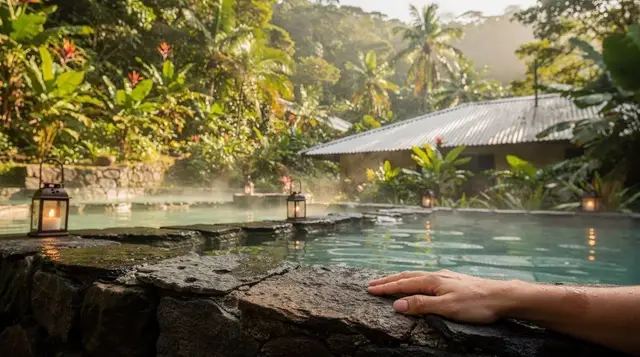
Tabacón has the most developed spa program in the area, with treatment rooms set within its gardens and a menu that goes well beyond a basic mud smear — massages, facials, and combination packages built around the resort’s naturally heated water. Baldi and Ecotermales both lean more toward the pools-and-slides side of the experience, though Baldi in particular has added massage add-ons in recent years.
It’s worth being clear that this guide is about the treatment menu specifically — for a full rundown of pools, admission tiers, and what a day at Tabacón actually involves, see the dedicated Tabacón hot springs guide rather than expecting that ground repeated here.
If you’re still deciding which hot spring complex suits your trip before thinking about spa add-ons at all, the hot springs comparison guide and the more decision-focused which hot springs to choose page cover that ground.
The Menu: Mud Wraps, Massages, and Combination Packages
Spa menus vary by resort and change from season to season, but a few formats show up consistently around La Fortuna:
| Treatment type | What it typically includes | Typical duration |
|---|---|---|
| Self-serve mud station | Open-air mud pit or trough, apply and rinse yourself | 15–30 minutes, informal |
| Guided mud wrap | Therapist-applied mud, wrap or rest period, rinse in a warm pool | 45–60 minutes |
| Volcanic stone or relaxation massage | Standard massage, sometimes using warmed stones | 50–60 minutes |
| Mud-and-massage combination package | Mud application plus a full massage, often with facial add-on | 90–120 minutes |
| Couples’ treatment room | Private room booked for two, mud and/or massage | 60–90 minutes |
Prices for these treatments run roughly from 40 to 150 USD per person depending on the resort, the length of the package, and whether resort or hot springs admission is bundled in or charged separately. Tabacón’s treatment menu tends to sit at the higher end of that range, reflecting the resort’s overall pricing and its private treatment-room setup; simpler mud-station access elsewhere can cost far less, sometimes nothing beyond the pool entry fee itself. Because these prices shift with season and resort promotions, treat the range as a planning figure, not a quote — confirm current pricing directly with the resort or through your booking before arrival.
What a Treatment Actually Involves, Step by Step
A typical guided mud-and-soak experience follows a fairly consistent pattern, even though the exact order varies by resort:
- Check-in and changing. Most spa treatments are booked as an add-on to resort or day-pass admission, so you’ll go through general entry first, then check in separately at the spa desk for your treatment slot.
- Mud application. A therapist applies the processed volcanic mud to skin, sometimes full-body, sometimes targeted to arms, legs, and back. It’s cool to lukewarm, not hot, and has a texture closer to fine clay than garden dirt.
- Drying period. The mud is left to partially dry, typically 10 to 20 minutes, often in open air or shade rather than direct sun.
- Rinse in a warm pool. This is where the geothermal water does its job — rinsing off in one of the resort’s naturally heated pools rather than a cold shower is part of the appeal, and it’s genuinely a pleasant way to end the mud portion.
- Massage, if included. Combination packages move from the mud rinse into a standard massage in a private room, using conventional techniques rather than anything mud-specific.
- Rest and rehydrate. Treatments end with a rest period; resorts generally offer water or a light beverage afterward, since the combination of heat, soaking, and massage is more dehydrating than people expect.
None of this requires special fitness or experience — it’s accessible to most visitors, though the same heat-exposure cautions that apply to the hot springs themselves (covered in the site’s hot springs comparison guide) apply here too.
Tabacón’s Spa vs the Rest: How the Mud and Massage Side Compares
Because Tabacón dominates the marketing around La Fortuna’s hot springs, it’s easy to assume every resort’s spa program looks similar. In practice, the gap is fairly wide:
- Tabacón runs the most complete program: multiple treatment rooms, a printed menu with several massage styles, mud and facial options, and combination packages designed to fill half a day. It’s also the most expensive baseline for entry, so a spa add-on here sits on top of an already premium admission price.
- Baldi offers massage add-ons and mud access at a noticeably lower combined cost, with a more casual, pool-park atmosphere rather than a dedicated spa building.
- Ecotermales keeps things simple — pools and gardens with limited or no separate treatment menu, which suits travelers who want the water experience without paying for extras.
- Free river pools like El Choyin have no spa infrastructure at all; anyone offering a “treatment” streamside is operating informally, and hygiene and safety standards there are not comparable to a licensed resort spa.
If the spa menu itself is the deciding factor in your choice of hot springs, Tabacón is the clear pick. If you mainly want the hot water experience and would treat a massage as a nice-to-have rather than the main event, Baldi or Ecotermales can deliver most of the relaxation at a fraction of the cost — a trade-off explored in more depth in which hot springs to choose.
What It Costs, and What You’re Paying For
It helps to separate what you’re actually paying for across three layers: resort admission, the pools and gardens themselves, and the spa add-on on top. A day pass to a premium resort like Tabacón can run well over 100 USD before any treatment is added; a spa package then adds another 40 to 150 USD depending on length and whether it includes a massage. That combined total — sometimes 150 to 250 USD for a full day with a treatment — is a meaningful chunk of a travel budget for what is, materially, warm water and a mud wrap.
None of that means it isn’t worth it for some travelers — the gardens, service, and setting at a resort like Tabacón are genuinely well done, and a couple’s treatment room booked for an anniversary or a milestone trip is a different purchase than a quick soak. But if the goal is simply hot water and relaxation rather than the spa experience specifically, it’s worth knowing that the geothermal heat itself — the actual physical mechanism behind every hot spring in the area — is the same water reaching every pool in town, including the free ones.
The free hot springs at El Choyin run on the same underlying heat source at no cost at all, just without the grounds, the mud menu, or the staff. For travelers weighing cost against experience across the whole trip, La Fortuna on a budget covers where spending on extras like this tends to be worth it and where it doesn’t.
Is It Worth It? Booking Sense and Alternatives
A few practical points to weigh before booking a mud or massage add-on:
- Book ahead in high season. Treatment rooms are limited, and slots at Tabacón in particular fill up, especially around holidays and the dry-season peak from December to April.
- Check what’s included versus what’s an upsell. Some packages bundle resort admission with the treatment at a discount versus buying separately; others charge full separate prices for each. Ask directly rather than assuming.
- Consider a combo tour if you want more than a spa day. Several day tours around La Fortuna pair a hot springs and mud stop with an adventure activity, which suits travelers who don’t want to spend a whole day at a resort. One option worth knowing about is the Fortuna zipline, rappel, hot springs, and volcanic mud combo, which folds a mud-and-springs stop into a broader adventure day rather than a standalone spa visit.
- If wellness rather than mud is really the goal, other options exist nearby. A rainforest yoga class set in the jungle or a sound bath experience among the trees can scratch the same relaxation itch without the resort price tag, and pair naturally with an early soak at a hot spring rather than replacing it.
- For a springs-and-trails alternative to the big resorts, some travelers prefer a smaller, less commercial property such as the Kuru Natural Springs jungle springs and trails experience, which trades some polish for a quieter, more forest-immersed setting.
None of these are a substitute if a specific mud-and-massage package at Tabacón is what you’re after — but they’re worth knowing about if you’re deciding how to spend a wellness-focused day around La Fortuna rather than having already committed to one resort.
Practical Notes: Timing, Health, and What to Bring
Timing. Spa treatments are usually booked for a specific slot, unlike general pool access, which is open for the duration of your admission. Morning and early-afternoon slots tend to be easier to secure than late-afternoon ones, when day-trippers arrive in larger numbers. Evening treatments exist at some resorts and pair well with an evening pool session, since La Fortuna’s weather tends toward afternoon rain regardless of season, and the volcano itself is more often visible in early morning than later in the day.
Health considerations. Prolonged heat exposure, common to both the pools and many spa treatments, isn’t recommended for people with certain cardiovascular conditions, and most resorts advise caution or modification during pregnancy. Skin sensitivities to the mud itself are uncommon but not unheard of; resorts generally allow a small patch test on request. As with the hot springs generally, staying hydrated before and after a treatment matters more than most visitors expect — the combination of heat and time in water is more dehydrating than a normal spa day.
What to bring. A swimsuit (worn under the mud during application at most resorts), a change of clothes for after your treatment, and any skin products you specifically want to use afterward, since resort products vary in quality and scent. Flip-flops or pool sandals make moving between mud stations and rinse pools easier. Cash or a card for tipping the therapist — typically 10 to 15 percent of the treatment cost, on top of any service charge already included in the resort bill — is worth having on hand, since not all resorts make tipping straightforward to add electronically.
Combining with other activities. A spa treatment day pairs naturally with a lower-key morning, since a massage and mud wrap aren’t ideal right before or after strenuous activity like the Arenal 1968 lava trail or a rafting trip. Many visitors schedule spa time as a deliberate rest day partway through a multi-day La Fortuna itinerary, between more physically demanding excursions.
Frequently Asked Questions About Volcanic Mud and Spa Treatments in La Fortuna
Is the volcanic mud at Tabacón actually from an active eruption?
No. Arenal stopped erupting in October 2010 and has had no lava since. The mud used in spa treatments is volcanic soil that has been processed, screened, and blended for cosmetic use; it is not scooped from a live flow, and no spa in La Fortuna is standing anywhere near active lava.
Do I need to pay for the full Tabacón resort to get a mud or massage treatment?
Usually yes. Most spa menus, including Tabacón’s, are add-ons booked alongside resort or day-pass entry rather than standalone walk-in services, so the treatment price sits on top of the hot springs admission, not instead of it.
How long does a typical volcanic mud wrap take?
Budget 45 minutes to an hour for a mud application, rinse-off in a warm pool, and a short rest period. Combination packages that pair mud with a massage typically run 90 minutes to two hours in total.
Can I do the mud treatment on my own for free instead of paying for a spa package?
At some pools, self-serve mud stations let guests apply mud themselves at no extra charge beyond entry; a guided spa treatment adds a therapist, a private area, and usually a massage, which is what you’re paying the premium for.
Is volcanic mud safe for sensitive skin or during pregnancy?
Most resorts consider mud treatments low-risk, but heat exposure, prolonged soaking, and some massage techniques are commonly restricted or modified during pregnancy or for certain skin and heart conditions. Confirm with the specific resort’s spa desk before booking, since policies vary by property.
Which La Fortuna hot springs actually have a real spa menu, not just a mud pit?
Tabacón has the most developed treatment menu with private treatment rooms, though Baldi and a few other resorts offer massage add-ons as well. The free river hot springs have no spa services of any kind.
Hot springs on GetYourGuide
Verified deep-linked GetYourGuide tours. Book through these links and we earn a small commission at no cost to you.
GetYourGuide does not provide a product photo for this activity — the image shows the meeting point, photographed by us.