The River Under the Bridge
Every hot springs complex around La Fortuna — Tabacón, Baldi, Ecotermales — draws on the same thing: mineral-rich water heated by the geothermal system underneath the Arenal volcano, channelled into landscaped pools with a fee at the gate. A few hundred metres down the road from the biggest of those gates, the same heated water crosses a public bridge in the open, and nobody has ever put a fence around it.
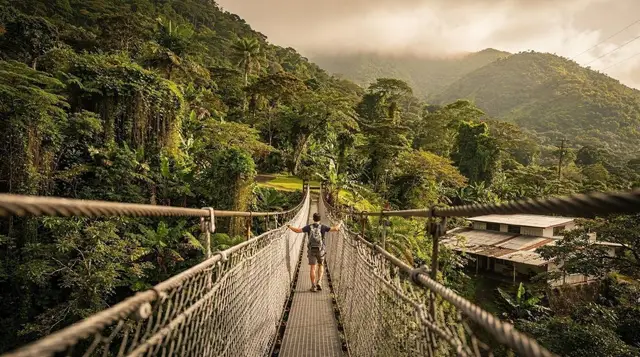
Locals call it the Chollín. Visitors, having heard it secondhand, usually spell it El Choyín. Either way it’s the same short stretch of river, a few minutes past the edge of town on the road toward Tabacón, where a bridge crosses a stream that runs noticeably warmer than the rain that feeds every other river in this valley. Cars pull onto the shoulder near the bridge, a rough path drops down to the bank on both sides, and people wade in and sit in the current the way they might sit in a hot bath — because that, essentially, is what it is.
This page covers only that free river crossing, not the paid complexes it sits between. If you’re deciding between Tabacón, Baldi and Ecotermales, that comparison lives on its own hot springs comparison guide. What follows is what to actually expect at El Choyín itself, including the part most short write-ups leave out: there is no one watching your things, and that matters.
Why the Water Is Warm
Arenal is a dormant stratovolcano now — it hasn’t produced visible lava since October 2010 — but the geothermal plumbing beneath it never switched off. Rainwater seeps down through porous volcanic rock, is heated by magma still sitting close to the surface, picks up dissolved minerals on the way, and re-emerges through fissures and springs scattered across the base of the volcano. Some of that heated groundwater is captured and piped into the pools at the resort complexes. Some of it simply surfaces on its own and joins the natural river system, which is exactly what happens at the Chollín.
The result is real, geologically the same water that costs 40 to 115 USD to sit in a few hundred metres away, just delivered without plumbing, filtration, or a receptionist. Temperature in the open river isn’t uniform — closer to where the warm water actually enters, patches can feel close to a hot bath; drift a few metres downstream and it cools toward ordinary river temperature. Finding the warmest pocket on a given day is part of the experience, and it changes slightly with rainfall and river flow.
What You’ll Actually Find There
Nothing, by design. There’s no ticket window, no landscaped pool, no swim-up bar, no changing rooms, no towel service, and no lifeguard. What exists is a natural riverbed with a mix of smooth and uneven rock, a current that varies with recent rain, and a handful of informal pockets where people tend to gather because the water runs warmest there. On a busy afternoon you’ll share the spot with a loose mix of backpackers, local families, and the occasional tour group that’s stopped in on the way past — on a quiet morning you might have a stretch of the bank to yourself.
There’s no signage explaining any of this, and no one enforcing an entry limit the way the Río Celeste trail or the national parks do. That informality is exactly what makes it free, and exactly what makes the next section necessary. A longer walkthrough of the access path and what to expect at different times of day is in the dedicated free hot springs El Choyín guide; this page focuses on the decision to go at all.
The Real Risk: Nobody Is Watching Your Things
This is the part that gets left out of most quick mentions of El Choyín, and it shouldn’t be. Because there is no gate, no staff, and no security presence of any kind, bags left on the riverbank or valuables left visible in a parked car are a known, recurring target. This isn’t a rare or exaggerated risk — it’s the direct and predictable consequence of an unsupervised public spot sitting on a road that tour vans and rental cars pass all day.
Travellers who’ve had phones, wallets or day bags taken while they were in the water are a common thread in trip reports about this exact place, and it’s the single biggest thing separating El Choyín from a paid complex: at Tabacón or Baldi, you’re paying in part for a locker and a staffed gate. Here, you’re not.
Treat it accordingly. The realistic options are: go with a friend and take turns watching a single small bag from the bank; carry nothing worth losing — no phone, no wallet, no jewellery — and simply wear your swimwear with a few small bills tucked somewhere secure; or park, wade in, and keep valuables locked in the boot of a rental car rather than visible on a seat (which carries its own smaller risk of a break-in, but a locked boot out of sight is meaningfully safer than an open riverbank).
None of this makes El Choyín unsafe to visit — it makes it a place where you plan around the fact that no one else is looking out for your things. Mistakes here are common enough that this exact trap has its own writeup on the travel mistakes to avoid page, and one visitor’s account of exactly this is told in the free hot springs nobody advertises.
Getting There From La Fortuna
The bridge sits on the road that runs from La Fortuna town centre out toward Tabacón and on to El Castillo, the same road every hot springs shuttle and most tour vans already use. There’s no address to give a taxi driver beyond “the free hot river near Tabacón” — most local drivers know it by that description or by the name Chollín, and it’s a short, flat, well-paved drive.
| Option | Time from town | Approx. cost | Notes |
|---|---|---|---|
| Taxi (one-way) | 10–15 min | USD 5–10 | Agree on a return pickup time, or arrange a pickup app for the way back |
| Rental car | 10–15 min | Fuel only | Roadside parking near the bridge; nowhere secure to leave the car |
| Walking from town | 45–60 min | Free | Along the road shoulder; no dedicated footpath |
| Combined with a hot springs day | Same drive | Add-on stop | Some visitors stop here briefly on the way to or from a paid complex |
There’s no formal parking area, so cars line the shoulder near the bridge on both sides — arrive a little earlier in the day if you want a spot close to the path down to the water, and don’t block the road itself.
What to Bring — and What to Leave Behind
Pack light and assume you’ll be watching everything you bring, not storing it:
- Bring: swimwear worn under your clothes, a light towel, water shoes or old trainers (the riverbed is uneven and can be slippery), a small amount of cash for a taxi, and sun protection for the walk down.
- Leave behind: your phone if you can manage without it, your wallet beyond a few small bills, jewellery, your passport, and anything else you’d genuinely mind losing. If you’re driving, lock valuables out of sight in the boot rather than leaving them on a seat.
- Consider: going with at least one other person so someone can stay with your things while others are in the water, and going earlier in the day when the spot tends to be quieter.
None of this is unique to El Choyín — it’s the same common sense that applies to any unattended riverbank or beach anywhere in the world. The difference is that at a paid hot springs complex, that risk is largely handled for you; here, it isn’t, and that’s the trade-off for not paying an entry fee.
El Choyín vs the Paid Hot Springs Complexes
The honest comparison isn’t about water quality — it’s about what the entry fee actually buys.
| El Choyín (free) | Paid complexes (Tabacón, Baldi, Ecotermales) | |
|---|---|---|
| Entry fee | None | Roughly USD 40–115 depending on the complex and package |
| Facilities | None — bare riverbank | Landscaped pools, changing rooms, towels, food and bars |
| Supervision | None | Staffed gate, lockers, lifeguards on duty |
| Belongings | Your responsibility, unwatched | Lockers and staff on site |
| Crowd | Informal, variable | Managed capacity, more predictable |
| Best for | A quick, free taste of geothermal water | A full afternoon or evening out |
If a landscaped, supervised pool day matters more to you than saving the entry fee, that’s what the resorts are built for. A day pass at Baldi’s hot springs complex or, for a quieter setting further along the road, the Los Lagos hot springs grounds gets you lockers, staff, and a proper afternoon rather than a supervised-by-nobody riverbank.
Some visitors combine the two: a free stop at El Choyín on the way past, then a full paid session later in the trip — there’s a longer breakdown of which complex suits which kind of visitor in the which hot springs to choose guide.
If your budget is the deciding factor across the whole trip rather than just this one stop, the free river is one of the few genuinely cost-free things to do in the area — see the wider La Fortuna on a budget guide for what else stretches a trip without a rental resort day. And if hot water isn’t really the point and you’d rather spend the afternoon on the volcano’s older lava fields instead, the El Silencio trail hike across the 1968 lava flow covers similar ground to the free river’s origin story — the same volcano, without the water.
When to Go
El Choyín is accessible year round, since it’s a natural river rather than a managed attraction with opening hours. Dry season, roughly December through April, tends to give calmer, clearer water and a firmer riverbed underfoot. In green season, from May through November, heavy rain upstream can raise the current and temporarily muddy the water — if it’s been raining hard for a day or two, expect a rougher, less appealing river than the postcard version.
Mornings on a weekday are generally the quietest time to visit, both for finding a warm pocket of water to yourself and for having fewer strangers and fewer parked cars around while you’re in the river. Arriving right after a heavy downpour is the one condition worth actually avoiding — not for the swim itself, but because a swollen river and slick rocks are a worse trade than waiting a few hours for it to settle.