Spa and Wellness in La Fortuna: What You're Actually Paying For
Is there a proper spa scene in La Fortuna?
Not in the sense of standalone spa buildings. Nearly all spa treatments here — massages, volcanic mud wraps, facials — are add-on services inside the big hot springs resorts like Tabacón, Baldi and The Springs. You pay resort entry first, then book the treatment separately, usually for an extra fee on top.
Where Wellness Actually Lives Here
Say “spa day” in most cities and you picture a standalone building: reception desk, robes, a treatment menu on its own. La Fortuna doesn’t really work that way. The geothermal water that made this district famous is also what built its wellness industry, and the two are fused together — almost every spa treatment you’ll find is delivered inside a hot springs resort, as an add-on to the pools rather than a business of its own.
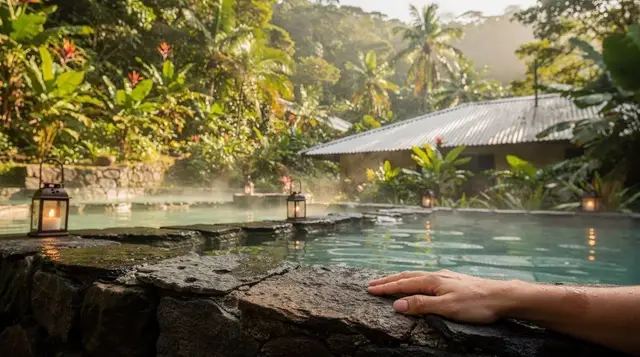
That’s not a complaint. It means the setting for a massage here is genuinely unusual: steaming pools threaded through tropical gardens, Arenal Volcano sometimes visible through the trees, geothermally heated water a few steps from the treatment room. It also means the economics work differently than a city spa, and that’s the part worth understanding before you book anything.
The Model: Resort Entry First, Treatments Second
Every major hot springs complex in the region — Tabacón, Baldi, Ecotermales, and others further out on the road toward the volcano — sells access to its pools as the base product. That entry fee is what shows up in the marketing and on the resort’s homepage: something in the 40 to 115 USD range depending on the property, sometimes bundled with a meal.
Spa treatments sit on top of that, as a separate line item, almost always requiring a separate booking. A resort might describe itself as having “a spa,” and it genuinely does — a dedicated building, trained therapists, a real menu — but walking in with a pool entry ticket does not get you a massage. You choose and pay for the treatment on top, either when you book your entry online or once you arrive.
This is the single most common source of disappointment we hear about from readers: someone books what looks like a full spa day online, budgets 60 or 70 USD, and discovers at check-in that the massage they pictured is another 80 to 120 USD on top of the entry fee they already paid. It isn’t a scam — resort websites do list treatments and prices separately if you read the fine print — but the marketing language (“spa,” “wellness,” “relax and rejuvenate”) does a good job of implying more inclusion than the ticket delivers.
The rule to remember: entry buys the water. Everything with your name on a therapist’s schedule is extra.
What’s Actually on the Menu
Treatment menus vary by resort, but a few things repeat across most of them:
| Treatment | Typical duration | Typical price (USD) | Notes |
|---|---|---|---|
| Swedish or relaxation massage | 50–60 min | 70–110 | The most common entry point; book ahead in high season |
| Deep tissue massage | 50–80 min | 90–140 | Priced above relaxation massage at most resorts |
| Volcanic mud wrap or mask | 30–45 min | 45–80 | Mineral-rich local mud, applied and rinsed, sometimes paired with a soak |
| Couples massage | 50–60 min | 160–220 total | Usually needs the longest advance notice |
| Facial | 30–45 min | 50–90 | Less widely offered than massage or mud treatments |
| Hot stone massage | 60–75 min | 100–150 | Offered at the larger resorts (Tabacón, The Springs) more than smaller ones |
Prices are rough — they shift by resort, season and whether you’re booking as part of a package. Treat every figure here as an order of magnitude, not a quote, and check the resort’s current menu before you commit.
The volcanic mud treatments are the thing most visitors haven’t encountered before and the thing worth trying at least once. The mineral content is drawn from the same geothermal ground that heats the pools, and resorts apply it as a mask or full-body wrap, often followed by a rinse in a dedicated pool. It’s a genuinely regional product rather than an imported spa-menu filler, and it’s usually one of the cheaper add-ons — a reasonable way to sample the treatment side of a resort without committing to a full massage price.
For the mechanics of how these treatments actually run — what to expect on arrival, how appointments are timed against pool access, what’s worth paying for versus skipping — see our dedicated guide to volcanic mud and hot spring treatments.
Choosing a Resort for the Spa, Not Just the Pools
We’ve deliberately kept this page about the treatments rather than re-litigating which hot springs resort is “best” — that comparison lives on its own page and covers pool count, crowd levels, food and family-friendliness in more depth than fits here. Go read the hot springs comparison guide for the full picture, and our which hot springs to choose breakdown if you want a faster decision.
For spa purposes specifically, a few things are worth knowing going in:
- Tabacón has the most built-out spa infrastructure of any resort in the area, with a dedicated treatment building and the broadest menu, at the top of the price range. Full guide: Tabacón hot springs.
- Baldi is priced lower and treats spa services as a simpler add-on rather than a headline feature. Full guide: Baldi hot springs.
- The Springs Resort, further from town, pairs its treatment menu with wildlife viewing on the property, which changes the day’s rhythm more than the treatment itself.
- Ecotermales keeps things smaller and quieter, with a shorter treatment list.
- El Choyin, the free public hot river near Tabacón, has no spa facilities at all — no changing rooms, no staff, no treatments. It’s worth knowing about as a genuine free alternative to paid entry, covered in our free hot springs guide, but it’s not part of this conversation. Nobody is offering a massage streamside.
If a massage is the actual goal of your day rather than a nice-to-have, book the treatment slot before you book the resort entry — treatment appointments fill before pool tickets sell out, especially on weekends and around Costa Rican holidays.
Beyond the Resorts: Yoga, Sound and Movement
Not every wellness option here runs through a hot springs complex, and if what you actually want is calm rather than a massage table, these are worth knowing about — they’re cheaper, don’t require booking pool entry, and set up differently than a resort spa day.
A rainforest yoga class trades the treatment room for open air and tree cover, usually held at a fixed time in the morning when temperatures are manageable and before the day’s heat and humidity build.
a morning yoga class set in the rainforest outside townA sound bath works differently again — no physical activity, just lying down while a practitioner works through singing bowls and other resonant instruments, aimed at the same nervous-system reset a massage delivers, without hands-on bodywork.
a sound bath session in a jungle settingAnd for something that leans playful rather than purely restorative, goat yoga has found its way to the region too, combining a beginner-friendly yoga class with actual goats wandering the mats, often with volcano views as a backdrop on a clear morning.
a goat yoga session with Arenal Volcano in viewNone of these substitute for a resort massage if that’s specifically what you’re after — but if the goal is simply to slow down for a couple of hours without paying a resort’s full day rate, they’re a legitimate route in, and one many visitors don’t know exists until they’re already in town.
Budgeting a Spa Day Realistically
Because entry and treatments are billed separately, it helps to plan the day as two costs rather than one:
| Component | Rough cost (USD) | Notes |
|---|---|---|
| Resort entry (day pass) | 40–115 | Varies widely by resort and whether a meal is included |
| One massage or mud treatment | 45–150 | Add per person, per treatment |
| Towel/locker rental (if not included) | 0–10 | Some resorts include this in entry, some don’t |
| Gratuity for therapist | 5–15 | Not automatically added the way restaurant service charges are |
A single person booking entry plus one massage at a mid-range resort is realistically looking at 130 to 220 USD for the day, once gratuity is factored in. That’s a legitimate splurge day, not a routine one — worth planning for rather than assuming it fits inside a standard hot springs budget. For the wider picture of what a trip here costs day to day, our La Fortuna on a budget guide covers where spa spending fits against everything else.
One more cost worth flagging honestly: gratuity for spa therapists is not folded into Costa Rica’s standard restaurant service charge, and most resorts don’t add it automatically to a treatment bill the way they do a dinner check. If you’re happy with the service, tipping the therapist directly — commonly 10 to 15 percent, cash if you can — is the norm, separate from anything already added to your resort bill.
Timing a Spa Visit Around the Rest of Your Trip
A spa day works best slotted in deliberately rather than tacked onto a day already built around something else. A few practical notes:
- Book treatments ahead, especially December through April. Pool entry can often be arranged same-day; spa appointments frequently cannot.
- Arrive earlier than your treatment time. Resorts generally want you checked in and settled 20 to 30 minutes before a booked massage or wrap, on top of however long you plan to spend in the pools before or after.
- Pair it with a low-key day, not a day that also includes ziplining or a long hike. Bodies that are sore or dehydrated from adventure activities don’t get as much out of a massage, and a rushed treatment squeezed between two tours defeats the point.
- Rain doesn’t cancel a spa day. Most treatment buildings are covered or indoor, and geothermally heated pools are arguably at their best in a light rain — one of the few La Fortuna activities genuinely unaffected by the region’s frequent afternoon showers.
If you’re building a full itinerary and trying to decide where a spa day fits against volcano hikes, waterfalls and day trips, our first time in La Fortuna guide and the La Fortuna honeymoon itinerary both treat a spa day as one deliberate slot rather than a default, which is the right way to think about it — it’s a highlight, not a filler activity.
A Realistic Expectation, Not a Discount One
The honest summary: La Fortuna’s spa offering is real, well-executed at the better resorts, and set in a genuinely striking environment that few city spas can match. What it isn’t is included. Treat the resort entry fee as the price of the pools, treat any treatment as its own purchase, and book that treatment ahead of time if it’s the actual point of your visit. Do that, and the day delivers exactly what the marketing promises. Skip that step, and you’ll be doing the math at the front desk instead of relaxing in the water.
Spa and wellness on GetYourGuide
Verified deep-linked GetYourGuide tours. Book through these links and we earn a small commission at no cost to you.
GetYourGuide does not provide a product photo for this activity — the image shows the meeting point, photographed by us.