La Fortuna on a Budget: What Things Actually Cost
How much does a trip to La Fortuna cost per day?
Budget travellers can get by on roughly 60-90 USD a day using the free Chollín hot spring, soda meals and one paid activity every other day. Mid-range travellers booking one tour a day, a hot spring complex and hotel-style rooms should plan for roughly 150-220 USD a day per person. Neither figure includes flights.
What a day in La Fortuna actually costs
La Fortuna does not have a single “budget” or “expensive” price tag — it has a range for every single thing you might do, and the range is wide. A hot spring afternoon can cost nothing or over 100 USD. A guided tour can run 45 USD or 140 USD depending on the group size and what is included. A hotel room can be 35 USD or 250 USD, often two blocks apart. What follows is not a total, because your total depends entirely on which end of each range you pick. It is a breakdown, by category, with real numbers, so you can build your own total before you land.
Everything below is quoted in US dollars, because that is how tours, hotels and park entries are almost always priced here. Treat every figure as an order of magnitude rather than a fixed quote — prices move with the season and the operator, and this page is not the final word on any single business’s rate.
Hot springs: the widest range in town
Hot springs are the one expense every visitor to La Fortuna weighs, because the volcano’s geothermal heat is genuinely the reason most people come, and the price to access it spans from zero to well over 100 USD for the exact same warm water.
| Option | Typical cost | What you get |
|---|---|---|
| El Chollín (free river) | 0 USD | Warm river under a bridge near /destinations/tabacon-hot-springs/, no facilities, no supervision |
| Ecotermales | roughly 45-60 USD | Smaller, quieter pools, capped visitor numbers, no waterslides |
| Baldi Hot Springs | roughly 45-65 USD | Large pool complex, waterslides, swim-up bars, day or night entry |
| Tabacón | roughly 85-115 USD | The most elaborate gardens and pools, closest to the original 1968 site |
The full comparison of what each complex actually offers — pools, crowd levels, food options — is in the /guides/hot-springs-comparison-guide/ and the shorter /guides/which-hot-springs-to-choose/ if you just want a quick pick. The free option is covered on its own in /guides/free-hot-springs-el-choyin-guide/ and at /destinations/el-choyin-free-hot-springs/, and it deserves a mention here because it is a genuine budget move, not a compromise: the water comes from the same geothermal source that feeds the paid resorts, minus the landscaping, the swim-up bar, and the entry fee. The trade is real too — no lockers, no lifeguard, and reported bag theft, so treat it like a public riverbank, not a resort.
A workable budget approach: pick one paid complex for one afternoon of your trip — most people are happy with either /destinations/baldi-hot-springs/ or /destinations/ecotermales-fortuna/ — and use El Chollín on any other day you want to soak. That alone can cut a multi-day hot springs budget by more than half without cutting out hot springs at all.
Day tours: where the range depends on group size
Tour pricing in La Fortuna tracks group size and inclusions more than anything else. A private tour for two can cost double a shared group tour of the same activity, and a tour that bundles lunch, transport and gear will always beat the sum of those parts bought separately.
| Activity type | Typical shared-group price | Typical private price |
|---|---|---|
| Hanging bridges walk | roughly 30-45 USD | roughly 70-100 USD |
| Safari float / river float | roughly 55-75 USD | roughly 100-140 USD |
| ATV tour | roughly 65-95 USD | roughly 120-160 USD |
| Wildlife / sloth walking tour | roughly 40-60 USD | roughly 80-110 USD |
| Day trip to Río Celeste or Tenorio | roughly 65-90 USD | roughly 130-180 USD |
For a first look at the volcano’s collapsed 1968 lava field paired with a river float and lunch, a bundled tour usually beats booking each piece on its own — see the safari float, hanging bridges and lunch combo as an example of that kind of packaging. If wildlife is the priority rather than adrenaline, the guided sloth and monkey walk is a lower-cost, lower-adrenaline alternative to a full-day combo. For a faster-moving, higher-cost outing, the ATV adventure through farmland and forest sits at the upper end of the shared-group range above.
How tours get bundled — and where bundling genuinely saves money versus where it just adds things you did not want — is explained in /guides/combo-tours-in-la-fortuna-explained/. If you are choosing between a river float and a rafting run specifically, /guides/rafting-vs-safari-float-which-to-choose/ breaks down the price and intensity difference.
Booking two or three activities as one package, rather than as separate reservations with separate transport, is usually the single biggest tour-budget lever after the choice of hot springs.
Accommodation: three tiers, roughly
Rooms in La Fortuna town and along the road toward the volcano span from simple guesthouses to resort-style properties with volcano views. Three rough tiers:
| Tier | Typical price per night | What it usually means |
|---|---|---|
| Budget | roughly 30-55 USD | Fan-cooled or basic air conditioning, simple room, walkable to town |
| Mid-range | roughly 70-140 USD | Pool, breakfast included, often a garden or partial volcano view |
| Higher-end | roughly 180-350 USD+ | Volcano-facing rooms, private hot spring access, full resort grounds |
Dry season (December to April) rates run higher across all three tiers than green season (May to November) rates for the same room. If your trip dates are flexible, /guides/best-time-to-visit-la-fortuna/ and /guides/la-fortuna-in-green-season/ both cover the trade-off between lower prices and more afternoon rain.
Food: sodas versus restaurants
Meals are one of the easiest places to control cost in La Fortuna, and the gap between options is large. A plate at a soda — the local term for a family-run, no-frills eatery — typically runs a fraction of what the same meal costs at a restaurant aimed at visitors, before service is even added.
Where to actually find good sodas versus where the tourist-priced restaurants cluster in town is covered in /guides/la-fortuna-town-centre-restaurants-guide/, along with a broader look at what to expect from the food scene in /guides/what-to-eat-in-la-fortuna/. One detail worth flagging here without repeating it in full: paying in colones rather than USD at a soda tends to get you a fairer price than paying in dollars, for reasons tied to how change gets calculated — the restaurant guide linked above goes into why.
Service charges, tax, and tipping — three different things
This is where a lot of visitors overpay without realising it, in both directions. Costa Rican law requires restaurants to add a 13% sales tax and a 10% service charge to every bill. Both are usually printed on the check, sometimes as “impuestos y servicio” or simply folded into the total. That 10% service charge is not a discretionary tip — it is a legal addition, and it goes some way toward paying the staff who served you, but it is not the same thing as tipping a guide.
Tour guides are the separate case. A guide fee is not built into most tour prices the way restaurant service is, so a tip of roughly 5-10 USD per person per day is the norm for a guided activity, on top of whatever you already paid to book the tour. Drivers on transfer-only bookings are typically tipped less, if at all, unless they also acted as a guide.
| Setting | What is already included | What to add |
|---|---|---|
| Restaurant bill | 13% tax + 10% service charge | Nothing required; round up is optional |
| Guided tour | Nothing | Roughly 5-10 USD per person per day for the guide |
| Hotel housekeeping | Nothing | A few dollars per stay is appreciated, not required |
| Private driver/transfer | Nothing | Optional, smaller than a guide tip |
The USD-versus-colones trap
Nearly everything aimed at visitors — tour prices, park entries, hotel rates — is quoted in US dollars, and most businesses will happily take dollar cash or a card. The trap is what happens when change is due. Change comes back in Costa Rican colones, and the exchange rate a shop or tour desk applies to convert your dollars is frequently worse than the bank rate, sometimes noticeably so. Large bills — 50s and 100s — are also often refused outright, particularly at smaller sodas and shops.
None of this makes dollar prices false, but it does mean the number printed on a tour brochure or hot spring gate is not quite the number you will actually pay once change and conversion are factored in. Carrying some colones for small purchases, and paying in colones where you can, tends to close that gap — the restaurant guide linked above covers this specifically for meals, where the effect is most noticeable given how often you will be paying small amounts.
Putting a few days together
A rough two-activity day, built from the ranges above, might look like:
| Item | Low estimate | Higher estimate |
|---|---|---|
| Accommodation (per person, shared room) | 20 USD | 90 USD |
| Breakfast + lunch + dinner | 15 USD | 45 USD |
| One shared-group tour | 40 USD | 95 USD |
| Hot springs (free or paid) | 0 USD | 60 USD |
| Guide tip | 5 USD | 10 USD |
| Rough daily total | 80 USD | 300 USD |
That range is wide on purpose — it reflects a genuinely different trip on each end, not the same trip priced two ways. For a sense of what a full week adds up to once transport between regions and a mix of activities is factored in, /blog/what-a-week-in-la-fortuna-really-costs/ walks through one real trip’s numbers. For a broader look at common overspending and under-planning mistakes beyond just money, see /guides/la-fortuna-travel-mistakes-to-avoid/, and for a first-timer’s overview of how many days to plan for in the first place, /guides/how-many-days-in-la-fortuna/ is a useful starting point before you start pricing anything.
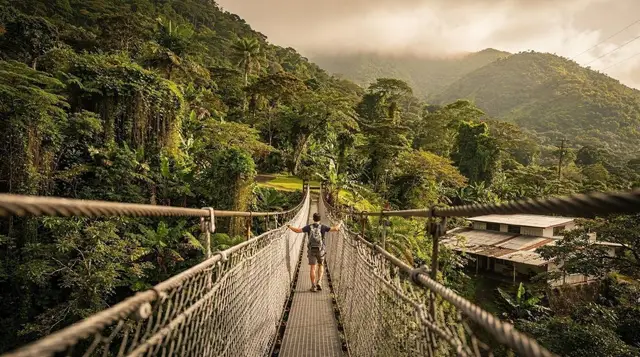
If you want to see how one traveller’s assumptions about tipping specifically played out in practice, /blog/tipping-in-costa-rica-what-i-got-wrong/ is a candid account worth reading before your first guided tour. And if the hanging bridges are on your list either way, the half-day hanging bridges tour is one of the lower-cost ways to tick that activity off without adding a second paid stop to the same day.
Frequently asked questions about La Fortuna’s costs
Are prices in La Fortuna really in US dollars?
Tours, hotels and park entries are almost always quoted in USD, and most places accept dollar cash or cards. Any change due back to you, though, comes in colones, and the exchange rate used at the till is often worse than the bank rate, so paying in USD is not free of cost.
Is the free hot spring at El Chollín actually free?
Yes. It is a public stretch of warm river near Tabacón with no entry fee, no changing rooms and no lifeguard. It is a genuine alternative to the paid resorts, but bag theft has been reported, so bring only what you can watch.
Do I need to tip on top of the bill?
Restaurant bills already include a mandatory 13% sales tax and 10% service charge by law, so the amount printed is close to final for food. Tour guides are a separate case: 5-10 USD per person per day is the norm and is not included anywhere on a receipt.
Is it cheaper to book hot springs and tours in advance or on arrival?
Advance online booking rarely undercuts walk-in prices in La Fortuna, but it does guarantee a slot, which matters for popular hot spring complexes and for parks with daily visitor caps such as Río Celeste.
What is the single biggest way to cut costs in La Fortuna?
Swap one or two paid hot spring afternoons for El Chollín, and eat at least half your meals at sodas rather than tourist-facing restaurants. Those two changes move the daily budget more than any single tour decision.
Does the dry season cost more than the green season?
Accommodation and some tour operators raise rates in the December-to-April dry season. The green season (May-November) often comes with lower room rates and occasional multi-tour discounts, for the trade-off of more afternoon rain.
Trip-planning essentials on GetYourGuide
Verified deep-linked GetYourGuide tours. Book through these links and we earn a small commission at no cost to you.
GetYourGuide does not provide a product photo for this activity — the image shows the meeting point, photographed by us.