Where to Eat in Downtown La Fortuna: Central Park & Beyond
Where should I eat in downtown La Fortuna?
The streets facing Central Park and the church are full of restaurants aimed squarely at tour groups; walk two or three blocks toward Calle 1 or the bus terminal side of town and prices drop while the clientele turns mostly local. Neither side is fake, but they are not interchangeable, and picking blind usually means overpaying for average food.
Reading the town centre by the block, not by the star rating
Every guidebook to La Fortuna mentions that the town has good food. What most of them skip is that “downtown La Fortuna” is not one restaurant scene — it is at least two, sitting a few hundred metres apart, and they do not serve the same purpose. This page is not a rundown of which dish to order; that lives on our general eating guide for La Fortuna, and we are not going to redo it here. This page is a map: where to walk, what each block of the town centre is actually optimised for, and how to tell a restaurant built for a coach tour from one built for the person who lives three streets over.
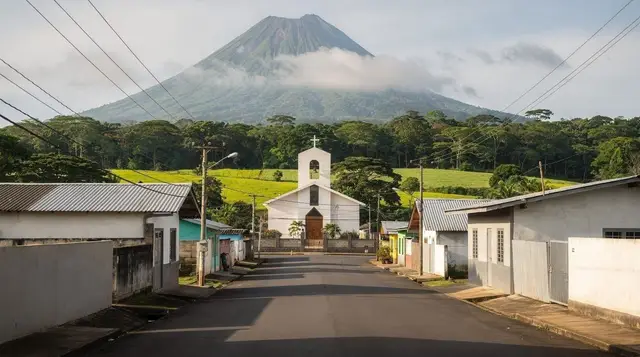
La Fortuna’s centre is small enough to cover on foot in under twenty minutes end to end, organised around Central Park and the Catholic church that faces it. That compactness is exactly what causes the confusion: a restaurant catering to a one-night visitor and a soda feeding a construction crew on lunch break can sit on the same block, sometimes the same corner, and nothing about their signage tells you which is which until you are inside reading the menu.
The park-facing block: built for people who are here for one night
The street directly facing Central Park and the church is the most photographed stretch in town, and the restaurants along it know exactly who walks past. Menus are printed in English and Spanish, often with photos of every dish. Prices are quoted in US dollars. Staff are trained to seat a table of six without blinking and to have a server hovering within a minute of the last bite finishing. Sangria, nachos, and a “traditional Costa Rican platter” built for sharing all show up more than once on this block.
None of this makes the food bad — several of these places do solid renditions of casado, grilled tilapia, or a mixed Tico breakfast, and the people-watching over the park at sunset is genuinely pleasant. What it means is that you are paying partly for the location and the ease, not only for the plate. A casado that costs a few dollars two streets away can cost noticeably more here, garnished the same way, portioned about the same. If a fast, comfortable, English-friendly dinner after a long day at the waterfall or the hot springs is what you want, this block delivers reliably. If you are chasing what La Fortuna actually eats on a Tuesday, keep walking.
Two to three blocks back: where the town still eats
Head away from the park toward the bus terminal, or along the parallel street that most tour buses do not bother using, and the character changes fast. Menus shrink to a chalkboard or a single laminated sheet, often Spanish-only. Prices are in colones. The casado here is the same dish as on the park block — rice, beans, salad, fried plantain, cabbage slaw, and a protein — but built for a local lunch crowd on a budget, not for a photo. Portions tend to be generous, service is quick and unfussy, and nobody is going to try to upsell a second round of anything.
This is also where you find the best breakfast value in town: gallo pinto with eggs, natilla, and coffee for a fraction of what a park-facing café charges for the same combination dressed up with a garnish. It is not that the touristic version is dishonest — it is a legitimate, comfortable option for a traveller who wants convenience — but calling every restaurant within the town centre equally “authentic” flattens a real difference that is worth knowing before you sit down. A soda near the terminal earning its living from local lunch trade is a different thing from a restaurant built around a steady rotation of one-night guests, even when both are five minutes from the same park bench.
A quick comparison
| Park-facing block | Terminal / back streets | |
|---|---|---|
| Menu language | English + Spanish, often with photos | Mostly Spanish, chalkboard or single sheet |
| Prices | Quoted in USD | Quoted in colones |
| Typical customer | One-night visitors, tour groups | Local workers, longer-stay travellers |
| Casado price range | Roughly 8–14 USD | Roughly 3,500–5,500 CRC |
| Pace | Full table service, built for lingering | Fast turnover, built for a lunch break |
| Reservations | Useful on weekend evenings in dry season | Rarely needed |
Prices above are ballpark figures for 2026 and move with the season and the cook of the day — treat them as a sense of scale, not a menu.
Breakfast: the one meal where the gap barely matters
Breakfast is the exception to most of the above. A plate of gallo pinto with eggs, natilla, and coffee is cheap and good almost everywhere in the centre, park-facing or not, because it is the meal every kitchen in town makes daily for its own staff before the tourists sit down. This is the easiest low-risk way to try a soda for the first time if the language gap feels intimidating: the menu is short, the dish is familiar within a minute, and the price difference from a hotel breakfast is immediate and real.
Lunch: the casado test
If you want one dish to use as a barometer for the whole town centre, make it the casado. Order it on the park block and note the price and portion. Order it again two streets back at a soda and compare. The dish itself rarely changes much — rice, beans, cabbage or salad, plantain, a protein — but the price gap and the room around you will tell you more about where you are eating than any review ever will. It is also, frankly, the cheapest reliable lunch in La Fortuna, filling enough to carry you through an afternoon at the hanging bridges or a hot springs visit without needing a snack before dinner.
Dinner and the group-oriented trap
Evenings are where the touristic side of downtown is strongest, and where it is easiest to end up somewhere built for a tour bus rather than for you. A few signals to watch for: a menu that reads almost identically to three other restaurants on the same block, a host actively working the sidewalk to pull walk-ins inside, and a “traditional” tasting platter priced well above the sum of its parts. None of this is a scam — it is a business model tuned to volume and predictability — but it is worth recognising for what it is before assuming it represents the town’s food culture at large.
For a dinner that goes further than a menu, a hands-on Costa Rican cooking class with a tasting menu puts you in a kitchen instead of a dining room, working through the same staples — gallo pinto, patacones, a slow-cooked protein — with someone explaining why each step exists rather than just plating the result. A longer version, the three-hour cooking class with dinner, folds the meal itself into the lesson, which is a reasonable answer on an evening when a sit-down restaurant feels like more of the same after a day of touring.
Coffee, cacao, and dessert without redoing the food guide
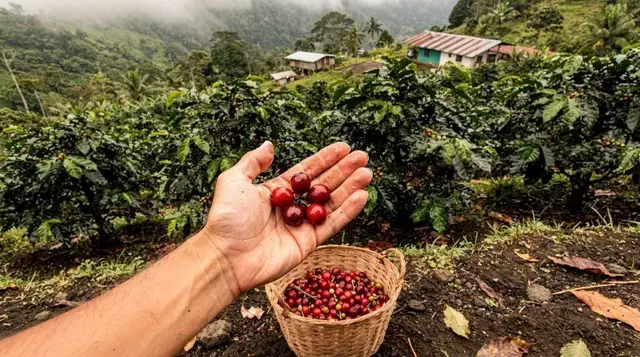
Downtown La Fortuna has a handful of small cafés worth a stop between activities, particularly for anyone skipping a dedicated coffee and chocolate tour outside town. If you do want the fuller story behind Costa Rican coffee and cacao — how it is grown, processed, and turned into the chocolate sold at every souvenir stand in the centre — that belongs to our chocolate and cacao workshop guide, not this one.
What matters for a walk through town: a proper cup of local coffee is cheap and good almost anywhere, including the sodas, and paying a premium for it at a park-facing café mostly buys you the seat and the view, which is a fair trade some evenings and not others.
Vegetarian and dietary notes
Vegetarian eating is straightforward in the centre — rice and beans, plantain, salad, and vegetable-based casado versions appear on nearly every menu, touristic or local, without needing to ask. Vegan and gluten-free options are more consistently labelled on the park-facing menus, since English-language signage tends to flag them explicitly; a soda may serve the same naturally vegan plate without calling it out, so it is worth asking directly — “¿es vegetariano?” or “¿tiene carne?” covers most of it.
What the service charge already covers
By Costa Rican law, a sit-down restaurant bill in the centre already includes 13% VAT and 10% service on top of the menu price — this applies equally to the park-facing restaurants and to any soda that runs a printed bill rather than a chalkboard total. That built-in 10% is not the same as a tip for a guide on a tour; it is a standard restaurant service charge, and most people do not add anything further on top of it for a normal sit-down meal in town. A soda paid for at the counter often has both folded straight into the number on the board, with no separate line to read.
Planning the rest of your stay around downtown
Downtown La Fortuna works best as a base for meals bookending days spent elsewhere — the volcano, the hot springs, the bridges — rather than as a destination in its own right. If you are still working out how long to spend in the area overall, how many days in La Fortuna is the place to start, and first-time in La Fortuna covers the broader orientation questions this page does not touch. For travellers watching the budget across the whole trip, our La Fortuna on a budget guide treats meals as one line among several, and downtown’s soda side is consistently the cheapest of the options it covers.
A few other pairings worth knowing: an evening night walk in the forest outside town ends late enough that a fast, park-facing dinner beforehand often makes more sense than a longer sit-down meal, while a slower day built around hot springs and spa time pairs naturally with a longer dinner back in the centre afterward.
And if the trip has covered enough restaurants already, a ATV tour through the volcano and hot springs area or a guided sloth and monkey walk makes for a good excuse to eat light downtown and save the appetite for later. For a full sense of what else the food and drink category covers around La Fortuna beyond the town centre, that hub page rounds up the rest.
The one thing worth remembering
Nothing in downtown La Fortuna is fake, and nothing needs to be avoided out of principle. The mistake is treating every restaurant within the town centre as interchangeable — assuming the park-facing block and the streets behind the bus terminal are serving the same experience at the same honesty level just because they are a five-minute walk apart. They are not. Walk the loop once, read two or three menus before committing, and choose on purpose rather than by whichever host waves first.
Food and drink tours on GetYourGuide
Verified deep-linked GetYourGuide tours. Book through these links and we earn a small commission at no cost to you.
GetYourGuide does not provide a product photo for this activity — the image shows the meeting point, photographed by us.