How Many Days Do You Need in La Fortuna?
How many days should I spend in La Fortuna?
Two nights is the practical minimum for the waterfall, one hanging bridge park and one hot spring, and even that is a full, busy stop. Four to five nights lets you add Río Celeste or Caño Negro as day trips, and a week or more makes room for Monteverde as well.
The half-day rule that decides your whole schedule
Almost every headline activity around La Fortuna takes up half a day on its own, not an hour or two squeezed between breakfast and lunch. The La Fortuna Waterfall alone runs to half a morning once you count the drive, the descent and climb back up the roughly 500 steps, and time in the pool at the bottom. A hanging bridge park is a similar block. A hot spring evening is its own activity, usually starting after 3pm and running past dark. Stack three of those into one day and you are rushing all three, arriving tired to dinner, and missing the point of what is meant to be a slow, outdoor stop.
That single fact is why this guide leans hard on half-day units rather than a headline number of days. Once you know that a day realistically holds one big activity plus something small, planning La Fortuna stops being guesswork.
It also explains the most common mistake in trip planning for this region: treating La Fortuna as an overnight stopover between San José and Monteverde. It can technically be done, but it turns a place people travel specifically to visit into a box to tick, and it usually means picking exactly one activity and skipping the rest.
Two nights: the essentials-only stay
Two nights is the floor, not a comfortable stay, but it is workable if you accept that you are choosing a short list rather than sampling everything. A typical two-night visit looks like this:
| Block | What fits |
|---|---|
| Arrival afternoon | Settle in, short walk around La Fortuna town centre, early dinner |
| Full day | Morning at La Fortuna Waterfall, afternoon at one hanging bridge park such as Mistico Hanging Bridges |
| Evening | Hot springs — either a paid complex like Tabacón or the free river at El Choyin |
| Departure morning | One short activity before checkout, or straight onward |
That is a full, satisfying two days, but it is also the ceiling of what two nights can hold. There is no slack for a rained-out afternoon, no room for Río Celeste or Caño Negro, and no time to simply sit by the pool and look at the volcano when the clouds happen to lift. If your itinerary already has La Fortuna sandwiched between two other stops and two nights is what you have, this is the version to plan for — see the two-day La Fortuna itinerary for a fuller breakdown.
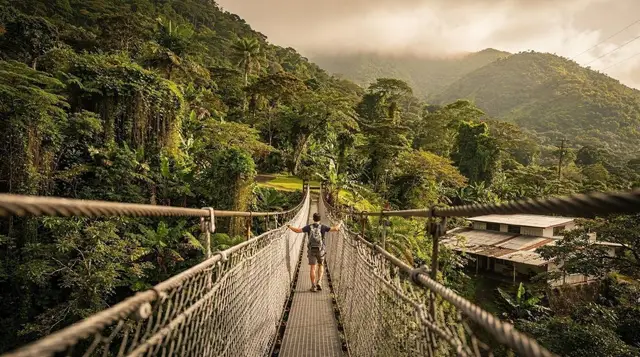
One activity worth building around on a short stay is a single guided outing that bundles more than one thing into a half day. A combined float trip, bridge walk and lunch stop covers wildlife spotting and a hanging bridge crossing in one booking, which matters when every half-day block is precious.
Three nights: room to breathe
A third night does not add a whole new region, but it changes the pace considerably. With three nights you can spread the same essentials across more time, add a spa evening without cutting into a full-day activity, or swap the rushed two-night plan for one where each activity gets a relaxed morning or afternoon rather than a tight slot.
Three nights is also the point where an activity like a guided half-day walk across the suspension bridges stops competing for time with the waterfall and gets its own unhurried slot, ideally in the early morning when the forest is quietest and the volcano’s cone is most likely to be visible before the cloud builds up.
It is still too tight to comfortably add Río Celeste or Caño Negro as well — both are 1.5 to 2 hour drives each way, and turning one into a rushed half-day usually means arriving after the best light and leaving before the last stretch of trail. If a day trip is the goal, four nights is the more realistic target. The three-day La Fortuna itinerary lays out one way to use the extra night.
Four to five nights: add Río Celeste or Caño Negro
This is where a La Fortuna stay stops being “the essentials” and becomes a fuller regional trip. Four nights leaves room for one full-day excursion beyond town; five nights comfortably fits two.
The two most common additions:
- Río Celeste, in the Tenorio Volcano National Park, for the turquoise river and its waterfall trail. It is roughly 1.5 to 2 hours from La Fortuna each way, and the park limits daily entries and closes the trail access in the mid-afternoon, so this needs an early start regardless of how many nights you have. A guided day trip that handles the park logistics and transport removes most of the planning friction. Full details are in the Río Celeste day trip guide.
- Caño Negro, a wetland wildlife refuge on the Río Frío, reached via Bijagua or directly through Los Chiles. It suits travellers prioritising birds and river wildlife over waterfalls, and a slower wildlife boat float near Bijagua is a good way to combine wetland scenery with a chance at spotting sloths on the way. See the Caño Negro day trip guide for what the excursion actually involves.
Trying to fit both into a single four-night stay is possible but tight — most people who want both take five nights, using one day for each and keeping the other two or three for the closer La Fortuna essentials. The four-day and five-day itineraries split the difference in slightly different ways depending on which day trip takes priority.
A note on Cerro Chato: it used to appear on plenty of four- and five-day plans as a half-day hike, but the crater trail has been closed to hikers since 2018 and stays that way. If you see it listed anywhere as a doable activity, treat that as outdated — the Cerro Chato closure guide explains why and what people mistakenly plan around it instead.
One week or more: La Fortuna plus Monteverde
Once a stay stretches past five or six nights, the natural next step for most travellers is not a third La Fortuna day trip but Monteverde. The two regions are usually paired rather than treated as separate trips, connected by the jeep-boat-jeep crossing over Lake Arenal — a roughly three-hour combination of minibus, boat and minibus that beats the 3.5 to 4 hour drive around the lake on both time and cost. That comparison is covered in full in the jeep-boat-jeep versus driving guide, so it is not worth repeating here beyond the headline: for almost everyone, the boat crossing is the better choice, and it is worth booking a night or two before you plan to move on so the timing lines up.
A common one-week split looks like four nights in La Fortuna, covering the essentials plus one day trip, followed by three nights around Monteverde or Santa Elena for the cloud forest reserves. The La Fortuna and Monteverde itinerary and the broader one-week La Fortuna itinerary both work from that structure. If Río Celeste is a bigger draw than Monteverde, the La Fortuna and Río Celeste itinerary pairs the two without adding the cloud forest leg at all.
For a direct sense of how the two regions differ before deciding which gets more nights, the La Fortuna versus Monteverde comparison is worth reading — broadly, La Fortuna is warmer, lower altitude and built around hot springs and the volcano, while Monteverde is cooler, higher, and built around cloud forest and birdlife.
What a rushed one-night stop actually costs you
It is worth being blunt about the one-night version, because it still shows up in a lot of pre-built itineraries as a convenient stopover between San José or Liberia and Monteverde. The problem is not that it is impossible — plenty of people do it — but that it forces a choice most visitors did not realise they were making.
With one night, you get roughly one half-day activity and an evening. That usually means the waterfall or a hot spring, not both, and rarely a hanging bridge park as well, since the drive-in and out already eats into the available time. Wildlife activities that reward an early start, like a guided walk on the Bogarín Trail or a night walk looking for frogs and sloths, get squeezed out entirely, since a night tour needs an evening slot that a one-night stay has usually already spent on dinner and an early departure the next morning.
The knock-on effect is that a one-night stop tends to produce a version of La Fortuna built around a single postcard activity rather than the mix that makes the region worth the detour in the first place — the combination of waterfall, forest canopy, thermal water and volcano geology in one compact area. If your route genuinely cannot spare a second night, that is a fair trade-off to make consciously. It is a worse one to make by accident because a pre-built itinerary assumed two nights was excessive.
Matching stay length to what you actually want
Not everyone wants the same version of La Fortuna, and stay length interacts with priorities more than it looks at first glance.
| If your priority is… | Aim for | Because |
|---|---|---|
| Ticking the waterfall and a hot spring | 2 nights | Both fit in one full day plus arrival/departure slack |
| A relaxed pace with no day trips | 3 nights | Same essentials, spread out, room for weather |
| Adding Río Celeste or Caño Negro | 4–5 nights | Each day trip needs its own full day, plus 1.5–2 hours of driving each way |
| Wildlife and night walks as a focus | 4+ nights | Night tours and early wildlife walks need dedicated evening and dawn slots |
| Continuing to Monteverde | 4+ nights here, then 2–3 there | The jeep-boat-jeep crossing works best as a planned transition day, not a rushed one |
The pattern across all of these is the same: count activities in half-days, not in a single number of nights, and the right length of stay becomes obvious rather than arbitrary. Two nights answers “what are the must-sees.” Four to five nights answers “what else is in the region.” A week answers “what does the wider area around Arenal and the northern lowlands look like.” None of them is wrong — they are just different trips wearing the same destination name.
Trip-planning essentials on GetYourGuide
Verified deep-linked GetYourGuide tours. Book through these links and we earn a small commission at no cost to you.
GetYourGuide does not provide a product photo for this activity — the image shows the meeting point, photographed by us.