Catarata Río Fortuna: what you’re actually walking down to
La Fortuna Waterfall — locally Catarata Río Fortuna — drops about 70 metres off a basalt cliff into a narrow canyon a few kilometres outside La Fortuna town. It’s the single most photographed sight in the region after Arenal Volcano itself, and unlike the volcano, it delivers on the postcard every single day: there’s no cloud cover to wait out here, just water falling into a green gorge.
The site is privately managed by ADIFORT, La Fortuna’s community development association, which uses entry fees to fund local infrastructure and trail maintenance. That’s worth knowing going in — this isn’t a national park, so SINAC reservations don’t apply, and the money you pay at the gate stays largely in the district. Entry runs roughly USD 20 per adult, less for children, payable in USD or colones at the entrance.
What you’re paying for is access to a well-built stone and concrete staircase — close to 500 steps — that switches back down the canyon wall to river level. It’s the main event as much as the waterfall is: a workout down, a bigger workout back up, framed by rainforest that stays humid and green through both the dry and the green season.
The 500 steps, honestly described
The staircase is not casual. It’s stepped, railed, and shaded for most of its length, which makes it safer and cooler than it sounds, but it is still close to 500 individual steps of uneven height, and the surface is often damp. Going down takes most visitors 15–20 minutes at an easy pace, with stops for photos. Coming back up is the part people underestimate: 25–40 minutes for an average adult, longer with kids, longer again in the mid-morning humidity.
A few practical points that actually change your visit:
- Wear closed shoes with grip, not sandals. The steps and the rocks near the water are frequently wet.
- Carry water. There’s a small snack bar and toilets near the entrance at the top, but nothing at the bottom.
- Go early. The staircase gets busy from mid-morning as tour buses arrive; a first-thing visit means fewer people to pass on narrow sections and better light for photos.
- Budget the return climb as its own activity. If you’re combining the waterfall with something else that day, do the waterfall first, while you’re fresh.
- There’s no fast way down. If the stairs are a genuine problem for your mobility, there’s a viewing platform partway that shows the falls from a distance without the full descent — ask staff at the entrance where it starts.
For travellers deciding whether to build a whole morning around this, the full waterfall guide goes deeper on timing and photo spots; this page focuses on the practical logistics of getting there, down, and back.
Where you can swim — and where you absolutely cannot
This is the detail that matters most and the one most easily skipped in a hurry. At the base of the staircase, the river arrives directly under the falls in a plunge pool with a genuinely strong current and constant spray. Swimming there, or standing under the falling water, is not safe: the force of the water and the undertow it creates have caused injuries at sites like this across Costa Rica, and staff actively discourage getting close.
The place people actually swim is a calmer pool a short walk downstream, reached by a marked side path from the main viewing area. The current there is manageable, the water is clear and cold — it’s runoff from the Arenal massif, so it never really warms up — and it’s the spot you’ll see in most of the photos of people actually in the water. Lockers aren’t standard, so bring only what you’re comfortable leaving on a rock or carrying in a dry bag, and keep an eye on belongings the way you would at any open swimming spot.
If your priority is swimming rather than sightseeing, it’s worth knowing this is a cold river pool, not a warm spring — for a warm soak, that’s a different kind of stop entirely (more on that below).
Getting there from La Fortuna
The waterfall entrance sits about 5–6 km south of town on a paved but narrow, winding road.
| Method | Time | Notes |
|---|---|---|
| Rental car / taxi | 10–15 min | Small paid parking lot at the entrance, fills up by mid-morning |
| Bicycle | 20–25 min | Uphill on the way back; fine for fit riders, tiring in full sun |
| Organised tour transfer | 10–15 min | Usually bundled with a guided walk or a second stop |
| Walking | 45–60 min | Shoulder-less road sections; not recommended in traffic or heat |
There’s no public bus that runs directly to the gate, so most independent travellers arrange a taxi both ways or rent a car for the day. If you’re already planning to be mobile, the waterfall pairs naturally with a stop in La Fortuna’s town centre before or after.
What a half-day here actually looks like
A typical independent visit: arrive at opening, descend the stairs over 15–20 minutes, spend 30–45 minutes at the bottom — photos at the main viewpoint, a swim in the downstream pool if the water’s inviting — then the climb back up, another 20–30 minutes with rest stops. Add time at the entrance for tickets and the small interpretive garden, and you’re looking at 1.5 to 2.5 hours total, not counting transport.
Because it’s a short, self-contained stop, it slots easily into a bigger day. Many visitors combine it with a soak at a hot spring afterwards — the climb back up the stairs is exactly the kind of thing a warm mineral pool is good for. Options range from the free riverside soak at El Choyin to full resort complexes like Tabacón or Baldi.
If you’d rather book a straightforward day-pass ahead of time, a Los Lagos Hot Springs admission ticket gets you volcano-view thermal pools without the higher price tag of the flagship resorts, and a Paradise Hot Springs day pass is a quieter, mid-range alternative if you’re avoiding crowds.
Other visitors prefer to spend the rest of the day on the volcano’s flanks: the marked trails toward the volcano’s base, through forest regrown since the 1968 eruption, make a natural second half to the day — a guided hiking experience to the Volcano Base Arenal Park covers that ground with a naturalist who can also help you spot wildlife along the way, which matters here: sloths and monkeys are genuinely common in the forest around La Fortuna, and a trained eye finds far more than most people do alone.
If wildlife is more the point than volcanic geology, a dedicated Arenal sloth and monkey guided tour is built specifically around that.
What this waterfall is not
Worth saying plainly, because expectations get set by other blogs: this is not a swimming hole under the falls, it’s not a hidden or quiet spot (it’s one of the most visited single sites in the region), and it’s not free — the ADIFORT entry fee applies to everyone, with no exceptions for a “quick look.” If what you actually want is a free, low-key river soak, that’s a different stop entirely — see the note on El Choyin above. And if you’re drawn here because you’ve read about hiking a volcanic crater lake nearby, that’s Cerro Chato, and it’s been closed to hikers since 2018; don’t build a day around it.
For travellers trying to decide between La Fortuna’s several waterfalls, this is the tallest, most developed, and most central of the three the region covers — La Leona and Llanos de Cortez sit further out near Rincón de la Vieja and Guanacaste and are genuinely different trips. The waterfall comparison guide lays out which one fits which itinerary.
Combining the waterfall with hanging bridges or a volcano day
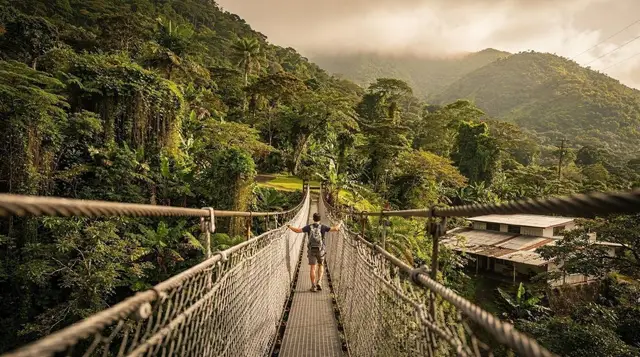
Because the waterfall visit itself only takes half a morning, most itineraries pair it with something else. A common combination is hanging bridges: Mistico Hanging Bridges, a short drive around the lake, adds elevated forest-canopy walking to a day that starts with the waterfall’s canyon-floor perspective — two very different ways of experiencing the same rainforest in a few hours. A guided Mistico Hanging Bridges tour is the straightforward way to book that second stop without arranging separate transport.
If you’re building a full first day or two in La Fortuna rather than planning stop by stop, the one-day itinerary and two-day itinerary both slot the waterfall in as a morning anchor, and how many days you actually need in La Fortuna is worth reading before you lock in flights, since most first-timers underestimate it.
Practical notes and common mistakes
A short list of the things that trip people up here, gathered from what actually goes wrong on site rather than from a generic checklist:
- Underestimating the climb back. The descent feels easy; the ascent in tropical humidity is the part that surprises people. Pace yourself, use the rest landings, and don’t schedule anything strenuous right afterward.
- Trying to swim at the base. The current under the falls is strong enough to be genuinely dangerous. The safe swimming pool is downstream, clearly marked from the main path.
- Arriving mid-morning expecting quiet. Tour buses cluster between roughly 9am and noon. Early opening or late afternoon (checking closing time first) both thin the crowd.
- Assuming it’s free or discounted for a short visit. The ADIFORT entry fee is flat regardless of how long you stay.
- Confusing it with Cerro Chato. They share a general area but are entirely separate sites; Cerro Chato’s crater lake has been off-limits to hikers since 2018.
- Forgetting cash or small USD bills. Card payment isn’t always reliable at the gate; carrying some cash avoids a wasted trip back to town.
If you’re travelling with younger children, the stairs and current change the calculus somewhat — the family-focused waterfall guide covers what ages tend to manage the descent comfortably and what to plan around instead if they don’t.
La Fortuna Waterfall FAQ
How much does it cost to visit La Fortuna Waterfall?
Entry is roughly USD 20 for adults, with reduced pricing for children, payable at the gate in USD or colones. The fee is managed by ADIFORT, the local community development association, and funds trail upkeep rather than a private operator.
Can you swim at the base of La Fortuna Waterfall?
No. The current directly beneath the falls is strong and considered dangerous; swimming there isn’t permitted. The designated swimming spot is a calmer pool a short walk downstream, reached by a marked path from the main viewing area.
How many steps are there to La Fortuna Waterfall?
Close to 500 steps down a stone and concrete staircase built into the canyon wall. Going down takes most visitors 15–20 minutes; the climb back up typically takes 25–40 minutes and is the part that catches people off guard.
Is La Fortuna Waterfall the same as Cerro Chato?
No, and they’re commonly confused. La Fortuna Waterfall is an open, paid, staircase-accessed site. Cerro Chato is a separate volcanic crater and lagoon that has been closed to hikers since 2018 due to erosion and safety concerns.
How long should I plan for a visit?
Around 1.5 to 2.5 hours on site, including the descent, time at the bottom, and the climb back up — not counting transport to and from La Fortuna town, which adds another 20–30 minutes round trip by car.
Is La Fortuna Waterfall worth visiting in the green season?
Yes. The rainforest around it stays humid year-round regardless of season, and the falls run strong through the green season (May–November). Water clarity is generally best in the December–April dry season, but the waterfall itself doesn’t dry up or lose its drama the way some seasonal attractions do.
Do I need a guide to visit La Fortuna Waterfall?
No — it’s a self-guided site with a clear staircase and marked paths, well suited to independent visitors. A guide adds value mainly for wildlife spotting along the trail rather than for navigating the waterfall itself.
Is there parking at La Fortuna Waterfall?
Yes, a small paid parking area sits at the entrance near the ticket office. It’s convenient but limited, and fills up by mid-morning on busy days, so an early arrival helps with parking as well as crowds.