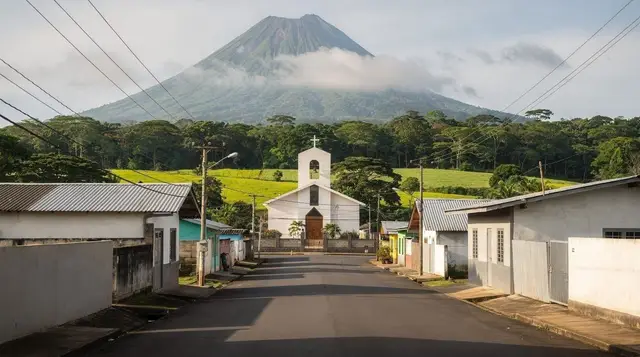
La Fortuna Waterfall: The Complete Guide to Catarata Río Fortuna
Can you swim under La Fortuna waterfall?
No. The current at the base of the 70-metre drop is strong and swimming there is not permitted. The designated swimming area is a calmer pool downstream, reached by following the marked path past the base of the falls.
Catarata Río Fortuna, step by step
The waterfall everyone in La Fortuna means when they say “the waterfall” is Catarata Río Fortuna, a single drop of roughly 70 metres into a narrow, forested canyon a few kilometres outside town. It isn’t the tallest or the most remote waterfall in Costa Rica, and it doesn’t need to be — it’s close, it’s reliably running, and it’s the one attraction in this part of the country that almost every visitor manages to fit in, whether they’re here for one night or ten.
It is also, by most measures, the most photographed single feature in the region, which means it’s also the most misunderstood. People arrive expecting to swim under the falls, to find a quiet spot to themselves, or to treat the walk down as a formality. None of those expectations quite hold up, and this guide exists to sort out what actually happens once you’re standing at the top of those steps.
The 500 steps: what the descent and climb are really like
The path from the entrance to the river follows a long staircase — commonly quoted at around 500 steps — cut into the side of the canyon and shaded by forest most of the way. Going down is the easy part: it’s steep in sections, but gravity is doing the work and the steps are solid, with handrails and landings to break up the descent.
The climb back up is the part people underestimate. It’s the same 500 steps in reverse, in the heat and humidity of the northern lowlands, usually after you’ve already spent time swimming and are carrying wet gear. Give yourself more time for the return than you think you need, and plan for a few stops along the way — there’s no shame in it, and most people are doing the same thing.
A few practical notes that make the difference between an easy visit and a miserable one:
- Wear proper shoes with grip, not sandals. The steps get wet from spray near the bottom, and loose flip-flops on a wet staircase are a common way to twist an ankle.
- Carry less than you think you need. A dry bag with a phone, a bit of cash, and a towel is plenty. Leave the rest at your hotel or in the car.
- Go early. Morning light is better for photos, the staircase is cooler, and you’ll share the trail with fewer people than you will by mid-morning.
- Pace the climb. There’s no rush, and the handrails and landings are there to be used.
Where you can — and can’t — swim
This is the single most important thing to get right before you go: you cannot swim directly under the waterfall. The point where the water lands after a 70-metre fall generates a current strong enough to be genuinely dangerous, and it isn’t a matter of caution signage being overcautious — people have been swept and injured there. It is not a spot for photos-in-the-spray, and it is not a spot to wade into “just for a second.”
The designated swimming area is a pool downstream, reached by following the marked path a short distance past the base of the falls, where the water has slowed and pooled. That’s where nearly everyone actually swims, and it’s a genuinely pleasant spot — cool river water, the waterfall still visible and audible from a safe distance, and rocks to sit on. Staff and signage mark the boundary; stay on the visitor side of it.
If a guide, another visitor, or your own instinct suggests getting closer to the base “for a better angle,” treat that as the moment to stop and reconsider, not proceed. The current near the impact zone doesn’t announce itself as dangerous until it already is.
Tickets, hours, and who actually runs it
Unlike some of the area’s paid attractions, which are private hot spring resorts or hanging bridge companies, Catarata Río Fortuna is managed by ADIFORT, La Fortuna’s community development association. The entrance fee, paid per person at the gate, funds trail maintenance and staffing rather than a corporate operator — worth knowing if you’d rather your money stay closer to the town it comes from.
Fees are quoted in USD, in line with most paid attractions around La Fortuna, and are payable in cash or by card at the entrance; bring smaller denominations where you can, since large bills aren’t always convenient to break at a park gate. There’s no advance online booking required for independent visits — you simply arrive during opening hours and pay at the entrance — though tour groups often bundle the entrance fee into a package price.
Basic facilities — restrooms, a snack stand, and parking — are available near the entrance, but there’s little in the way of shade or shelter down at the river itself, so plan around the weather rather than counting on cover.
Getting there from La Fortuna
The waterfall sits a short drive from La Fortuna town centre, close enough that many visitors combine it with other stops on the same road. If you’re staying in town without a car, taxis and shuttle services run the route regularly, and it’s a common stop on combined tours that also cover hanging bridges, hot springs, or wildlife walks. If you’re self-driving, the access road is paved and well signed, with parking at the entrance — see our notes on renting a car for La Fortuna and getting around without one if you haven’t decided how you’ll get around yet.
Because it’s this close and this straightforward to reach, the waterfall is one of the easiest things to slot into even a single day in the area — see our one day in La Fortuna and two days in La Fortuna itineraries for how it fits alongside hot springs, hanging bridges, or a night walk, and how many days in La Fortuna if you’re still working out your overall trip length.
Tours that include the waterfall
Plenty of visitors do the waterfall as a standalone, independent visit — pay at the gate, walk down, swim, walk up, done. But if you’d rather have transport sorted and the visit bundled with other stops, several guided options run through La Fortuna.
a guided half-day trip to the waterfall with transport included is the straightforward option if you want the logistics handled without adding much else to the day. For a longer outing that pairs the falls with a look at local farm life and a meal afterwards, a waterfall hike combined with a farm visit and lunch stretches the visit into a fuller half-day.
If you’d rather combine the falls with a chance at spotting wildlife on the same outing, a guided sloth and monkey spotting walk elsewhere in the area pairs well as a second activity on the same day, before or after the waterfall.
None of these are the only way to see the falls — an independent visit with your own transport works just as well and costs less — but they’re worth considering if you’d rather not manage the driving, timing, and ticket queue yourself. For more on how these bundled outings work in general, see our guide to combo tours in La Fortuna and the best combo tour for a single day.
Combining it with the rest of your day
Because the visit itself — walk down, swim, walk up — takes a couple of hours at most, most people pair it with something else nearby rather than treating it as a half-day on its own. A hot spring soak afterwards is the classic pairing: the free river at El Choyin is one option if you’re keeping costs down (see our free hot springs guide), while our hot springs comparison guide covers the paid resorts if you’d rather have facilities and a full pool complex.
If you’re travelling with children, worth reading first is our dedicated waterfall guide for families, which goes into more detail on the steps, the swimming area, and what to expect managing kids on a staircase in the heat. And if you’re trying to avoid the common missteps first-timers make around La Fortuna generally, our travel mistakes to avoid guide covers more ground than just the waterfall.
What this waterfall isn’t — and where to find the alternatives
Catarata Río Fortuna is the closest, easiest, most visited waterfall in the area, and that’s exactly why it isn’t the right stop if you’re after something quieter or less developed. It gets busy, especially mid-morning through early afternoon, and the infrastructure — staircase, entrance building, snack stand — reflects how many people pass through it daily.
If you want a sense of the other waterfalls closer to La Fortuna and how they compare on crowds, access, and cost, our waterfalls near La Fortuna compared guide lays them out side by side rather than repeating that comparison here. For visitors extending toward Guanacaste, La Leona waterfall is a quieter, less developed alternative near Rincón de la Vieja, and on the way toward San José, La Paz Waterfall Gardens is a very different, more built-up experience with multiple falls and an attached wildlife park — worth knowing about, but not something this guide re-covers in depth here.
Weather, seasons, and when to actually go
The falls run year-round regardless of season, fed by a watershed that rarely dries out completely even in the driest months. What changes with the season is less the waterfall itself and more your experience getting to and from it. Dry season, roughly December through April, means a more comfortable staircase climb and clearer photos, but also more visitors on the busiest days.
Green season, May through November, brings afternoon downpours more often than not — La Fortuna sits on the wet, windward side of the country and gets rain through most of the year regardless of season, usually concentrated in the afternoon. A morning visit sidesteps most of that, and the forest around the canyon looks noticeably greener and fuller after rain. See our guides on the best time to visit La Fortuna and visiting in green season for the wider picture, and planning around rainy afternoons if you’re building out a longer itinerary around the region’s rain patterns.
Catarata Río Fortuna: frequently asked questions
Can you swim directly under the waterfall?
No. The current where the water lands after the 70-metre drop is strong enough to be dangerous, and swimming there is not permitted. Everyone swims in the calmer pool a short walk downstream, where staff and signage mark the safe swimming area.
How many steps are there, and how hard is the walk?
Around 500 steps, mostly a staircase through forest down to the river. The descent is the easy half; the climb back up the same steps afterwards, often while tired and carrying wet gear, is the part that catches people out.
Is the trail suitable for kids or older visitors?
It’s manageable for reasonably fit visitors of most ages, but the steps are steep and can be slippery near the bottom where spray reaches the trail. Build in extra time and rest stops rather than rushing it, especially with children — see our dedicated guide on visiting with kids for more specifics.
How much does it cost to enter, and who runs it?
Entry is managed by ADIFORT, La Fortuna’s community development association, and paid per person at the gate — in the same moderate range as other paid attractions around town, quoted in USD. It isn’t a private resort or tour-company operation.
What’s the best time of day to visit?
Early morning, ideally close to opening, before tour groups arrive and while the staircase is still cool to climb. Afternoons are busier and hotter, particularly in dry season.
Does rain affect the waterfall or the visit?
The falls run year-round and often look fuller after rain. What changes is the walk itself — afternoon downpours are common from May through November, so a morning visit is the more comfortable choice regardless of season.
Can the waterfall be combined with other stops on the same day?
Yes, easily. Most visitors pair it with a hot spring soak, a hanging bridges visit, or a wildlife walk on the same day, since the waterfall itself only takes a couple of hours. See our one- and two-day itineraries for how it fits alongside other stops in the area.
Waterfalls on GetYourGuide
Verified deep-linked GetYourGuide tours. Book through these links and we earn a small commission at no cost to you.
GetYourGuide does not provide a product photo for this activity — the image shows the meeting point, photographed by us.