Getting Around La Fortuna Without a Car
Can you visit La Fortuna without renting a car?
Yes, for most of the region. Local taxis and shared shuttles cover La Fortuna town, the waterfall, the hot springs and the hanging bridges cheaply and reliably. Farther, more scattered sites like Río Celeste and Caño Negro are still reachable, but an organized day tour with transport included is usually simpler and not much pricier than piecing together transfers yourself.
Can you actually skip the rental car here?
Mostly, yes — with one honest caveat up front. Renting a car for La Fortuna is its own decision with its own trade-offs, and this page isn’t here to re-argue it. What it covers instead is what actually happens if you decide not to: which sights stay easy, which ones get harder, and which ones you should stop trying to reach on your own and just book as a tour.
The short version: the attractions clustered close to La Fortuna town — the waterfall, the hanging bridges, most of the hot springs — are genuinely simple without a car. Taxis are cheap, distances are short, and drivers know every gate and ticket booth by name. The attractions that sit far outside that cluster — Caño Negro, Río Celeste on your own timetable, a same-day loop through two or three distant parks — are a different story.
Public transport in the rural north runs on sparse, locally-known schedules that don’t show up on any app, and stitching together buses and connections can eat most of a day for a site you meant to enjoy in the morning. For those, an organized tour with transport included isn’t a fallback for people without a car — it’s usually the smarter choice even for people who have one.
The three ways to get around without driving
Three options cover almost everything: local taxis, shared shuttle vans, and day tours that include transport as part of the ticket price. Each has a role.
Local taxis
Red official taxis (and a smaller fleet of grey ones licensed for rural routes) work well for anything within a 20-minute radius of town: the La Fortuna Waterfall, Tabacón, the Mistico Hanging Bridges, or a quick run out to the free hot river at El Choyin.
Fares aren’t always metered outside town, so agree the price before you get in — drivers are used to the question and won’t be offended by it. Hotels and the tourist information kiosks in town can also arrange a taxi with a fixed round-trip rate, including a wait while you’re inside a park, which is often the cleanest way to do a single attraction on your own schedule.
| Trip from La Fortuna town | Typical one-way fare (USD) |
|---|---|
| Within town | 2 – 4 |
| La Fortuna Waterfall | 8 – 12 |
| Tabacón / Baldi area | 8 – 15 |
| Mistico Hanging Bridges | 10 – 15 |
| El Castillo | 15 – 20 |
| Arenal Observatory Lodge area | 15 – 20 |
These are rough, cash-negotiated figures, not a fixed tariff — expect some variation by driver and by season.
Shared shuttle vans
For longer hops between hubs — La Fortuna to Monteverde, La Fortuna to Liberia or San José — shared shuttle companies run scheduled minivans that pick up at hotels and drop at hotels on the other end. They’re slower than a private transfer because of the extra stops, but they cost a fraction of one, and for Monteverde specifically the shared jeep–boat–jeep crossing is the standard, sensible way to make the trip.
See jeep-boat-jeep versus driving to Monteverde for the full comparison — the short version is that the boat crossing takes about 3 hours against 3.5–4 hours of mostly unpaved road, and it costs noticeably less than either a rental for that single leg or a private transfer.
| Route | Shared shuttle | Approx. time | Approx. cost (USD) |
|---|---|---|---|
| La Fortuna → Monteverde/Santa Elena | Jeep–boat–jeep | ~3 h | 30 – 45 |
| La Fortuna → San José (SJO) | Van | ~3 h | 20 – 45 |
| La Fortuna → Liberia (LIR) | Van | ~2.5 – 3 h | 25 – 50 |
| La Fortuna → Manuel Antonio | Van, often with a transfer | 4.5 – 5.5 h | 40 – 65 |
If your route runs further afield — down to the Pacific coast rather than between the northern hubs — a private door-to-door transfer can be worth the extra cost for the time it saves, and is arranged the same way as a shuttle, just for one party instead of a shared van: a private transfer between Manuel Antonio and La Fortuna is the kind of route where a shared van’s extra stops start to cost you real hours.
The same logic applies heading the other direction, toward the Caribbean side: a private transfer from La Fortuna to Guápiles skips the connections a public route would otherwise require.
Organized tours with transport included
This is the option that actually unlocks the far-flung sites. A tour that includes hotel pickup, a driver who knows the roads, and drop-off at the end of the day removes the single biggest obstacle to visiting places like Río Celeste or Caño Negro without a car: the fact that no direct public transport serves them well, and taxiing there and back on your own would cost more, in both money and hours, than the tour itself.
For Río Celeste, that means booking a day tour rather than trying to arrange your own taxi and park-entrance timing: a guided day trip to Río Celeste and Tenorio National Park handles the drive, the park logistics, and the return trip in one booking.
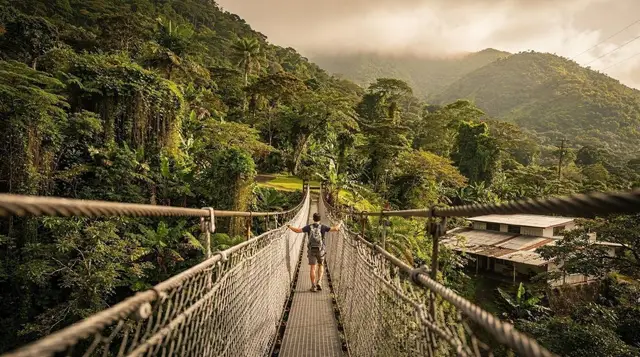
For the hanging bridges and the region’s floating-river wildlife circuit, a tour bundles transport with the activity itself: a half-day guided walk across the Arenal hanging bridges or, if you’d rather combine the bridges with a river float and lunch, a combined safari float and hanging bridges tour with lunch included covers both without you arranging separate transport for each. For the Caño Negro area, a wildlife-focused boat tour out of Bijagua works the same way: a floating wildlife boat tour near Bijagua gets you onto the water without a rental car or a multi-leg bus connection.
What’s easy without a car
If your plan stays close to town, you won’t miss a rental car at all. The La Fortuna Waterfall, the Mistico Hanging Bridges, most of the hot springs, and the town centre itself with its restaurants and shops are all a short, cheap taxi ride apart. Several tour operators also run their own shuttle service between the main hot spring resorts and hotels in town, so even a soak at Tabacón or Baldi doesn’t require arranging your own transport. This cluster is genuinely the easiest part of Costa Rica to see car-free.
What stays hard: Caño Negro and Río Celeste on your own
Be realistic about this one, because a lot of trip-planning content glosses over it. Caño Negro has no direct public bus from La Fortuna — you’d be routing through Los Chiles with connections that don’t line up conveniently with a single day trip, and once there you’d still need transport to the boat launch itself. Attempting the wetlands in a day without a booked tour is a real gamble on wasted hours. The organized boat safari isn’t there because independent access is impossible; it’s there because independent access is inefficient enough that almost nobody actually does it that way, car or no car.
Río Celeste is a notch easier — there is some public transport toward Bijagua — but the schedule is sparse, the connection from the bus stop to the park entrance still needs a taxi, and the park itself limits daily entries and closes the trail access point in the mid-afternoon. Trying to self-arrange this trip without a car means gambling your one shot at the turquoise water on a bus timetable that might not cooperate.
If you want to compare the logistics side by side with a car, the Río Celeste day-trip guide and the Caño Negro day-trip guide both lay out the driving option too — but for a car-free visit, the tour is the sensible route, not a consolation prize.
The honest takeaway: don’t let a guide (this one included) talk you into believing car-free means access to everything. It doesn’t. It means access to almost everything close in, and access to the far-flung sites through a different door — a booked tour instead of your own steering wheel.
A sample three-day, car-free plan
| Day | Plan | How you get there |
|---|---|---|
| 1 | Arrive, settle into town, evening soak | Airport shuttle in; taxi to hot springs |
| 2 | Waterfall in the morning, hanging bridges in the afternoon | Taxi both ways |
| 3 | Río Celeste day trip | Organized tour with pickup and return |
Swap day 3 for the Caño Negro boat safari, or split it across a longer stay if you have more time — see how many days in La Fortuna if you’re still working out your trip length. If you’re arriving without a car from the start, check getting from SJO to La Fortuna or getting from LIR to La Fortuna for the first leg, since that shuttle or transfer booking is worth arranging before you land rather than after.
Keeping costs down
Taxis and shuttles add up fastest when you book each leg separately at the last minute. A few things that help: ask your hotel to negotiate a fixed round-trip taxi rate rather than paying two separate one-way fares, favor shared shuttles over private transfers whenever your schedule allows the extra stops, and bundle activities into a single tour (like the hanging bridges plus a river float) rather than paying for transport twice. For a fuller breakdown of what a car-free week actually costs against renting, see La Fortuna on a budget.
Getting to La Fortuna without a car — frequently asked questions
Do I need a car to visit La Fortuna?
No. Taxis and shared shuttles handle the town, the waterfall, the hanging bridges and the hot springs without trouble. A car mainly saves time and gives you flexibility for early starts, not access you would otherwise lack.
How do I get to Río Celeste without driving?
A day tour from La Fortuna is the practical option. Public transport to Bijagua exists but runs on a sparse schedule and still leaves you needing a taxi to the park entrance, so most car-free visitors book a tour with pickup and transport included.
Is Caño Negro reachable by public transport?
Barely, and not comfortably. There is no direct bus from La Fortuna, so you would need to connect through Los Chiles with long waits. A guided boat safari that includes transport from La Fortuna is the realistic way to see Caño Negro in a single day.
How much does a taxi cost around La Fortuna?
Short hops within town run about 2 to 4 USD. Trips to nearby attractions like the waterfall or Tabacón are roughly 8 to 15 USD one way. Always agree the fare before getting in, since meters are not consistently used outside town.
Are there shared shuttles between La Fortuna and Monteverde?
Yes, and the shared jeep-boat-jeep crossing is the standard way to make that trip without a car. It takes about 3 hours, crosses Lake Arenal by boat, and costs a fraction of a private transfer or the driving alternative.
Can I do everything in the region without a car?
No, and be wary of anything that claims otherwise. Central sights are easy without a car. Outlying ones like Caño Negro, Río Celeste on your own schedule, or a same-day loop through several distant parks are genuinely harder, and an organized tour is often the more sensible choice, not a compromise.
Is it cheaper to rent a car or use taxis and tours?
For a short stay focused on the core sights around La Fortuna, taxis and tours usually come out similar in cost to a rental once you add insurance, fuel and parking. A car pays off mainly if you are combining several regions over a longer trip.
Transfers and transport passes on GetYourGuide
Verified deep-linked GetYourGuide tours. Book through these links and we earn a small commission at no cost to you.
GetYourGuide does not provide a product photo for this activity — the image shows the meeting point, photographed by us.