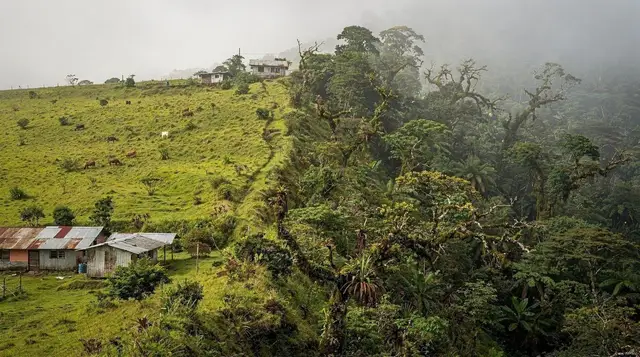
Most travelers arrive in Monteverde expecting a jungle and get something closer to a mountain village wrapped in fog. That’s not a downgrade from La Fortuna — it’s a genuinely different Costa Rica, cooler, quieter, and built around a very different kind of tourism.
From Alabama dairy farmers to cloud-forest gateway
Monteverde’s story doesn’t start with ecotourism. In 1951, a group of Quakers from Fairhope, Alabama left the United States, partly to avoid military conscription and partly drawn by Costa Rica’s decision three years earlier to abolish its army altogether. They bought land on a remote, roadless ridge above the Pacific slope, at around 1,400 m elevation, and set up dairy farms — the Monteverde Cheese Factory (Productores de Monteverde) is a direct descendant of that first community and still operates today.
It was this same Quaker community, working with visiting biologists in the 1970s, that began setting aside forest rather than clearing it — land that eventually became the reserve system the region is known for. The tourism that followed came later, once biologists and birders started publishing what they were finding in the mist above the farms. The town itself grew almost by accident around that attention.
That history matters for how you should think about a visit. Monteverde isn’t a purpose-built resort zone; it’s a working agricultural community that absorbed a large tourism economy on top of dairy farms, family land, and a school that still runs one of the two big reserves. The pace and the infrastructure both reflect that — narrow roads, small-scale lodges, and a town center that’s still recognizably a village.
Getting here from La Fortuna: road or water
There is no shortcut between La Fortuna and Monteverde — both routes take roughly the same time, for different reasons.
| Route | Time | Notes |
|---|---|---|
| Jeep-boat-jeep | ~3 hours | Minibus to Lake Arenal, boat across, minibus into Santa Elena |
| Driving (Route 702) | 3.5–4 hours | ~130 km, much of it unpaved, several one-lane bridges |
The jeep-boat-jeep crossing crossing is the route most independent travelers without a rental car choose — it’s usually cheaper than a private transfer and breaks the trip into three manageable legs instead of one long drive. We cover the crossing itself, operators, and what to expect on the boat in a dedicated guide, so we won’t repeat it here — see our jeep-boat-jeep versus driving comparison if you’re still deciding.
If you’re driving, know what you’re signing up for. Route 702 is unpaved for long stretches, and a standard sedan can manage it in dry season with care. From May to November, ruts fill with water and the surface turns to mud in places — a 4x4 stops being optional and starts being sensible. You’ll also cross several one-lane bridges typical of Costa Rica’s back roads: whoever reaches the “CEDA EL PASO” sign yields.
Either way, budget the better part of a travel day for this leg. Trying to squeeze Monteverde into a single day out of La Fortuna means roughly 6 hours on transfers for a handful of hours on the ground — doable, but not comfortable. See our Monteverde day-trip guide if that’s genuinely your only option, and our La Fortuna and Monteverde itinerary if you can spare a night or two instead.
Monteverde and Santa Elena: two villages, one destination
Ask for directions to “Monteverde” and you’ll usually end up in Santa Elena — the two have grown into each other, but they aren’t the same place. Santa Elena is the busier, lower town: most of the hotels, hostels, restaurants, tour desks, and the main bus terminal are here. Monteverde proper sits further up the hill, quieter and more spread out, closer to the older of the two big reserves and to the dairy cooperative that gave the area its start.
Most visitors base themselves in Santa Elena for the restaurants and easy walking access to town, then take short taxi or shuttle rides up to whichever reserve or activity they’ve booked for the day. Distances between the two aren’t far — a few kilometres — but the roads are narrow, unlit at night, and not really built for casual walking after dark.
The cloud forest, in outline
Monteverde’s reputation rests on its cloud forest — a habitat that forms where moist air off the Caribbean condenses against the mountains, keeping the canopy wrapped in mist for much of the year. The result is a dense, epiphyte-heavy forest that looks and sounds different from the lowland rainforest around Arenal: cooler, quieter underfoot, louder overhead with bird calls.
There are several protected areas to choose from, each with its own entrance, trail system, and personality — the Monteverde Cloud Forest Reserve, the community-run Santa Elena Reserve, the smaller and often quieter Curi-Cancha Reserve, and the Children’s Eternal Rainforest, the largest private reserve in the country. We compare them in detail — trail length, crowd levels, wildlife odds — in a separate reserve-by-reserve guide, since picking the right one matters more than most visitors expect.
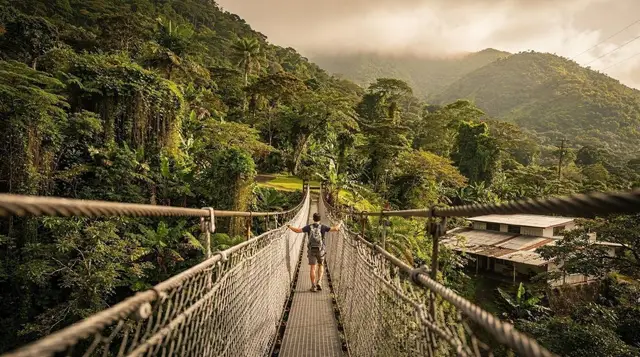
Beyond the reserves themselves, Monteverde has built a second layer of attractions around the same canopy: hanging bridge networks, zipline canopy tours, and guided night walks that go looking for what the daylight trails miss.
For an elevated walk through the canopy without a hike, an operator like Monteverde’s Skywalk hanging bridges route puts you well above the forest floor on a series of suspended walkways, a different vantage point from the Monteverde Sky Walk trail system itself. If you’d rather stay on the ground with a naturalist pointing things out, a private guided afternoon nature walk tends to turn up far more wildlife than walking the trails alone — local guides know where the sloths and mixed feeding flocks tend to sit.
Nights work differently here than in La Fortuna’s lowland forest, but the logic is the same: many species only show themselves after dark. A private night wildlife tour is the standard way to look for kinkajous, olingos, sleeping birds, and the frogs and insects that the daytime trails miss entirely.
For travelers who want zip-lining alongside the wildlife focus, Monteverde is where the format started in this country — The Original Canopy Tour runs on the site of the country’s first commercial zipline. If canopy adventure is the main draw for your visit rather than a side activity, our ziplining in La Fortuna guide and its Monteverde equivalents are worth reading side by side before booking, since the two towns’ offerings differ in length and setting.
Wildlife rescue is also part of the Monteverde circuit: a visit to a place like the NATUWA sanctuary conservation tour gives close, guaranteed views of rescued sloths, monkeys, and birds that can’t be released — a useful complement to wild sightings, which are never guaranteed on a forest trail.
The quetzal question
The resplendent quetzal is Monteverde’s headline bird, and also its most overpromised one. Every tour desk in Santa Elena has a photo of an iridescent green-and-scarlet male with its long tail streamers, and it’s tempting to assume a walk in the reserve makes a sighting likely. It doesn’t, at least not year-round.
Quetzals follow the fruiting cycle of wild avocado trees, and their breeding season concentrates activity from roughly February through July — outside that window, they range more widely and turn up far less predictably. A guide who tells you a sighting is close to guaranteed in, say, October is either misinformed or managing your expectations badly.
If you’re building a trip specifically around this bird, aim for the February–July window and still treat a sighting as a highlight rather than an assumption. Our birdwatching guide for Monteverde and the surrounding area covers other resident species worth watching for regardless of season — motmots, hummingbirds, bellbirds, and the mixed flocks that move through the canopy most mornings.
How long to stay, and what it costs
A single night is workable if Monteverde is a brief detour on a wider loop, but two to three nights fit the destination better. That gives you one day for a reserve or hanging-bridge walk, one evening for a night tour, and a spare half-day for either a canopy activity or simple downtime in Santa Elena — without stacking everything around the long transfer in and out.
Costs run a bit higher here than in La Fortuna proper, largely because reserve entries, guided walks, and canopy tours are priced individually rather than bundled.
| Expense | Typical range (USD) |
|---|---|
| Reserve or hanging-bridge entry | 20–35 per person |
| Guided walk or night tour | 25–55 per person |
| Canopy/zipline tour | 45–75 per person |
| Simple lodging (per night) | 40–100 |
| Meals (day, mid-range) | 25–40 per person |
Budget travelers can trim this by choosing one reserve rather than several and skipping a private guide in favor of a scheduled group walk, though a guide’s trained eye is genuinely the difference between seeing wildlife and walking past it. For a fuller breakdown, see what a week in La Fortuna really costs for context on regional pricing, and our guide to La Fortuna on a budget for trade-offs that apply just as well up here.
Weather and what to pack
Cloud forest means cloud forest in every month — mist, drizzle, and a fine, wind-driven rain locals call “bajareque” are normal even in the supposed dry season of December to April. Temperatures sit in the 16–22°C (61–72°F) range during the day and drop further at night, cool enough that La Fortuna’s warm-weather packing list falls short. Bring a light rain jacket, a fleece or warm layer, and shoes with real grip — reserve trails get slick with moisture regardless of the calendar.
December through April is still the better window for trail conditions and visibility, and it overlaps usefully with the quetzal season from February onward. May through November brings heavier rain and lower cloud ceilings, but also thinner crowds at the reserve entrances and a forest arguably closer to its natural state.
Comparing Monteverde to the rest of your trip
Because the transfer costs a real chunk of a Costa Rica itinerary, it’s worth being honest about what Monteverde adds versus other stops reachable from La Fortuna. If your main interest is wildlife density and turquoise water rather than cool cloud forest, Río Celeste sits closer and delivers a very different, equally photogenic landscape in about half the travel time. Our La Fortuna versus Monteverde and La Fortuna versus Río Celeste comparisons lay out the trade-offs directly if you’re deciding between the two rather than doing both.
For travelers who do have the days, pairing La Fortuna’s hot springs and volcano scenery with Monteverde’s cool, misty forest gives a genuinely different picture of the country in the space of a week — heat and lowland jungle on one side, altitude and cloud forest on the other, linked by a lake crossing that’s an experience in its own right. Whichever way you arrive, give the destination more than a rushed afternoon: the fog that makes Monteverde what it is rarely lifts on a schedule.