What to Bring on a Night Walk in La Fortuna
What should I actually bring on a night walk in La Fortuna?
Bring closed, sturdy shoes (never sandals), your own headlamp as backup to your guide's light, and insect repellent for mosquitoes and sandflies. Add long trousers and a light rain layer, because night walks go ahead even after a downpour.
Packing for the Dark Isn’t the Same as Packing for the Day
A night walk is the one activity in La Fortuna where the wrong gear turns a good evening into a miserable one, or occasionally a dangerous one. Daytime hikes here are forgiving: trainers get you most places, and a missed step usually just means a wet sock. After dark, the calculus changes. You can’t see the root you’re about to trip on, the frog you’re trying not to step near, or the snake that would much rather you didn’t come within a metre of it. This guide covers exactly what to bring, what your operator is likely to supply already, and the one mistake — sandals — that shows up in reviews of nearly every night walk in La Fortuna at least once a season.
It’s written as a standalone reference. If you’ve already read up on a specific reserve, like Ecocentro Danaus or Arenal Natura, this page won’t repeat what those trails look like — it only covers what to put in your bag before you go, whichever reserve you end up booking.
Footwear: the One Item That Isn’t Optional
Start here, because it matters more than everything else on this list combined. Wear closed, sturdy shoes that cover the ankle: trail shoes, light hiking boots, or at minimum a pair of trainers you don’t mind getting muddy. Sandals, flip-flops, and open-toed shoes of any kind are off the table, and a guide who takes their job seriously will say so before you set off.
Two separate risks are stacked here. The first is simply the terrain: unlit trails with tree roots, loose volcanic stone, wooden boardwalks that can be slick with dew, and the odd stream crossing. A twisted ankle is the most common injury on any Costa Rican night tour, and it’s almost always someone in open shoes.
The second risk is the one operators mention more carefully: this region is fer-de-lance (terciopelo) habitat, a pit viper responsible for most snakebites in Costa Rica, and it is more active at night than during the day. Guides know where to look and how to walk, and serious incidents are rare precisely because everyone follows the same basic rule — feet stay covered, hands stay off vegetation you can’t see clearly. It is not a rule you want to be the exception to. If you’re weighing this trip against a family-friendly daytime option instead, the Bogarín Trail and its family sloth walk are a useful comparison for what changes once the sun is up.
Your Own Headlamp, Even If the Guide Brings One
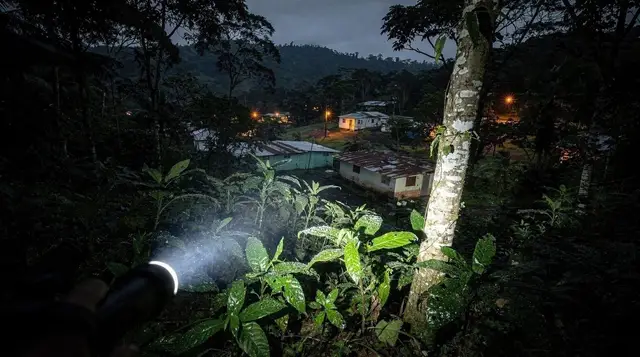
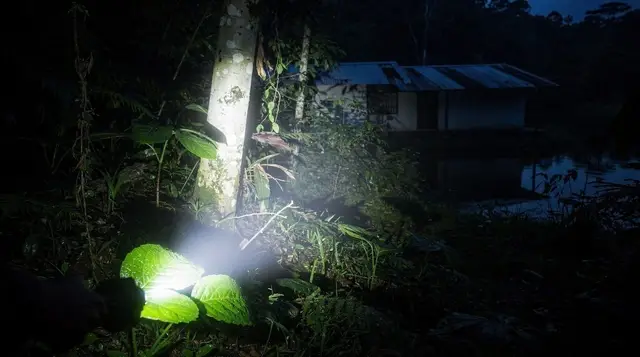
Almost every operator supplies lighting, usually one flashlight or headlamp shared between two or three guests, sometimes one per group led by the guide. That’s enough to follow the trail safely, but it is not enough to actually see well. Wildlife spotting at night is a game of catching eye-shine — the reflection of light off an animal’s eyes from twenty or thirty metres away — and that only works if you have your own beam pointed roughly where you’re looking.
A basic headlamp costs very little and solves three problems at once: it frees both hands for the suspension bridges and handrails you’ll cross on several routes, it means you’re not waiting your turn to borrow the group light, and a model with a red-light mode is genuinely useful, since red light disturbs nocturnal animals far less than white light and won’t wreck everyone else’s night vision every time you switch it on. If you only pack one extra item for this trip, make it this one.
Leave the powerful 1000-lumen camping torch at home, though. It’s overkill for a guided walk, heavy in a daypack, and a blinding light swept across a tree is a good way to send a nesting bird or a sleeping bat straight off its perch before your guide even points it out.
Insect Repellent: Dengue Is a Green-Season Reality Here
Costa Rica’s northern lowlands, La Fortuna included, see dengue transmitted by mosquitoes, particularly during green season from May to November when standing water is more common. Night walks push you straight into peak mosquito hours: the hour around dusk, and the damp, still air of forest-edge trails after dark.
A repellent containing DEET or picaridin, applied to any exposed skin before you leave your accommodation, is the simplest thing on this list and the easiest to forget. Reapply if the walk runs past ninety minutes or if you’ve been sweating heavily in the humidity. It’s also worth packing a small bottle rather than counting on your hotel gift shop having stock — some do, many don’t, and the pharmacy in town closes earlier than you’d expect.
This isn’t a reason to stay indoors. It’s a five-minute step before you leave, the same as sunscreen during the day, and it removes the single most avoidable discomfort of an evening in the forest.
Clothing: Layers for a Canyon That’s Warmer Than You Think
La Fortuna sits at roughly 250 metres of elevation in the northern lowlands, so evenings stay warm and humid rather than cold — this isn’t Monteverde, where a fleece earns its place after dark. What you want instead is coverage: light, long trousers and a long-sleeved top made from a breathable fabric. That combination does double duty, cutting down mosquito bites and protecting your skin from stinging nettles, thorny palms, and rough bark along narrower sections of trail, without leaving you overheating in the humidity.
Pack a thin rain jacket regardless of the forecast. La Fortuna sits on the windward side of the country, and rain here isn’t seasonal so much as a daily possibility — even in dry season, and especially from September through November. A shower that starts twenty minutes into a night walk rarely ends the tour; it just means everyone who packed a jacket stays comfortable and everyone who didn’t gets a soggy reminder for next time. If you’re planning your trip dates around this, the guides to green season and the best time to visit go into more detail on what each month actually looks like on the ground.
Small Extras Worth the Pocket Space
A short list of items that aren’t essential but consistently earn their place in a daypack:
- A dry bag or ziplock for your phone. Even a light shower can catch a phone left in an open pocket, and condensation from the humidity alone is enough to fog a lens.
- A reusable water bottle. Most tours run 1.5 to 2 hours; the humidity means you’ll want it even after dark, and only a handful of reserves sell drinks on site.
- Cash in small denominations. Bathroom facilities and any post-walk snack stand at smaller reserves rarely take cards, and 5,000-colón notes are easier to break than a 50-dollar bill.
- A light backpack, not a shoulder bag. You want both hands free on bridges and uneven steps.
- A spare set of dry socks in the car or hotel room. Trails can be damp underfoot even without rain, from dew and stream crossings.
What to Leave at the Hotel
A few items that sound sensible but tend to be more trouble than they’re worth: strong perfume or scented sunscreen, which can affect how wildlife behaves around the group; loose jewellery that catches on vegetation; and large camera bags with tripods, which slow the group down on narrow boardwalks. If photography matters to you, a compact camera with a fast lens or a phone with a steady grip, paired with your own light source, will get you further than heavier gear you can’t comfortably carry one-handed.
Night Walk Packing List at a Glance
| Item | Why | Provided by most operators? |
|---|---|---|
| Closed, sturdy shoes | Terrain + fer-de-lance risk | No, always bring your own |
| Headlamp (ideally red-light mode) | Wildlife spotting, free hands | Shared group light only |
| Insect repellent (DEET/picaridin) | Dengue risk in green season | Rarely |
| Long trousers, long sleeves | Bites, scratches, thorns | No |
| Light rain jacket | Rain can start any evening | No |
| Dry bag or ziplock for phone | Humidity, rain, stream crossings | No |
| Water bottle | 1.5–2 hour walks in humidity | Sometimes |
| Small cash | Facilities, snacks | — |
Choosing a Night Walk to Bring This Gear To
Once your bag is sorted, the remaining decision is which walk to book. A few options differ mainly in setting and how much walking is involved:
For a classic private-reserve route with a small group and a strong focus on frogs, insects, and snakes spotted at close range, the Costa Rica Night Walk Tour in La Fortuna is the most straightforward starting point. If spotting a wider range of animals — sloths, kinkajous, owls — matters more to you than insect detail, the La Fortuna night walk built around wildlife spotting leans that way instead.
And for something further afield with fewer crowds, the night walk inside Juan Castro Blanco National Park trades convenience for a genuinely wilder patch of forest, at the cost of a longer drive each way.
Every one of these routes uses the same gear list above — the differences are in terrain and target species, not in what you need to pack. For a fuller comparison of what each reserve specialises in spotting, see the guide to wildlife spotting in La Fortuna, and if bioluminescent fungi or insects are on your list specifically, the glow-in-the-dark and bioluminescence guide covers which walks are more likely to show it and which mostly don’t.
A Note on Managing Expectations
None of this gear guarantees a great sighting. Frogs, snakes, and sloths don’t work to a schedule, and a quiet night happens even to experienced guides. What good gear does guarantee is that you’re comfortable and safe enough to actually enjoy two hours in the forest regardless of what turns up, which is really the point. For a broader sense of what tends to go wrong on a first Costa Rica trip beyond just packing — overbooking days, underestimating drive times, skipping the free hot springs in favour of the paid ones — the guide to travel mistakes to avoid in La Fortuna is worth a read before you finalise your itinerary.
If wildlife is the main reason you’re visiting this part of Costa Rica at all, it’s also worth building a night walk into the itinerary early rather than as an afterthought — see the La Fortuna for wildlife itinerary for how other travellers have sequenced it against daytime activities.
For most visitors, one properly equipped night walk is enough: an hour or two in closed shoes, a headlamp of your own, and repellent already on your skin before you reach the trailhead in La Fortuna town centre or wherever your reserve pickup point is. Everything else on this list is a comfort upgrade. Those three are not optional, and skipping them is the single most common regret mentioned in reviews of every operator running night tours in the area.
If you’d rather understand what a particular reserve or operator actually does on the ground before deciding what to bring, the Ecocentro Danaus and Arenal Natura destination pages, along with the dedicated Arenal Natura night tour guide, cover the sites themselves, and the what seeing a sloth actually means field note is worth a read if a guaranteed sloth sighting is what you’re hoping for — it isn’t one, on any tour, day or night.
FAQ: Gear and Safety for a La Fortuna Night Walk
Does the guide provide a headlamp, or do I need my own?
Most operators hand out a shared flashlight or headlamp at the start, but it is usually one per small group, not one per person. Bringing your own means you are not stuck staring at someone else’s beam, and you can keep both hands free for the suspension bridges and uneven ground.
Why can’t I wear sandals or flip-flops on a night walk?
The trails are unlit, often muddy, and cross tree roots and loose stone. La Fortuna’s forests are also fer-de-lance (terciopelo) habitat, and this pit viper is most active after dark. Closed, sturdy shoes that cover the ankle are non-negotiable, not a style preference.
Is mosquito repellent really necessary in La Fortuna?
Yes, especially in green season (May to November), when dengue is present in the northern lowlands. Night walks take you into damp forest edges right at dusk, peak mosquito hours. A repellent with DEET or picaridin applied to exposed skin is worth the five minutes it takes.
What should I wear besides footwear?
Light long trousers and a long-sleeved top cut mosquito bites and scratches from vegetation without overheating in the humidity. A thin rain jacket is worth packing even on a dry-looking evening, since a shower can start with no warning in this part of Costa Rica.
Can I use my phone flashlight instead of a headlamp?
It works in a pinch but is a poor substitute. A phone light is dimmer, drains your battery fast, and occupies the hand you need free for bridges, handrails, and photos. A basic headlamp with a red-light setting is inexpensive and does not disturb nocturnal animals the way white light does.
Do night walks still go out if it’s raining?
Usually yes, light rain rarely cancels a night walk here, and some guides say wildlife activity actually increases just after a shower. A rain jacket and a dry bag for your phone or camera cover the scenario without changing your plans.
Is a night walk safe for kids?
Generally yes on the easier, boardwalk-style routes at private reserves, provided a child can manage roughly an hour of slow walking on uneven ground in the dark while holding an adult’s hand. Ask the operator about trail difficulty before booking, and keep the same footwear rule for children as for adults.
What camera gear is worth bringing?
A phone camera struggles badly in near-total darkness. If you want real photos of frogs or insects, a small flashlight to steady focus and a lens or macro attachment help far more than a bigger sensor. Otherwise, treat the walk as an eyes-and-ears experience and let the guide’s photographer, if the tour includes one, handle the shots.
Night tours on GetYourGuide
Verified deep-linked GetYourGuide tours. Book through these links and we earn a small commission at no cost to you.
GetYourGuide does not provide a product photo for this activity — the image shows the meeting point, photographed by us.