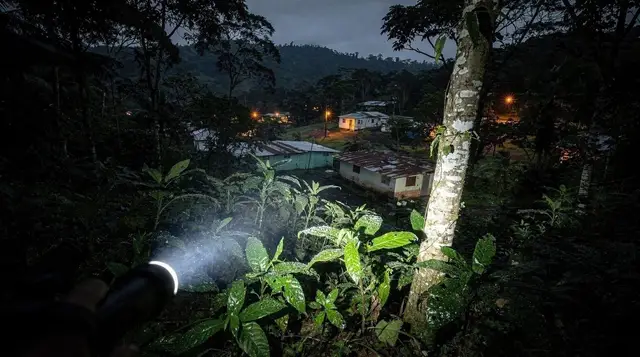
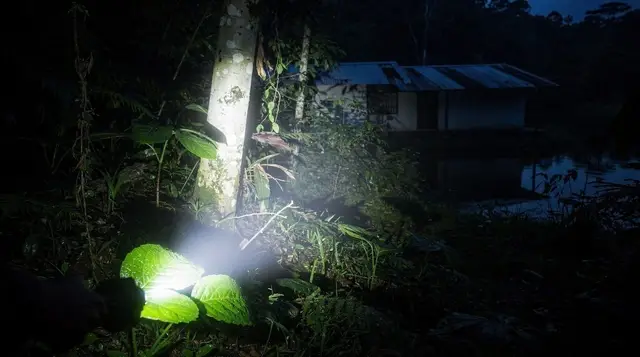
Bioluminescent Mushrooms and Fluorescent Scorpions in La Fortuna
Can you see glowing mushrooms or scorpions on a night tour near La Fortuna?
Occasionally, yes. Some rainforest fungi produce a faint natural glow (foxfire), and scorpions fluoresce bright blue-green under a UV flashlight that some guides carry as an extra. Neither is promised or scheduled: both depend on rain, season, the individual guide's kit, and luck on the night.
Beyond the Frogs: What Else Glows After Dark
Every night walk operator in La Fortuna will show you sleeping birds tucked into leaves, a red-eyed tree frog if you’re lucky, and maybe a tarantula peering out of its burrow. That standard rotation is covered in full in our night walks in La Fortuna guide — this page skips past it entirely to focus on something narrower and rarer: the things that actually produce or reflect their own light in the dark, and why you shouldn’t book a tour expecting to see them on demand.
There are two distinct phenomena that get lumped together under “glow-in-the-dark” in La Fortuna, and they work completely differently. Bioluminescent fungi produce their own faint, genuine light through a chemical reaction inside living tissue — the same basic mechanism as a firefly, just much dimmer and much less well known.
Fluorescent scorpions don’t produce light at all; a compound in their exoskeleton absorbs invisible ultraviolet light and re-emits it as a visible blue-green glow, which is why you need a UV flashlight to see it and why it disappears the instant that light is switched off. Understanding the difference matters, because it changes what you should actually expect from a night out in the rainforest around Arenal Volcano National Park.
Bioluminescent Mushrooms: The Rare One
Glowing fungi — sometimes called foxfire, a term that goes back centuries in temperate forests but applies just as well to a handful of tropical species — grow on rotting wood in consistently damp conditions. Around La Fortuna and El Castillo, the forest floor and fallen branches along trails like the Bogarín Trail or the private reserves near Arenal Natura occasionally host these fungi, and under the right conditions the fruiting bodies emit a soft, greenish light that’s only visible once your eyes have fully adjusted to darkness — a process that takes a genuine 15 to 20 minutes of no white light at all, including no phone screen.
Here’s the honest problem with promising this sight: it’s genuinely uncommon. Guides who lead night walks four or five nights a week might find visibly glowing fungi only a handful of times a season. The light is faint enough that a group walking at normal pace, even with a good guide, can pass within a metre of a glowing patch and never notice it — it takes someone stopping, killing every light source, and letting eyes adjust before the glow becomes visible at all. Some guides will deliberately pause the group and switch off headlamps for a minute near a promising patch of deadwood specifically to give it a chance; that’s a good sign of an experienced operator, not a guarantee of a result.
Conditions that help: sustained rain over several days, so deadwood stays saturated rather than drying out between showers, which is why the green season (roughly May through November) offers noticeably better odds than the dry months of December to April. Even then, treat it purely as a bonus. If an operator’s listing shows a photo of glowing mushrooms as if it’s a fixed stop on the route, that photo was almost certainly taken on an exceptional night, not a typical one.
this La Fortuna night tour runs most evenings and covers the standard wildlife circuit; ask your guide directly whether they’ve seen bioluminescent fungi recently on their usual route before assuming it’s part of the plan.
Fluorescent Scorpions: The Reliable UV Trick
Where glowing mushrooms are a matter of luck, fluorescent scorpions are closer to a genuine party trick — reliable wherever scorpions are present, as long as someone in the group is carrying a UV flashlight. Scorpion exoskeletons contain compounds (hyaline layer chemicals, if you want the precise term) that absorb ultraviolet wavelengths and re-emit them as visible light, producing a striking blue-green glow that makes an otherwise camouflaged scorpion stand out sharply against dark bark or leaf litter. It works on every scorpion species reliably enough that biologists use UV surveys as a standard field technique, not just a tourist gimmick.
The catch in La Fortuna specifically is that not every operator carries a UV light as standard equipment. Some guides pack one every night as a matter of routine and will actively sweep tree trunks and buttress roots looking for the telltale glow; others only bring one if a guest requests it in advance, and a few simply don’t own one. If finding a fluorescent scorpion is something you actually want to see rather than stumble into, the single most useful thing you can do is message your tour operator before the walk and ask directly whether the guide will have a UV flashlight with them. It’s a small, specific question, and most operators will give you a straight answer.
Scorpions found around La Fortuna are not considered dangerously venomous to a healthy adult — expect pain and swelling similar to a bad wasp sting rather than a medical emergency — but your guide should always be the one pointing the light, never picking one up. A scorpion sighting under UV light pairs naturally with the rest of a standard night walk, since guides scanning for frogs and spiders with a normal beam will often switch to UV for a few minutes specifically to check nearby bark and root systems.
this Costa Rica night walk is one of the operators known locally for carrying UV kit as standard — worth confirming directly if the scorpion search is your main interest.
Setting Realistic Expectations
It’s worth being blunt about the marketing gap here. A search for night tours in La Fortuna will turn up some listings that lead with photos of glowing mushrooms or fluorescent scorpions, phrased in a way that makes them sound like fixed highlights of the route. In practice, both are opportunistic finds that depend on three variables stacking in your favour: recent rainfall (for fungi), the individual guide’s habits and equipment (for both), and plain chance on the specific night you go out. A tour that genuinely delivers one of these sights on a given evening isn’t cutting corners on the nights it doesn’t — it’s simply how rainforest wildlife works.
If glow-in-the-dark finds are the main reason you’re booking a night tour rather than a pleasant bonus, a few things improve your odds without guaranteeing anything: go during green season rather than dry season, ask specifically about UV flashlight availability when booking, and pick an operator whose guides work the same forest trails night after night rather than a one-off route — familiarity with a specific patch of forest is what lets a guide notice a glowing log they walked past the week before. Small groups also help, simply because a guide leading four people can pause and adjust everyone’s eyes to darkness far more easily than one leading twenty.
None of this should overshadow what a night walk near La Fortuna delivers reliably: sleeping birds at eye level, a real chance at a two-toed or three-toed sloth curled in the canopy, tree frogs, katydids, and the general strangeness of a rainforest after dark, none of which needs a UV torch or a lucky patch of deadwood. Our night walks in La Fortuna guide and what to bring on a night walk cover that fuller picture, including closed-toe shoes and insect repellent as non-negotiables for any evening trail.
Where to Look, and Where Not to Bother
Not every property or reserve around La Fortuna is set up for this kind of find. Private reserves that run guided night tours on the same patch of forest every evening — places like Arenal Natura and the grounds around El Castillo — tend to produce better odds simply because the same guides walk the same trails repeatedly and notice small changes, including a new patch of glowing deadwood after a wet week. The Bogarín Trail closer to La Fortuna’s town centre runs mostly as a daytime sloth-spotting walk rather than a night tour, so it’s not the right pick for this specifically.
Public trails inside Arenal Volcano National Park itself generally close at dusk and aren’t open for night walks at all — the guided night tours you’ll book operate on private reserve land adjacent to the park, not inside it. That’s a useful distinction to know when comparing listings, since a few blur the line between “near the volcano” and “inside the national park” in their descriptions.
this guided sloth and monkey tour runs during daylight and focuses on different wildlife entirely — it’s a good complement to a night walk rather than a substitute for one, since sloths are far easier to spot with natural light than a headlamp beam.
Quick Comparison: Fungi vs. Scorpions
| Bioluminescent mushrooms | Fluorescent scorpions | |
|---|---|---|
| Light source | Genuine bioluminescence (self-produced) | Fluorescence under UV torch only |
| Frequency | Rare — a handful of sightings per season for an active guide | Common where scorpions are present, if a UV light is used |
| Best season | Green season (May–November), after sustained rain | Year-round, no seasonal dependency |
| What you need | Fully dark-adjusted eyes, no white light for 15–20 minutes | A guide carrying a dedicated UV flashlight |
| How to improve odds | Book in wet weeks, ask for a pause with lights off | Ask the operator directly before booking if UV kit is included |
| Safety | Don’t touch — handling kills the glow | Don’t touch — sting causes pain and swelling, not usually dangerous |
Planning the Rest of Your Night Out
If a glow-in-the-dark find is a bonus rather than the whole plan, treat this as one layer on top of a well-chosen night tour rather than a separate outing. Read the full wildlife spotting guide for La Fortuna for what else is realistically on the table after dark, check what to bring on a night walk so you’re not caught out by rain or biting insects, and browse the night tours category if you’re comparing more than one operator.
For travellers building out a longer stay, how many days in La Fortuna and first-time in La Fortuna both help slot a night walk into a schedule that also covers the La Fortuna Waterfall, the hot springs, and at least one day trip out to Río Celeste or Monteverde.
this sloth tour with tortilla making is a popular daytime pairing for travellers stacking a night walk with a cultural stop on the same trip, and it books through the same small operators who tend to know which nights their forest trails have been productive.
Whatever you see on the night — a genuinely glowing log, a scorpion lit up bright green under UV, or simply frogs and a distant howler monkey — the honest version of this experience is that the rainforest around La Fortuna doesn’t perform on a schedule. A good guide who knows the trail well is the single biggest factor in whether an unusual find turns up, far more than any specific tour name or price point.
Night tours on GetYourGuide
Verified deep-linked GetYourGuide tours. Book through these links and we earn a small commission at no cost to you.
GetYourGuide does not provide a product photo for this activity — the image shows the meeting point, photographed by us.