A Sloth Walk Built Around Actually Finding Sloths
Most sloth sightings in Costa Rica happen by luck: a guide on some other tour glances up at the right moment, or they don’t. The Bogarín Trail works differently. It’s a privately run wildlife trail on the edge of La Fortuna town, and its guides spend their days tracking the same resident sloths — noting which tree they moved to, whether they’re a two-toed or three-toed animal, roughly how far up the canopy they’ve settled. When your walk starts, the guide already has a shortlist of likely trees rather than a hope.
That’s the honest case for choosing this trail over a random stretch of forest path elsewhere: not that sloths are common animals easy for anyone to spot, but that this particular operation has built its whole method around finding the ones that are already there. It still doesn’t turn a wild animal into a scheduled exhibit. A sloth can shift position, tuck itself behind a branch, or simply not be where it was the day before. Treat a sighting as likely, not guaranteed, and you’ll enjoy the walk on its own terms rather than measuring it against a promise nobody should have made you.
Sloths: What You’re Actually Likely to See
Costa Rica has two sloth species, and the Bogarín Trail’s guides are quick to point out which one you’re looking at, because the two behave differently. The brown-throated three-toed sloth is more visible — it’s active by day, if “active” can describe an animal that moves a few metres an hour, and it’s the one more likely to be seen with a baby clinging to its chest. The Hoffmann’s two-toed sloth is nocturnal by preference and often curls into a tighter, harder-to-identify ball high in the canopy; guides find these mostly by knowing exactly which tree to check.
Either way, what you’ll see through the scope is usually a still, grey-brown shape wedged into a fork of branches, easy to miss without someone pointing a laser at it first. Bring or rent binoculars if you have them, though most guided groups share the trail guide’s spotting scope, which does the real work. A zoom lens helps far more for photos than proximity does — you will not be walking up to touch a sloth, nor should you want a place that lets you.
Walking the Trail: Layout, Difficulty, and Timing
The trail itself is flat, shaded, and short enough that the walking is never the point — the looking is. Guided visits run roughly 1.5 to 2 hours, moving slowly by design, stopping wherever a guide spots movement or a known roosting tree. There’s a small butterfly garden section near the entrance and a frog pond that gets more interesting after dark, though most day visitors are there primarily for the sloths.
Because it sits a short drive — or a walkable 20 minutes — from La Fortuna’s town centre, it doesn’t require the half-day commitment that a trip out to somewhere like Caño Negro or the Peñas Blancas River does. That makes it an easy slot to drop into a day that already has a hot springs evening or a waterfall morning planned, and one of the few wildlife activities here that genuinely works if you’re without a rental car.
Guided vs Not — Why a Guide Matters Here
This isn’t a trail where paying for a guide is a nice-to-have that a confident independent walker could skip. It’s closer to the entire product. Sloths at rest are camouflaged, motionless, and frequently 20 to 30 metres up — three things that make them nearly impossible for an untrained eye to pick out of a canopy, even standing directly beneath one. The guides’ advantage isn’t just trained eyesight; it’s institutional memory of where specific animals have been settling over recent days.
If you’ve read about wildlife spotting elsewhere around La Fortuna and found the advice frustratingly vague — “look up, be patient” — the difference here is that patience is replaced by prior knowledge. That’s worth paying for on a trip where you likely have one shot at seeing a wild sloth.
Book the Bogarín Trail sloth-watching walk with a guide, which includes entrance and the guided search — the two aren’t meaningfully separable here.
Prices and What’s Included
| Option | Typical price (USD) | What’s included |
|---|---|---|
| Guided walk, standard group | $25–35 pp | Entrance, guide, spotting scope use, 1.5–2 hr |
| Guided walk, private/small group | $40–55 pp | Same, smaller group, more scope time per person |
| Add-on night walk | +$20–25 pp | Frog and nocturnal-wildlife walk after dark |
Prices move with season and operator, so treat these as planning ranges rather than quotes. Given how central a knowledgeable guide is to this particular trail, the cheapest unguided-adjacent option rarely represents good value — you’d be paying entrance without the thing that makes entrance worthwhile.
How the Bogarín Trail Compares to Other La Fortuna Wildlife Sites
La Fortuna has several private reserves built around guided nature walks, and it’s easy to conflate them. Without turning this page into a review of each one, a quick sense of how they differ helps:
| Site | Known for | Typical visit length |
|---|---|---|
| Bogarín Trail | Sloth-tracking specifically | 1.5–2 hrs |
| Ecocentro Danaus | Broader wetland and forest wildlife | 1.5–2 hrs |
| Arenal Natura | Trails plus a small serpentarium/frog exhibit | 1.5–2.5 hrs |
If sloths specifically are your priority, the Bogarín Trail’s day-to-day tracking approach is the more targeted choice. If you’d rather one stop cover a wider mix of habitats, Ecocentro Danaus or Arenal Natura are reasonable alternatives — each deserves its own look if that’s what you’re after, rather than a side-by-side verdict here.
Beyond Sloths: Other Wildlife on the Trail
Sloths carry the trail’s reputation, but guides here regularly point out toucans (usually the keel-billed, La Fortuna’s most photographed bird), poison dart frogs in the leaf litter, green iguanas basking in patches of sun, herons along the water features, and agoutis — the rabbit-sized rodents that dart across paths throughout the region. None of it is staged; it’s the same forest-edge habitat that supports the sloth population, just noticed along the way.
If frogs are more your interest than sloths, note that the Bogarín Trail’s daytime walk is a different experience from a dedicated night walk in La Fortuna, where red-eyed tree frogs and other nocturnal species become the main event after dark. Some visitors do both on the same trip: a daytime sloth walk here, then a separate evening night walk elsewhere in town.
How to Combine the Bogarín Trail With the Rest of Your Day
Because the walk is short and close to town, it slots neatly around other plans rather than requiring a day of its own. A few combinations that work without rushing either activity:
- Morning sloth walk, afternoon hot springs. Book an early Bogarín Trail slot, then unwind afterward — a Baldi Hot Springs admission ticket is one straightforward option for the afternoon.
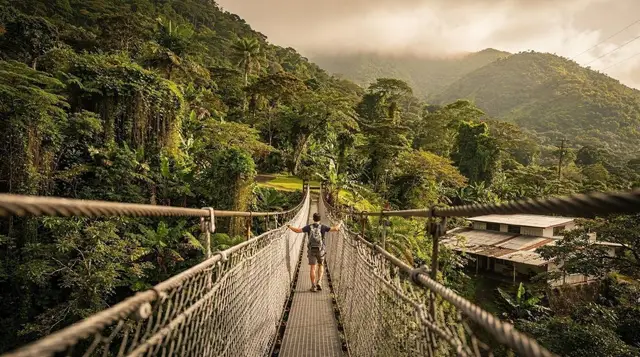
- Sloth walk plus hanging bridges. Both are guided, moderate-effort activities that fit into a single day without overlapping content — a guided Mistico Hanging Bridges tour covers the suspension-bridge side of things.
- A dedicated wildlife day. Pair this trail with an Arenal sloth and monkey guided tour elsewhere in the valley if wildlife, not adrenaline, is the theme of your visit.
For more structured planning, see how many days you actually need in La Fortuna, or browse combo tours explained and the best combo tour for a single day if you’re trying to fit several activities into a short stay.
Getting There and Practical Tips
The trail sits close enough to La Fortuna’s town centre that a taxi ride is short and inexpensive, and walking is realistic if you don’t mind 20 minutes each way on a warm morning. Most tour bookings include round-trip transport from central hotels, which is worth taking if you’re travelling without a rental car.
A few things worth knowing before you go:
- Footwear: closed shoes on damp paths; sandals are fine but flip-flops aren’t ideal.
- Rain: La Fortuna gets rain most days of the year regardless of season — bring a light rain layer and expect the walk to continue anyway, since the forest doesn’t stop for a shower.
- Insect repellent: standard practice anywhere in the lowlands here.
- Photography: a zoom lens (200mm or more) makes a real difference; phone cameras struggle at canopy distance even through a scope.
- Booking ahead: popular time slots, especially early morning, can fill up in high season — reserve rather than walking up.
If you’re travelling with children, this is one of the more forgiving wildlife activities in the region precisely because it asks so little physically — see La Fortuna with kids for how it fits into a family itinerary, and what seeing a sloth actually means for a more personal take on why the payoff is worth the patience.
Setting Realistic Expectations
It’s worth repeating plainly, because so much tour marketing in this region doesn’t: no operator, however good, can promise a wild sloth will be visible on any given morning. What the Bogarín Trail offers is a meaningfully better process — guides who track known animals rather than hoping to stumble across one — and that raises your odds substantially above a random forest walk. It does not remove the animal’s own unpredictability from the equation. Go in expecting a strong chance and a genuinely relaxed, low-effort walk either way, and a sighting becomes a bonus on top of a worthwhile morning rather than the sole measure of whether the visit was a success.
If your trip has room for only one wildlife-focused stop and sloths are the priority, this is the trail most La Fortuna visitors choose for that reason. If you’re building a broader wildlife day or comparing your options across the region’s wildlife spotting overall, it’s one strong piece of a longer list rather than a single verdict on where to spend your time.
Either way, an observatory-lodge stay or a budget-conscious itinerary can both make room for a morning here without much disruption, and one day in La Fortuna is enough time to include it alongside one or two other activities.
Bogarín Trail Sloth Walk: Frequently Asked Questions
Will I definitely see a sloth on the Bogarín Trail?
No walk in the wild can promise that, and you should be wary of anyone who does. What the trail offers is a much higher chance than an ordinary park path, because its guides check on known sloths in the trees they favour before your walk even starts. Most groups see at least one; it is not guaranteed for every single visitor.
Do I need a guide, or can I walk it myself?
Guided access is how the trail works, and it’s also why it’s worth choosing over a random walk elsewhere. The guides know which trees held a sloth the previous day and carry spotting scopes to find animals sitting still 20–30 metres up in the canopy, which is nearly impossible for an untrained eye.
How does the Bogarín Trail compare to Ecocentro Danaus or Arenal Natura?
All three are private reserves near La Fortuna with guided wildlife walks, and any one of them is a reasonable choice. The Bogarín Trail’s particular strength is its sloth-tracking reputation and its location a short hop from La Fortuna’s town centre, which makes it easy to fit around other plans.
How long does the walk take and how difficult is it?
Guided visits run 1.5 to 2 hours on flat, well-maintained paths, suitable for most fitness levels and for children. It is not a strenuous hike; most of the effort is standing still while a guide lines up a scope on a distant animal.
What else might I see besides sloths?
Toucans, poison dart frogs, iguanas, herons, and agoutis turn up regularly, along with a butterfly garden section near the entrance. Sloths are the headline, but the trail is a general wildlife walk, not a single-species enclosure.
What’s the best time of day to go?
Early morning and late afternoon slots tend to have calmer light for photography and slightly cooler walking conditions, though sloths themselves move so little that time of day matters less here than at more active wildlife sites. Book whichever slot fits your itinerary.
Can I combine the Bogarín Trail with hot springs or another tour the same day?
Yes — because the walk is short and close to town, it pairs easily with an afternoon hot springs session or an evening night walk without eating up a full day.