Night Walks in La Fortuna: A Guide to Guided Wildlife Tours
Are La Fortuna's night walks worth doing, and will I see a red-eyed tree frog?
Guided night walks at venues like Ecocentro Danaus are worth doing for the sheer density of nocturnal life — frogs, insects, spiders, and occasionally a sloth — but no guide can promise a red-eyed tree frog on any given night. It's the most-requested sighting and the least reliable one.
What happens on a guided night walk around La Fortuna
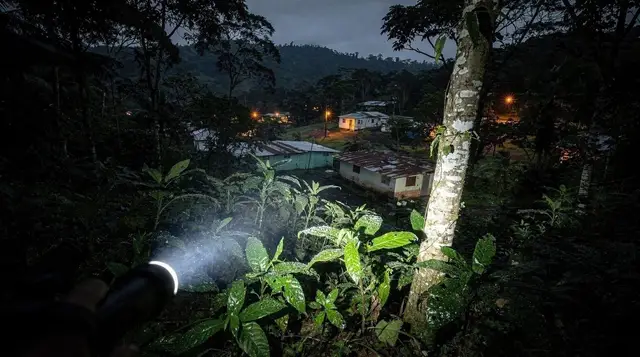
The rainforest around La Fortuna doesn’t switch off after sunset — it changes shift. The birds and daytime lizards go quiet, and a different set of animals takes over: frogs calling from ponds and leaf litter, insects that only move once the heat of the day has passed, spiders that build or repair their webs at night, and the occasional nocturnal mammal moving through the canopy. A guided night walk is built around finding as much of that second shift as possible in a two-hour window, using flashlights, a trained eye, and a guide who already knows which ponds, tree trunks and leaf clusters tend to produce something.
Most night walks near La Fortuna run through private reserves rather than the Arenal Volcano National Park itself, which closes to visitors well before dark.
Ecocentro Danaus, a small reserve a few minutes outside town built around a lagoon, secondary forest and a butterfly garden, is one of the most consistently used venues for this — its network of short, well-lit trails and standing water make it a genuinely productive place to search, without a long drive out of town. Arenal Natura runs a comparable format nearby, and it’s covered in its own guide if you want a side-by-side sense of what each reserve tends to turn up.
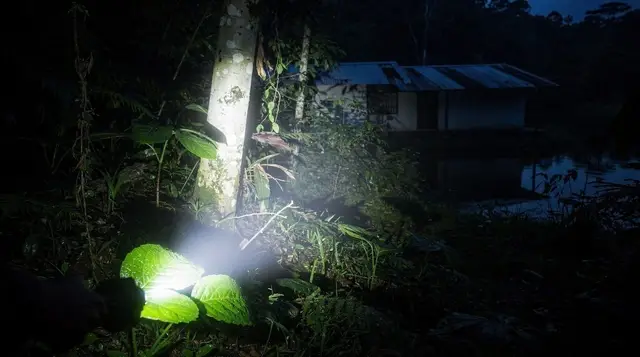
A typical outing groups eight to fifteen visitors with one or two guides, each carrying a powerful handheld spotlight and, often, a laser pointer to indicate a sighting in the canopy without disturbing the animal. The pace is deliberately slow — this isn’t a hike, it’s a search, and a guide who moves too fast past a promising log or a still pond will miss what a guide who stops and looks won’t. Expect frequent pauses, quiet voices, and a lot of scanning leaves and branches with a flashlight beam before anyone spots anything at all.
What you might actually see
The species list that comes up on a typical night walk near La Fortuna is genuinely long, even if any single night only delivers a fraction of it:
| Category | Typical finds |
|---|---|
| Frogs | red-eyed tree frog, glass frogs, smoky jungle frog, various rain frogs |
| Insects | stick insects, leaf-mimic katydids, walking sticks, tarantula hawks, glowing click beetles |
| Spiders | orb-weavers, wandering spiders, occasionally a tarantula in a burrow entrance |
| Reptiles | anoles asleep on leaves, sometimes a sleeping basilisk, occasionally a snake (venomous and non-venomous alike) |
| Mammals | kinkajous, olingos, and — less often — a sloth moving at night rather than resting |
That last row is worth being honest about. Sloths are mostly associated with daytime sightings in La Fortuna — the Bogarín Trail is the area’s most reliable spot for that — but sloths do move and feed at night, and a night-walk guide occasionally picks one out mid-canopy with a spotlight. It happens far less often than a frog or an insect sighting, so treat any nocturnal sloth as a bonus rather than something to expect.
Insects and spiders are, in practice, the most consistent finds on any given night — there are simply more of them, and they’re active regardless of weather or season. Frogs depend heavily on humidity: a night after rain, with ponds full and the air thick and warm, is a far better frog night than a dry one. Guides at venues like Ecocentro Danaus know this and often adjust the route toward standing water when conditions look promising.
The red-eyed tree frog problem
If there’s one species driving bookings for La Fortuna night walks, it’s the red-eyed tree frog — the bright green, red-eyed, orange-toed animal that appears on every postcard and tour advertisement in this part of Costa Rica. It’s a striking, genuinely wild-looking creature, and it’s the single most requested sighting on any night tour in the area.
It is also not guaranteed, on any tour, at any venue, on any night. This needs to be said plainly, because a lot of marketing around night walks blurs the line between “commonly seen” and “guaranteed.” Red-eyed tree frogs are nocturnal and largely arboreal, spending daylight hours pressed flat against the underside of leaves where their green colouring hides them almost completely. At night they become active and easier to spot near ponds and slow water, which is exactly why guides steer groups toward those spots — but activity still depends on humidity, recent rainfall, and a degree of luck that no guide controls.
A guide worth booking will tell you this upfront rather than let the marketing photo do the promising. If a tour description or a guide’s pitch guarantees a red-eyed tree frog sighting, treat that as a sign to book elsewhere — it’s the clearest tell of an operator overselling what a night in the forest can actually deliver. For a broader sense of what tends to show up and when, the wildlife spotting guide covers realistic expectations across every major species in the area, not just frogs.
Night walk vs the Bogarín Trail: not the same activity
It’s worth separating two things that get lumped together by visitors planning a trip: the Bogarín Trail and a guided night walk. They are not the same activity, they don’t run at the same time of day, and they don’t target the same wildlife.
| Bogarín Trail | Guided night walk | |
|---|---|---|
| Time of day | Daytime | After dark, roughly 5:30–9:30pm |
| Primary target | Sloths (two- and three-toed) | Frogs, insects, spiders; sloths rare |
| Venue | Trail adjacent to central La Fortuna | Private reserves such as Ecocentro Danaus, Arenal Natura |
| Pace | Walking tour, moderate pace | Slow search, frequent stops |
| Guide equipment | Spotting scope | Handheld spotlight, laser pointer |
The Bogarín Trail is covered in full in its own guide, and it remains the better bet specifically for daytime sloth sightings — sloths are far easier to find and photograph in daylight, when they’re visible resting high in a tree rather than moving unseen through a dark canopy. A night walk is a different kind of search for a different set of animals, and treating the two as interchangeable is the most common planning mistake visitors make when they only have time for one.
Some visitors do both on the same trip — a morning or afternoon at Bogarín for sloths, an evening at Ecocentro Danaus or a similar reserve for frogs and insects — and that combination covers most of what La Fortuna’s wildlife scene has to offer without overloading a single day.
Snakes, footwear, and why this matters after dark
The fer-de-lance, a venomous pit viper responsible for most snakebite incidents in Costa Rica, is present on trails around La Fortuna — day and night alike. It’s a well-camouflaged, ground-dwelling snake that relies on stillness rather than retreat, which is exactly the combination that makes closed, sturdy shoes non-negotiable on any trail here, not just after dark.
At night the risk isn’t higher because the snake is more active — it’s higher because visibility is limited to a flashlight beam and a footpath that would be obvious in daylight can hide far more in shadow. Guides at venues like Ecocentro Danaus walk these trails constantly and know how to scan the path ahead, but visitors should never rely on a guide’s vigilance as a substitute for basic footwear. Sandals, flip-flops or open-toed shoes have no place on a night walk, regardless of how short or well-maintained the trail is advertised as being.
For the full rundown on what to wear and pack for an evening walk — footwear, layers, insect repellent, and what to leave at the hotel — see the packing list and the dedicated guide on what to bring on a night walk. Long trousers and a light rain layer are worth adding even in dry season, since La Fortuna sits on the wet, windward side of the Arenal range and a light shower can arrive with little warning at any time of year.
Booking a guided night walk
Several operators run night tours in and around La Fortuna, and the differences between them come down to venue, format and whether the walk is combined with another activity.
a guided night search along the Río Habana, one of the area’s dedicated after-dark wildlife routes is a straightforward standalone option focused entirely on the walk itself. For visitors who want the search paired with a broader rainforest context, a guided rainforest night tour around La Fortuna covers similar ground with a slightly wider route.
Two other formats worth knowing about: an evening tour centred on Arenal’s fireflies rather than frogs and insects is a different kind of night activity — shorter, quieter, and built around bioluminescence rather than a general wildlife search (the glow-in-the-dark guide covers this in more depth). And a combined sloth-and-monkey guided tour runs closer to dusk than full darkness, aimed at visitors who want a middle ground between the daytime Bogarín-style walk and a true after-dark search.
Whichever tour you book, confirm the venue in advance — “night walk” and “night tour” get used loosely in marketing, and the difference between a lagoon-based search at a reserve like Ecocentro Danaus and a roadside firefly viewing is significant.
Practical logistics
| Typical range | |
|---|---|
| Duration | 1.5–2.5 hours |
| Start time | 5:30pm–7:30pm (shortly after sunset) |
| Price per person | 25–45 USD |
| Group size | 8–15 visitors, 1–2 guides |
| Hotel pickup | Often included; confirm at booking |
| Best conditions | Warm, humid nights, ideally after recent rain |
Sunset in La Fortuna falls around 5:30–5:45pm year-round, since the country sits close enough to the equator that day length barely shifts by season. Most night walks start shortly after that, giving the forest time to fully switch over to its nocturnal activity before the group sets out. Booking a night walk earlier in a multi-day stay rather than on the last evening gives some flexibility — if a particular night is unusually dry and quiet, some operators or independent guides are willing to reschedule.
Green season (May to November) generally produces more frog activity thanks to higher humidity and more standing water, though it also means a higher chance of rain during the walk itself — a light poncho or rain jacket is worth carrying regardless of season. For visitors weighing up when to build a night walk into their itinerary, the best time to visit guide and the how many days in La Fortuna guide both cover how to fit an evening activity like this around volcano weather and daytime plans.
Setting expectations before you book
A good night walk delivers on volume rather than a guaranteed checklist: expect to see several frogs (species uncertain), a handful of striking insects, at least one or two spiders worth stopping for, and — with real luck — something rarer, whether that’s a nocturnal mammal or a snake spotted safely from a distance by an experienced guide. What it won’t reliably deliver is the single photogenic red-eyed tree frog from the postcard, and any operator promising otherwise is setting expectations that the forest itself doesn’t control.
Approached with that framing, a night walk at Ecocentro Danaus or a similar reserve is one of the more consistently interesting two hours available near La Fortuna — closer, in spirit, to a slow scavenger hunt through a working rainforest ecosystem than to a wildlife-viewing guarantee. For a wider view of how it fits alongside the area’s daytime wildlife activities, the wildlife spotting guide and the things to do: night tours category round out the rest of what runs after dark around La Fortuna.
Night tours on GetYourGuide
Verified deep-linked GetYourGuide tours. Book through these links and we earn a small commission at no cost to you.
GetYourGuide does not provide a product photo for this activity — the image shows the meeting point, photographed by us.