A town built to send you somewhere else
La Fortuna de San Carlos is a district of the San Carlos canton, in Alajuela province, in the northern lowlands of Costa Rica. It has around 15,000 residents and sits at roughly 250 m of elevation, on the flat land east of Arenal Volcano’s cone. None of that geography matters much to a visitor except for one consequence: La Fortuna exists almost entirely to put people close to the volcano, and everything about the town — its grid of streets, its density of tour agencies, its restaurants timed around pickup schedules — is organised around that function.
This page is about the town as a base: how it’s laid out, how far things actually are from it, where to stay, and what a few days built around it look like. For the Arenal Volcano National Park itself, the La Fortuna waterfall, or the compact downtown core with its church and central park, see their own pages — La Fortuna’s town centre is covered in detail separately.
Where La Fortuna sits relative to everything else
La Fortuna is the population centre closest to Arenal Volcano, about 6 km from the base of the cone by road. It’s also, less obviously, the transport hub for a wider slice of Costa Rica’s north: Lake Arenal and the crossing to Monteverde sit to the west, Río Celeste and the Tenorio volcano area to the northwest, Caño Negro and the Río Frío wetlands to the north, and Sarapiquí to the east. Ciudad Quesada, the larger administrative town of the San Carlos canton, is 45 minutes away and handles some banking and bus connections La Fortuna itself doesn’t.
That central position is the entire reason the town grew the way it did. A traveller arriving from San José or Liberia can reach hot springs, a waterfall hike, a hanging bridges park, whitewater rafting, and a cloud forest day trip without changing hotels — something few other single bases in the country can offer. It’s also why La Fortuna gets busy: it is genuinely the country’s most concentrated adventure-tourism town, and in high season its restaurants and tour vans reflect that.
The one thing La Fortuna cannot offer
Arenal is a near-perfectly conical stratovolcano that erupted violently on 29 July 1968, destroying the villages of Tabacón, Pueblo Nuevo and San Luis and killing an estimated 87 people. It then stayed in near-continuous strombolian activity — visible lava flows, incandescent rock, nighttime glow — for 42 years. That activity ended in October 2010, and Arenal has been quiet since.
No tour, viewpoint, or hotel balcony in La Fortuna will show you flowing lava today. What you can see, when the summit isn’t wrapped in cloud, is the cone itself, plus the solidified 1968 lava field you can walk across on a guided hike, and the geothermal heat that still feeds the area’s hot springs. Any listing that promises “watch the lava” from town is describing a Costa Rica that hasn’t existed for over fifteen years.
Getting to La Fortuna
| From | Distance | Typical time |
|---|---|---|
| San José / SJO airport | ~125 km | ~3 h by road |
| Liberia / LIR airport | ~145 km | 2.5–3 h by road |
| Monteverde (jeep-boat-jeep) | — | ~3 h |
| Monteverde (by road) | ~130 km | 3.5–4 h |
| Ciudad Quesada | — | ~45 min |
Most visitors arrive from San José, either self-driving, taking a shared shuttle, or booking a private transfer; full guidance on that leg is covered in getting from SJO to La Fortuna. Arriving through Liberia’s airport instead is often faster if your trip starts on the Pacific side — see getting from LIR to La Fortuna. Either way, the roads climb gradually through farmland and forest before La Fortuna’s grid appears at the base of the volcano.
If Monteverde is also on your itinerary, the routing decision matters more than it looks: driving the direct road takes 3.5 to 4 hours over roughly 130 km, much of it unpaved, while the jeep-boat-jeep connection — a minibus to the lake, a boat across it, a minibus on the far side — covers the same distance in about 3 hours for less money than a private transfer. The comparison is worth reading properly before you book anything: see jeep-boat-jeep versus driving to Monteverde.
Using La Fortuna as a hub: how far is everything, really
The appeal of basing in La Fortuna is that almost nothing else in the region is more than a couple of hours away. In practice:
| Destination | Time from La Fortuna |
|---|---|
| Arenal Volcano National Park | 15–20 min |
| La Fortuna waterfall | 10–15 min |
| Lake Arenal / dam | 20–30 min |
| El Castillo | ~45 min (partly gravel) |
| Río Celeste / Bijagua | 1.5–2 h |
| Caño Negro | ~2 h |
| Sarapiquí | ~2 h |
| Monteverde | 3 h (boat) / 3.5–4 h (road) |
| Rincón de la Vieja | ~3 h |
| Poás Volcano | ~2 h 15 min |
That radius is why multi-day itineraries built around La Fortuna work so well: you can do a hot springs afternoon, a waterfall or hanging bridges morning, and an adventure activity like rafting or ziplining without ever repacking a bag, then add a single long day trip to Río Celeste or Lake Arenal toward the end of your stay. What it doesn’t offer is a beach — the nearest Pacific coast is about 3 hours away, and the Caribbean coast around 4.5 hours, so a La Fortuna-based trip is fundamentally a forest, river and volcano trip, not a beach one.
Where to stay
Accommodation in and around La Fortuna splits roughly into three zones, and which one suits you depends on whether you have a car and how much you value volcano views over walkable convenience.
Downtown, within walking distance of the Parque Central. The most practical choice without a car — restaurants, tour agency storefronts, the bus stop and pharmacies are all a short walk away. Views of the volcano are limited or absent from most properties here.
The road toward the volcano (Route 142). Hotels here, roughly 5–15 minutes’ drive from town, often have direct volcano views and closer access to the national park entrance and several hot spring resorts, at the cost of needing a car or arranged transport for everything else.
Toward El Castillo and Lake Arenal. Quieter and more scenic, with some of the region’s best-regarded lodges, including the Arenal Observatory Lodge inside the national park boundary. This zone suits travellers prioritising nature and quiet over nightlife, and who either have a car or are comfortable relying on hotel-arranged transfers.
A daily budget of USD 60–150 per person is a reasonable range across these zones, covering a mid-range room, two or three meals, and one paid activity; hot springs resort admission alone can run from about USD 40 for a simpler day pass — such as the Los Lagos Hot Springs day pass — up to well over USD 100 at the most elaborate complexes.
Practical basics
Costa Rica’s official currency is the colón (CRC), but tours, hotels and park admissions in La Fortuna are almost universally priced and accepted in US dollars, with change given back in colones — often at a weaker rate than you’d get from an ATM. Large bills (USD 50 and 100) are frequently refused, so carry smaller denominations. Emergency services are reached at 911. Power runs at 120V/60Hz on type A and B plugs, the same as North America. Spanish is the local language; English is common among tour guides and hotel staff in La Fortuna itself, noticeably less so once you’re out toward Bijagua or Guatuso. The whole country runs on UTC-6 year-round, with no daylight saving changes.
Weather deserves a specific note because it shapes how a stay here should be planned. Costa Rica has a dry season from December to April and a green season from May to November, but La Fortuna sits on the windward side of the mountains and gets rain in some form throughout the year, typically in the afternoon. The volcano’s summit is often in cloud regardless of season, which is one more reason not to build a trip around “seeing” it — treat any clear view as a bonus, not a guarantee. Restaurant bills already include a 10% service charge and 13% sales tax by law; a guide tip of USD 5–10 per person per day is customary on top of that.
A sample structure for a stay
A typical three-to-five night stay based in La Fortuna might run: an arrival day with a low-key evening in the town centre; a day for the national park and waterfall, covered on their own pages; a hot springs afternoon or evening, since most complexes are more atmospheric after dark; an adventure day built around rafting, a hanging bridges walk, or an ATV tour; and, if time allows, one full day trip out to Río Celeste or Caño Negro. Families often swap the adventure day for wildlife-focused activities closer to town, such as a guided sloth and monkey walk — a guided sloth and monkey walk near town covers exactly that ground without a long transfer.
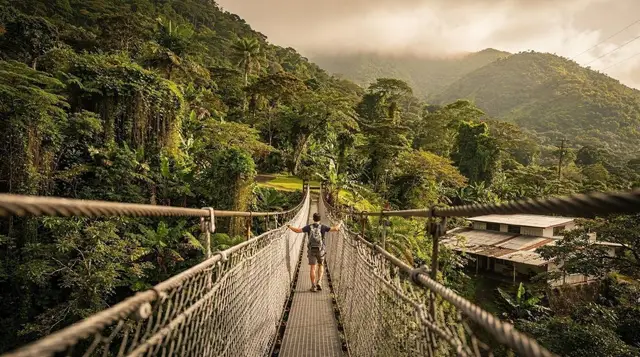
For a hike that actually reaches the volcano’s base rather than just viewing it from a distance, a guided hike to the Arenal volcano base is a reasonable half-day anchor, and a hanging bridges walk pairs well with it on a second day — see a half-day hanging bridges walk for the shorter of the region’s several bridge parks. Travellers who want river time and lunch combined into one outing without a separate rafting commitment tend to like a gentle safari float paired with a hanging bridges visit and lunch.
For a full breakdown of how many days actually make sense given your interests, see how many days in La Fortuna; if this is your first Costa Rica trip, first time in La Fortuna walks through the decisions that trip up newcomers specifically, and La Fortuna travel mistakes to avoid covers the recurring booking and timing errors.
If you’re deciding between bases entirely, La Fortuna versus Monteverde lays out the tradeoff directly, and La Fortuna and Monteverde sketches a combined itinerary. A tighter three days in La Fortuna plan works well if this is one stop among several. Budget-conscious travellers should read La Fortuna on a budget before booking hot springs admission, since prices vary enormously between operators.
Who La Fortuna suits — and who it doesn’t
La Fortuna works best for travellers who want one comfortable base with a wide menu of activities reachable in under an hour: families balancing wildlife walks with pool time, first-time visitors who want the “greatest hits” of adventure Costa Rica in a single stop, and anyone connecting onward to Monteverde, Rincón de la Vieja, or the Central Valley gateway around San José and Alajuela.
It suits people who are fine with rain most afternoons and who don’t need — or have already let go of — the idea of watching lava. It suits it less well if a beach day is non-negotiable, or if cloud forest birdwatching is the actual priority; for that, Monteverde itself, higher and cooler, is the better base to build around.