Not the attraction — the room the town eats in
If a guide, a driver, or another traveller tells you to “spend a day in La Fortuna town,” they mean something different from what the phrase usually implies. There’s no museum here, no ruin, no paid entrance gate. What La Fortuna’s centre actually is: a modest central park (Parque Central), a church that faces it, and two or three blocks of sodas, restaurants, and tour agencies wrapped around that square. It’s the town’s front room, not its attraction. The attractions — the waterfall, the hanging bridges, the hot springs, the volcano itself — are all a short drive out, not in it.
That distinction matters because of how a La Fortuna day usually runs. Tours leave early — 6 or 7am pickups aren’t unusual — and come back mid-to-late afternoon. The town centre’s real job is what happens after: dinner, a walk, maybe a beer at a bar with a view of the volcano’s silhouette if the clouds cooperate, and an early night before the next 6am pickup. Treat it that way and it earns its keep every single evening of a stay. Treat it as a sightseeing stop and you’ll wonder, correctly, why you bothered setting aside the time. For the bigger picture of what La Fortuna is and how it functions as a base, see the main La Fortuna overview — this page stays narrowly on the park and what surrounds it.
The park and the church at its centre
Parque Central sits at the heart of the grid, a compact square of trees, benches, and paths with the town’s Catholic church — dedicated to San Juan Bosco — facing it directly. Unlike the older colonial churches found in many Costa Rican towns, this one is modern, built after the 1968 eruption reshaped the region and the town grew around tourism rather than agriculture alone. It’s a simple, functional building rather than an architectural landmark, and nobody should come to La Fortuna expecting cathedral-grade craftsmanship.
What the church does offer, on a clear evening, is a backdrop: Arenal’s cone occasionally shows itself over the rooftops to the north, especially in the early morning or right around sunset before the clouds close back in. It is not a reliable photo — the volcano spends much of the year wrapped in cloud, and a clear view from the park is a matter of luck on any given evening, not something to build a plan around. If the cone is out, it’s a nice five minutes. If it isn’t, the park still functions perfectly well as what it actually is: a place to sit, eat an ice cream from one of the carts, and watch the town go by.
The park itself is small — a loop around it takes five minutes at a slow walk — with a modest playground area, some shaded benches, and enough open space that it doesn’t feel crowded even on a busy evening. It’s genuinely pleasant rather than a destination: worth the walk after dinner, not worth rearranging a day’s itinerary to fit in.
Sodas, restaurants, and where the town actually eats
The two or three blocks immediately around the park are where La Fortuna concentrates its restaurants, and the range runs from plastic-chair sodas to sit-down places with table service and a wine list. This is where a lot of a stay’s food budget actually gets spent, and it’s worth knowing the difference before picking a table.
Sodas — the small, family-run canteens found all over Costa Rica — serve the casado: rice, beans, a protein, plantain, salad, and usually fresh juice, for somewhere around $6–9. They’re not aimed at tourists particularly, which is exactly the appeal: this is what the town eats, priced for the town. A few sit right off the park; more are scattered along the streets leading away from it. For a fuller rundown of what to order and where, see the town centre restaurants guide and the broader what to eat in La Fortuna guide.
Restaurants facing the park trade the plastic chairs for proper seating, sometimes a second-floor terrace with a partial volcano view, and a menu that stretches from Costa Rican staples to pizza, burgers, and international comfort food aimed squarely at tour groups coming off a long day. Expect roughly $10–20 a plate, more for steak or seafood, and add the mandatory 10% service charge and 13% tax that Costa Rican law requires on every bill — it’s already on the check, not optional, and separate from any additional tip for a guide elsewhere in the day.
| Type | Where | Typical plate | Notes |
|---|---|---|---|
| Soda | Streets around the park | $6–9 | Casado, fresh juice, cash appreciated |
| Park-facing restaurant | Facing the plaza | $10–20 | Broader menu, sometimes a volcano view |
| Specialty / steakhouse | A block or two off the park | $15–30 | Better for a splurge night |
| Café / bakery | Around the park and main street | $4–8 | Coffee, pastries, breakfast |
None of this is exotic advice for a capital city — it’s the ordinary geography of a small tourism town — but it’s worth stating plainly: the park is where the choice happens, not a single standout restaurant to seek out. Pick based on budget and how much you want table service that evening, not on chasing one famous name.
Evening in La Fortuna: the town after the tours end
The town centre’s real character shows up after dark, once the day’s tour vans have dropped everyone back at their hotels and the streets around the park fill with people deciding where to eat. This is when La Fortuna feels most like the base camp it is: dusty boots from a hike or a rafting trip, sunburned shoulders, groups comparing notes on which hot spring or which zipline was worth it, tour desks still open and taking bookings for the next morning.
It’s an unpretentious, easy-going scene rather than a nightlife destination — a couple of bars with drink specials aimed at the backpacker and adventure-tour crowd, live music some nights in high season, and otherwise just people eating dinner and going to bed early because the next pickup is at dawn. If you’re coming from a beach town with a real bar scene, temper expectations; if you’ve spent the day on a canyoning rappel or a night walk looking for wildlife, an early night is usually exactly what’s wanted anyway.
Ice cream carts and small dessert stands work the edges of the park most evenings, and it’s a genuinely nice half hour: buy something cold, sit on a bench, and let the day’s activity wear off before heading back to the hotel. This is the town centre doing its actual job well — not as a sight to check off, but as the wind-down between one day’s excursions and the next.
Around the park: outfitters, tour desks, and where bookings happen
Several tour agencies and outfitter storefronts cluster within a block or two of the park, and for travellers who haven’t pre-booked everything, this is where a lot of last-minute planning happens. It’s genuinely convenient — you can walk from soda to soda comparing casado prices and then step into an agency to sort out tomorrow’s hanging bridges walk or hot springs pass in the same evening.
The trade-off is consistency. Commission structures vary by agency, availability isn’t guaranteed for time-slotted or popular activities, and prices at a walk-in desk aren’t always better than booking ahead. For anything with a fixed schedule or limited capacity — a park entrance, a specific hot springs resort at a specific hour — booking in advance is the safer route rather than hoping a desk near the park has an opening.
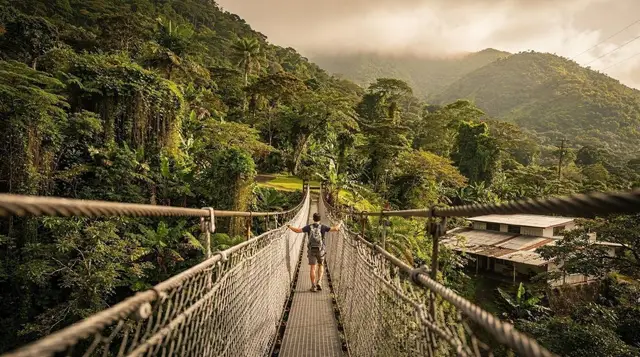
A short evening walk to check availability for a guided walk across the Mistico hanging bridges or to confirm an evening soak at Los Lagos is a reasonable use of the time between dinner and bed, but treat it as confirming a plan, not building one from scratch the night before.
Some travellers use the town centre almost as a booking hub for the whole stay: sort out a guided hike to the Arenal volcano base one evening, a sloth and monkey walk the next. It works, but it isn’t the only way — most of these same activities can be booked from a hotel, or ahead of arrival, without needing an evening walk to the park at all.
What the town centre is not
Worth being direct about this, because the temptation to over-schedule around it is real. The town centre is not where the waterfall is, not where the hanging bridges are, not where the volcano trail starts, and not where the thermal rivers run. Every one of those sits outside town, reached by a short drive or a tour shuttle. Treating an evening at the park as one of the trip’s highlight activities — the way a guide or a rushed itinerary sometimes implies — sets up disappointment, because there’s genuinely not much to it beyond a nice park, a modest church, and good food.
The honest way to think about it: the town centre is infrastructure, and good infrastructure. A place to eat well without much effort, a place to sort out logistics, a walkable, low-key evening after a day that was almost certainly spent somewhere else. It doesn’t need — and doesn’t reward — a dedicated slot on a packed itinerary. Fold it into every evening instead of scheduling it as a stop, and it does exactly what it’s supposed to do.
Practical notes for an evening in the plaza
A few things worth knowing before a first evening at the park. Cash matters more here than at hotel restaurants: sodas often prefer colones, and while most places accept cards, smaller family-run spots sometimes don’t or add a surcharge. ATMs are available around the centre if you need to withdraw colones rather than pay in USD and receive change at a poor rate.
The park and surrounding streets are walkable from most in-town accommodation, and even from some of the closer hotels on the edge of town, in well under fifteen minutes. If you’re staying further out — towards the lake, or near one of the larger hot spring resorts — a short taxi ride in is normal and inexpensive rather than something to plan around.
Rain is a near-daily reality in La Fortuna regardless of season, and it tends to arrive as short, heavy afternoon or evening showers rather than settling in for the whole night. Restaurants around the park mostly have covered seating, and a sudden downpour rarely closes anything down — it just means a wet dash between the park and a doorway, over almost as quickly as it started.
La Fortuna town centre FAQ
Is La Fortuna’s town centre worth a special visit?
Not as a stand-alone attraction. It’s a small central park with a church, useful for dinner, a walk, and booking tours — plan an hour or two around a meal, not a dedicated half-day. For what actually deserves a full day near La Fortuna, see how many days in La Fortuna.
What is there to actually do in the town centre?
Walk the plaza, look at the church — especially at dusk, with the volcano occasionally visible behind it — and choose from the sodas and restaurants around it. There are no paid attractions inside the town itself; those are all outside it.
Where should I eat near the park?
Sodas just off the plaza serve casados for around $6–9 and are where locals eat. Restaurants facing the park itself charge more, roughly $10–20 a plate, for the view and the table service. See the full town centre restaurants guide for specifics.
Is the church open to visitors?
Yes, the church facing the park is open outside services and visitors are welcome to step inside briefly. It’s more photogenic from the outside, especially on the rare clear evening when the volcano shows above the rooftops.
Is it safe to walk around the plaza at night?
The park and the streets immediately around it are well lit and busy most evenings, and walking there is generally fine. Standard precautions apply, as they would in any crowded outdoor space anywhere.
Can I book tours from the town centre?
Yes, there are tour desks and agency storefronts around the plaza, but prices and availability vary between them and same-day slots for popular activities aren’t guaranteed. Booking ahead is the safer route for anything time-slotted, like a specific hot springs resort or a limited-capacity trail.
Is the town centre where I should base myself?
Many budget and mid-range travellers do stay within walking distance of the park for convenience. That said, most of the well-known lodges and hot spring resorts sit outside town, on the roads toward the volcano and the lake, so basing yourself further out is just as common — see first time in La Fortuna for how that trade-off usually plays out.
How much should I budget for an evening around the park?
Somewhere in the $15–35 range per person covers a meal, a drink, and dessert from a cart, depending on whether you eat at a soda or a sit-down restaurant. For a fuller sense of daily costs across a whole trip, see what a week in La Fortuna really costs and La Fortuna on a budget.