Most visitors see Lake Arenal for about four minutes, through a bus or rental-car window, on the winding road between La Fortuna and Monteverde. That’s a shame, because the lake — Costa Rica’s largest — is worth a morning or an afternoon of its own: a sheet of grey-blue water backed by the volcano’s near-perfect cone, a shoreline of pasture and rainforest, and enough boat trips, kayak put-ins and roadside pull-offs to fill a full day. It’s also, underneath the postcard view, a piece of engineered infrastructure that reshaped this entire region — and that’s worth knowing before you go, not glossing over.
A Dam, Not a Natural Lake
Lake Arenal did not exist in its current form before 1979. It’s a reservoir, created when the Costa Rican Institute of Electricity closed a hydroelectric dam across the Arenal river valley. As the water rose behind the dam, it drowned the original farming villages of Arenal and Tronadora, which had to be evacuated and rebuilt on higher ground before the flooding reached them. Those relocated towns are why the settlement nearest the lake today is called Nuevo Arenal — “new” Arenal — and why Tronadora reappears a few kilometers away as well, both sitting above the waterline that swallowed their predecessors.
This isn’t a footnote to mention once and move past. Guides and brochures that describe Lake Arenal as a scenic natural lake are skipping the most interesting fact about it: there are building foundations, a former church, and old farmland somewhere under that water. At roughly 85 km2, it’s the largest lake in the country, and it now does real work — supplying a substantial share of Costa Rica’s electricity and feeding irrigation canals that reach all the way into dry-season Guanacaste. The view is genuinely beautiful. It’s also a working reservoir with a flooded valley underneath it, and both things are true at once.
The View Across the Water
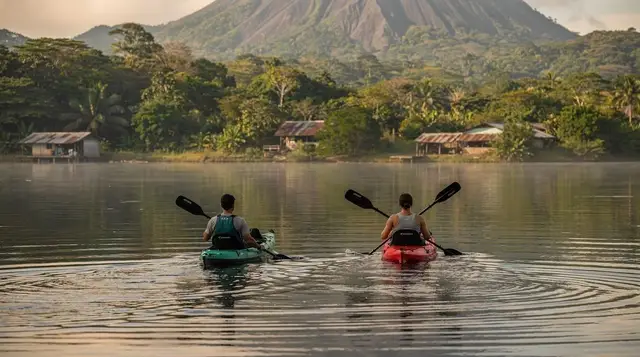
On a clear morning, the reward for the drive out is the classic postcard shot: Arenal’s cone rising directly behind open water, sometimes with a thin collar of cloud, sometimes fully bare. Mornings are the better bet — cloud tends to build through the day and often wraps the summit by early afternoon, a pattern covered in more detail in what to expect when Arenal is cloudy. Don’t plan an entire visit around getting the clean volcano-over-lake photo; treat it as a bonus if the sky cooperates, not the reason the trip is worth it.
The northern shore road, which runs along the water between the dam and Nuevo Arenal, has a string of informal pull-offs and small restaurants with lake-view decks. None of them charge admission just to look — this is one of the few Arenal-area views that costs nothing.
Getting to the Lake From La Fortuna
The dam and the eastern end of the lake are the closest points, roughly 20 to 30 minutes from downtown La Fortuna by car. Continuing along the northern shore road to Nuevo Arenal takes closer to an hour, on pavement that’s in reasonable condition but narrow, hilly, and threaded with one-lane bridges — the kind where the driver facing the yield sign lets the other side go first. If you’re driving yourself, renting a car for the La Fortuna area is worth reading first, since this road is exactly the kind of route where local driving habits catch first-timers off guard.
Many visitors reach the lake as part of a longer trip toward Monteverde, either by road or by the jeep-boat-jeep crossing that uses a boat to cut straight across the water. That crossing deserves its own planning, and comparing the jeep-boat-jeep option against driving the long way around is the better place to work through the trade-offs — this page focuses on the lake itself, not on getting past it.
Things to Do Around the Lake
You don’t need a full-day itinerary to enjoy Lake Arenal, but there’s more here than a five-minute photo stop if you want it.
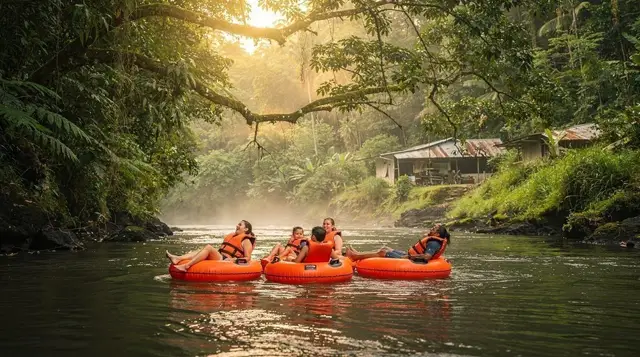
Boat tours with a hot springs stop. The most popular way to experience the lake combines a scenic cruise with a soak, since it solves two things at once: you get out on the water, and you end the outing warm and relaxed rather than just wet from spray. A Lake Arenal boat cruise paired with a hot springs stop typically runs three to four hours door to door, with transport from La Fortuna hotels included.
Kayaking and stand-up paddling. Calm coves near the eastern shore are sheltered enough for beginners, and the volcano-backdrop views are arguably better from water level than from a boat deck. Guided half-day kayak trips are widely available; see kayaking on Lake Arenal for what to expect and where the calmer put-ins are.
Fishing. The lake was stocked with rainbow bass (guapote) and tilapia after it filled, and it’s now a modest but real freshwater fishing destination. Half-day guided trips with a boat and tackle included are the norm; independent shore fishing is possible but less productive.
Windsurfing and kitesurfing. The western end of the lake, toward Tilarán, catches a steady trade wind for much of the dry season and has a small but established windsurfing and kiting scene — one of the more reliable wind spots in Central America. It’s a specialist trip rather than a casual add-on to a La Fortuna day.
Birdwatching. The lake’s edges and the pasture-and-forest mix around it attract a good mix of waterbirds and forest species without the crowds of Monteverde or Caño Negro. Early morning along the northern shore road is the best window.
| Activity | Typical duration | Approx. price (USD) | Notes |
|---|---|---|---|
| Boat cruise + hot springs | 3–4 h | 70–90 pp | Most popular, includes transport |
| Guided kayak / SUP tour | 3–4 h | 45–65 pp | Best on calm eastern coves |
| Guided fishing trip | 4–6 h | 90–150 pp | Boat and tackle included |
| Windsurfing / kiting lesson | 2–3 h | 60–90 pp | Western end, dry season only |
| Roadside viewpoint stop | 15–30 min | Free | No entry fee anywhere on the shore road |
If you’d rather stay closer to the volcano itself, an Arenal Volcano nature walk combined with a hot springs visit covers the forest and thermal-water side of the region without the drive out to the lake proper.
Nuevo Arenal and Tilarán, in Brief
The lake’s shore is anchored by two towns that each deserve their own visit rather than a rushed pass-through: Nuevo Arenal, the relocated village on the northern shore with a small expat community, a Sunday market, and easy access to the lake’s calmer coves; and Tilarán, the windier town at the western end, closer to the wind-sport scene and the back route toward Guanacaste. Both sit directly on the lake but have their own character and their own list of things to do — worth reading separately if either is on your route, rather than folding them into a single lake stop.
A zipline adventure based near Nuevo Arenal is a reasonable way to combine a stop in that town with an activity, if you’re passing through on the way to or from Monteverde.
Where the Shore Meets the Volcano
The road between La Fortuna and the dam also passes close to Arenal Observatory Lodge, whose hillside trails give some of the closest legal views of the 1968 lava field, and near Tabacón, the best-known of the volcano-fed hot springs resorts. Neither is technically “on” the lake, but both sit close enough to the same road that combining a lake outing with one of them in a single day is straightforward, and it’s a common way to structure a first visit — see how many days to plan for La Fortuna if you’re deciding how much of your trip to give this side of the region.
When to Visit
Dry season, roughly December through April, gives the most reliable combination of clear volcano views and steady wind at the western end. It’s also busier and, on the water, can mean stronger midday chop for kayakers, so early mornings are still the better window even in the “good” months.
Green season, May through November, brings more cloud and afternoon rain, but mornings on the lake are frequently calm and clear before the daily buildup arrives — read the best time to visit La Fortuna for how this compares with the rest of the region’s weather pattern. If Lake Arenal is one stop on a longer loop that includes Monteverde, planning La Fortuna and Monteverde together is the more useful starting point than treating the lake as an isolated afternoon.
Practical Notes
There’s no admission fee to view the lake from the shore road, and no single “entrance” the way there is for a national park — it’s a public reservoir with a public road running most of its northern edge. Cell signal is patchy in stretches between La Fortuna and Nuevo Arenal, so download offline maps before you set out if you’re self-driving. Fuel up in La Fortuna or Nuevo Arenal; stations thin out along the shore road itself. And if you’re driving rather than joining a tour, budget more time than the distance suggests — the road’s curves, one-lane bridges, and photo-stop temptations all add minutes that a straight-line map doesn’t show.
Lake Arenal: Common Questions
Is Lake Arenal natural or man-made?
Man-made. It’s a reservoir formed when a hydroelectric dam was closed across the Arenal river in 1979. The basin behind the dam filled and became Costa Rica’s largest lake, at roughly 85 km2.
What happened to the villages that used to be there?
The original settlements of Arenal and Tronadora sat in the valley that the reservoir now fills. Both were relocated before the flooding, rebuilt on higher ground nearby as Nuevo Arenal and Tronadora, which is why the town closest to the lake is called “new” Arenal.
Can you swim in Lake Arenal?
Yes, in places, though it isn’t set up with the beach infrastructure of a resort lake. Most visitors experience the water from a boat, a kayak, or a lakeside restaurant deck rather than swimming.
Is Lake Arenal visible from La Fortuna town?
Not really — La Fortuna sits on the volcano’s southeastern side, and the lake stretches away to the west and northwest. You need to drive out toward Nuevo Arenal or up onto the dam road to see open water.
What’s the best way to see the lake with only a few hours?
A short boat tour that combines a spin on the water with a stop at a hot springs resort is the most time-efficient option, since it packs the two things people actually come for — the view and a soak — into one outing.
Do I need a rental car to visit the lake?
It helps but isn’t essential. Organized boat and kayak tours include transport from La Fortuna hotels, so a car mainly matters if you want to stop freely at the roadside viewpoints along the northern shore or continue on toward Nuevo Arenal on your own schedule.
Is the western end of the lake worth the extra drive?
For windsurfers and kiters, yes — the western end near Tilarán is one of the more reliably windy stretches of water in Central America. For a general sightseeing stop, the closer eastern and northern shore views are usually enough.