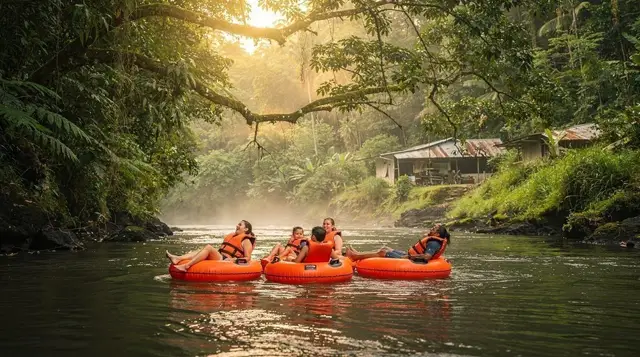
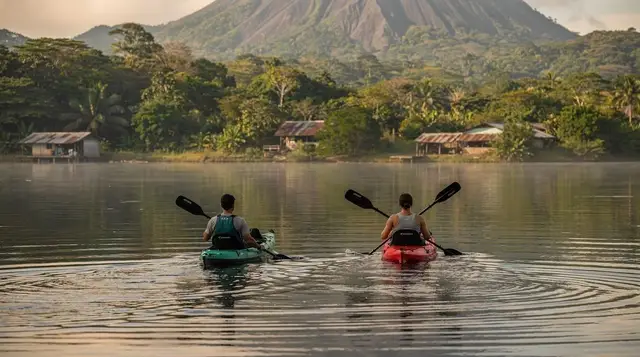
Kayaking on Lake Arenal, Costa Rica
Is kayaking on Lake Arenal worth it?
Yes, for calm-water paddling with a volcano backdrop and birdlife along the shoreline, but book an early-morning slot. Lake Arenal is Costa Rica's largest lake, created by a 1979 dam, and afternoon wind regularly turns the surface choppy from around midday onward.
A Lake That Didn’t Exist Before 1979
Everything about paddling Lake Arenal starts with one fact: the lake is younger than most of the people who visit it. It didn’t exist as it looks today until the Arenal Dam was closed in 1979, backing up the Río Arenal and several smaller streams into a reservoir of roughly 85 km2 — the largest lake in Costa Rica. Two villages, Arenal and Tronadora, sit under the water; their communities were relocated and rebuilt higher up as Nuevo Arenal and Tronadora. The dam still generates a meaningful share of the country’s electricity and feeds irrigation systems in Guanacaste, so this is a working lake as much as a scenic one.
None of that history is visible from a kayak, but the shape of the lake is. It’s long, narrow, and hemmed in on the east end by the near-perfect cone of the Arenal volcano, which is exactly why people want to paddle here in the first place: flat water, forested shoreline, and — on a good morning — a volcano rising straight out of the far end of the lake. On a bad morning, that same volcano is a grey wall of cloud, and that’s the trade-off this guide is honest about before you book anything.
What Kayaking on Lake Arenal Actually Involves
Most commercial kayak trips launch from the eastern end of the lake, closest to La Fortuna and El Castillo, or from access points nearer Nuevo Arenal and Tilarán on the western shore. You’ll typically be in a sit-on-top kayak — stable, hard to capsize, easy to climb back onto if you do go in — paddling in a small group with a guide a short distance from shore rather than out into open water. It’s recreational paddling, not a sea-kayaking expedition: expect calm, flat conditions rather than waves, and a pace that suits beginners.
A typical morning runs like this: pickup from your hotel in La Fortuna, a 30–45 minute transfer to the launch point, a safety and paddling briefing, then 60–90 minutes on the water before the wind picks up. Guides point out birdlife along the shoreline — herons, kingfishers, sometimes toucans in the trees above the water — and, cloud cover permitting, stop for photos with the volcano in frame. Some itineraries add a swim break in a quiet cove; check with your specific operator, since not every trip includes one.
a guided Kayaking on Lake Arenal tour is the standard version of this outing — small groups, a set morning departure, transport from La Fortuna included. this La Fortuna: Lake Arenal Kayaking Trip covers similar ground with a different operator and pickup window, worth comparing if the first slot you check is sold out.
Why the Trips Leave So Early
Lake Arenal sits in one of the windiest corridors in Central America. The same wind that makes the western end of the lake, near Nuevo Arenal and Tilarán, a destination for windsurfers and kitesurfers is the reason kayak tours don’t run in the afternoon. Air funnels between the volcano and the Cordillera de Tilarán, and the lake is close to still at dawn, then builds through the morning as the day heats up, typically turning choppy by early-to-mid afternoon. This isn’t a light-breeze inconvenience — a kayak that felt easy to control at 7:00 a.m. can be genuinely hard work against a headwind by 1:00 p.m.
That’s the entire reason nearly every operator on this page departs between 7:00 and 9:00 a.m. It isn’t about light for photos, though the early light helps; it’s about paddling before the wind arrives. If a tour offers you an afternoon slot, ask directly what the wind has been doing that week before you commit — some weeks it builds later than others, but you’re gambling either way.
The Volcano View: Don’t Book on the Promise of It
This needs saying plainly, because plenty of marketing photos imply otherwise: you are not guaranteed to see the Arenal volcano from the lake, even on an early-morning tour. Cloud cover on the summit is common at almost any hour, and mornings are not automatically clearer than afternoons — the cone can be wrapped in cloud from sunrise straight through to dusk on a given day, and it can also clear briefly and close back up within the hour. Guides watch conditions and time departures to give you the best realistic chance, but nobody controls the weather over a 1,670 m stratovolcano in a rainforest climate.
What you’re actually booking, reliably, is calm water, forest shoreline, and birdlife — a pleasant morning on the country’s biggest lake. The volcano is a bonus if the sky cooperates, not the guaranteed centerpiece. If a fully clear summit view is the one thing that would make or break the trip for you, treat the odds as a coin flip at best and plan accordingly rather than being disappointed on the water.
Comparing the Ways to Get on Lake Arenal
| Option | Format | Typical length | Best for |
|---|---|---|---|
| Guided kayak tour from La Fortuna | Small group, sit-on-top kayaks, guide | 2–3 hrs door to door | First-timers, wildlife spotting, no gear hassle |
| Self-paddled rental at El Castillo | Solo or pair, no guide | Hourly, your pace | Independent travelers with a car, flexible timing |
| Standup paddleboard rental | Solo, no guide | Hourly | Travelers who prefer SUP to sitting |
| Sunset or evening lake crossing | Motorized boat, one-way transport | Half day with transfer | Combining lake time with travel to Monteverde |
renting a kayak or paddleboard by the hour near El Castillo is the option to know about if you have your own rental car and want to set your own schedule rather than join a fixed morning departure. It’s a straightforward self-guided rental at the lake’s edge — you carry your own timing risk on the wind, so still aim to be off the water before midday.
Kayaking vs. the Jeep-Boat-Jeep Crossing: Two Different Things
People sometimes conflate a kayak tour with the jeep-boat-jeep crossing to Monteverde, because both put you on Lake Arenal. They’re unrelated in purpose. The jeep-boat-jeep route is a one-way transport solution: a minibus from La Fortuna to the lake, a motorized boat across the water, and a second minibus up to Santa Elena, cutting a 3.5–4 hour road trip on the unpaved Route 702 down to roughly 3 hours total. You’re not paddling; you’re being taken across, luggage and all, to reach Monteverde.
A kayak tour, by contrast, is a self-propelled recreational outing that starts and ends back in La Fortuna the same morning. If your itinerary includes both a lake kayak session and a later transfer to Monteverde, they’ll be separate bookings on separate days, not one experience. Worth knowing before you assume a “lake crossing” tour will let you paddle, or that a kayak tour will get you to Monteverde — neither is true.
If your evening plans point toward Monteverde rather than a morning paddle, the La Fortuna to Monteverde Lake Crossing Night Tour is the transport option, not a paddling one — worth booking on its own terms.
Best Time of Day and Season
| Factor | Morning (before ~11 a.m.) | Afternoon |
|---|---|---|
| Wind | Usually calm to light | Builds, often choppy |
| Volcano visibility | Possible, never guaranteed | Possible, never guaranteed |
| Wildlife activity | Higher — birds active early | Lower |
| Heat | Cooler, more comfortable paddling | Warmer, more exposed |
Seasonally, Lake Arenal can be paddled year-round, but expect more frequent rain delays and a browner, more churned-up shoreline during the peak of the green season from roughly September through November. Rain in this part of Costa Rica tends to arrive in the afternoon rather than the morning, which happens to line up neatly with the early kayak departures — one more reason operators keep pushing trips toward sunrise.
Getting to the Launch Point
Most kayak tours include hotel pickup from La Fortuna and handle the transfer as part of the booking, so you don’t need your own transport. If you’re driving yourself — say, to reach the self-paddled rental near El Castillo — the drive from central La Fortuna is short, around 30–45 minutes depending on your hotel, mostly on paved road with the final stretch to some launch points on gravel. Watch for the area’s frequent one-lane bridges; whichever direction reaches the “CEDA EL PASO” sign first yields.
Travelers combining a kayak morning with a longer swing around the lake sometimes continue on to Nuevo Arenal or Tilarán afterward — renting a car for the wider La Fortuna area makes that kind of loop easy, while getting around without a car still works fine if you’re sticking to a single organized kayak tour with pickup included.
What to Pack
- Quick-dry clothing and a swimsuit worn underneath
- A hat and reef-safe sunscreen — there’s little shade once you’re on the water
- A light layer for the cooler pre-dawn transfer and launch
- Closed-toe water shoes or sandals with a back strap
- A dry bag or waterproof phone pouch if your operator doesn’t provide one
- A reusable water bottle
Leave valuables at your hotel. Most tours provide life jackets and, where required, a dry bag for small items, but don’t count on secure storage for anything you’d hate to lose overboard.
Combining Lake Arenal with the Rest of the Trip
A morning kayak session pairs naturally with an afternoon back in town, since most tours have you back in La Fortuna by late morning with the rest of the day open. Travelers building out a longer stay around the lake often add it to an itinerary that includes Monteverde, pairing an early paddle with the lake crossing later that day or the next.
For a broader look at what else fills a lake-focused day, the things to do around Lake Arenal hub rounds up hiking, boating, and dam-view stops beyond kayaking, and travelers weighing multiple water-based mornings can browse the wider kayaking and boating category for comparisons with river-based options like the Río Frío boat tours further north.
If you’re still deciding whether the volcano side of La Fortuna or the cloud forest side of Monteverde deserves more of your itinerary, this comparison and the Monteverde day trip guide both cover ground that intersects with a Lake Arenal morning, since the lake sits geographically and logistically between the two.
Kayaking on Lake Arenal: Your Questions Answered
Is kayaking on Lake Arenal worth it?
Yes, for calm-water paddling with a volcano backdrop and birdlife along the shoreline, but book an early-morning slot. Lake Arenal is Costa Rica’s largest lake, created by a 1979 dam, and afternoon wind regularly turns the surface choppy from around midday onward.
Will I definitely see the Arenal volcano from the lake?
No. Cloud cover on the summit is common even in the early morning, and the cone can stay wrapped in cloud for an entire outing. Guides watch the sky and pick departure times to improve the odds, but nobody can promise a clear view on a given day.
Why do kayak tours on Lake Arenal leave so early?
Wind. Lake Arenal sits in a natural wind corridor between the volcano and the Cordillera de Tilarán, and it is calm most mornings, then builds through the afternoon as the trade winds funnel across the water. Most operators launch between 7:00 and 9:00 a.m. to paddle before the chop sets in.
Do I need kayaking experience to do this?
No. Most Lake Arenal kayak trips use stable sit-on-top kayaks on flat water near the shoreline, and guides give a short paddling briefing before setting off. It suits first-timers and families with older children.
Can I paddle Lake Arenal on my own, without a tour?
Yes, at a few points around the lake, mainly near El Castillo and Nuevo Arenal, where operators rent kayaks and stand-up paddleboards by the hour. A self-paddled rental gives you flexibility but no guide to read the wind or point out wildlife.
How long is a typical Lake Arenal kayak trip?
Guided outings usually run 2 to 3 hours including transport from La Fortuna, with roughly 1 to 1.5 hours actually on the water. Sunset and night-crossing options run longer and cover more distance since they combine paddling or boating with a transfer toward Monteverde.
Is Lake Arenal warm enough to swim after kayaking?
The lake is a comfortable freshwater temperature most of the year and some tours build in a swim stop, but check with your specific operator since not all itineraries include one. It is not thermally heated like the hot springs around La Fortuna — this is ordinary lake water, not volcanic runoff.
What should I bring on a Lake Arenal kayak tour?
Quick-dry clothing, a swimsuit under your clothes, reef-safe sunscreen, a hat, and a dry bag or waterproof phone pouch if your operator doesn’t supply one. Mornings on the water can feel cool before the sun is fully up, so a light layer helps.
Is kayaking on Lake Arenal different from the jeep-boat-jeep crossing to Monteverde?
Yes, they’re separate activities that happen to use the same lake. A kayak tour is a short recreational paddle near the shore that returns you to La Fortuna, while the jeep-boat-jeep crossing is a one-way transport option that uses a motorized boat to cut hours off the road trip to Monteverde.
Kayaking and boating on GetYourGuide
Verified deep-linked GetYourGuide tours. Book through these links and we earn a small commission at no cost to you.
GetYourGuide does not provide a product photo for this activity — the image shows the meeting point, photographed by us.