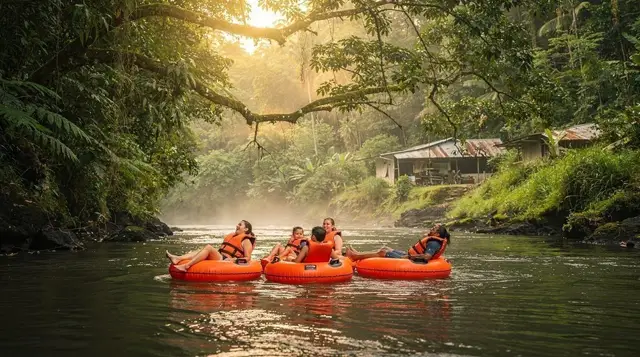
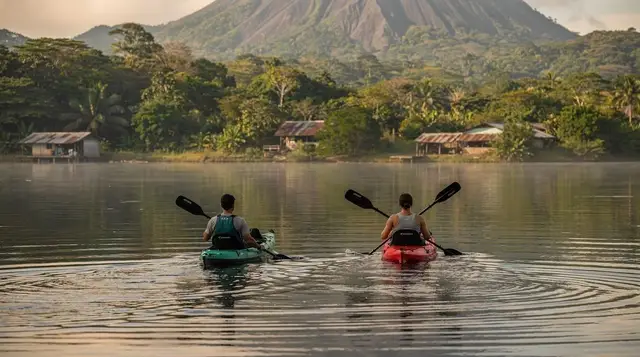
A working town, not a resort stop
Tilarán sits on the far western edge of Lake Arenal, on the opposite shore from La Fortuna and well past Nuevo Arenal. It’s a genuine Costa Rican town — a grid of streets around a plain concrete church, a Saturday cattle market, hardware stores instead of zipline booths — and it makes its living from ranching and, increasingly, from wind.
That last point matters more than it sounds. Tilarán sits in a natural funnel where cool air from the Caribbean lowlands squeezes through the Cordillera de Tilarán before spilling out toward Guanacaste. The result is some of the most reliable wind in Central America, strong enough that this stretch of the lake has a small but committed following among windsurfers and kitesurfers, mostly clustered around the village of Tronadora and the shoreline closer to Nuevo Arenal rather than the town centre itself.
This page covers Tilarán the town and its immediate surroundings — the western end of the lake basin, the road toward Guanacaste, and the practical business of passing through. It does not cover Nuevo Arenal or the lake itself, both of which have their own pages, since they’re different stops with different reasons to visit.
The one thing to get straight before you plan around this
Tilarán is not a detour you casually add to a short stay based in La Fortuna. It’s roughly 65 to 70 kilometres from La Fortuna by road, and because the route curls around the northern and western shore of the lake through Nuevo Arenal, that distance takes 2 to 2.5 hours, not the 45 minutes the map distance might suggest. A round trip alone eats close to half a day, before you’ve done anything in the town itself.
If you’re staying in La Fortuna for two or three nights and trying to fit in the waterfall, the hanging bridges, and a hot spring evening, Tilarán does not belong on that list. It earns a place on your itinerary under different circumstances:
- You’re driving the full Lake Arenal loop — La Fortuna, along the north shore past Nuevo Arenal, around to Tilarán, and back — as a scenic half-day or full-day drive.
- You’re continuing overland from the Arenal area toward Guanacaste (Liberia, the beaches, Rincón de la Vieja) and Tilarán sits naturally on that route.
- You’re heading toward Monteverde by road rather than by jeep-boat-jeep crossing, in which case Tilarán is a plausible fuel-and-food stop, though not the only one.
- You specifically want to try windsurfing or kitesurfing on the lake’s windier western reaches.
Outside those cases, most visitors are better served treating Tilarán as a place they pass through rather than a destination they plan a night around.
Getting there and what the road is like
From La Fortuna, the drive to Tilarán runs along the paved and mostly reasonable Route 142 around the north side of the lake, through Nuevo Arenal, before the road curves south and west toward Tilarán itself. This section is in noticeably better shape than the rough Route 702 that continues on toward Monteverde and Santa Elena — a distinction worth knowing if you’re weighing which way to route a rental car. A 4x4 is not strictly required for the Tilarán leg the way it can be for the Monteverde back roads, though clearance still helps on side roads down to the lakeshore.
Expect single-lane bridges on this stretch, as almost everywhere in the northern zone — the vehicle facing the CEDA EL PASO (yield) sign gives way, and the etiquette is well established locally even where signage is faded. Fuel up before you leave La Fortuna or Nuevo Arenal; stations thin out on the western side and Tilarán’s own station is not always the cheapest option in the region.
Public buses connect Tilarán to both La Fortuna (via Nuevo Arenal) and to Liberia and San José, but schedules are infrequent and mostly serve locals rather than tourists, which is one more reason this town suits travellers with a rental car more than those relying on shuttles.
What there actually is to do
Tilarán is not built around attractions in the way La Fortuna is, and that’s part of its appeal for the travellers it does suit. The town itself is walkable in under an hour: a central park, a modest church, a handful of sodas serving casados at local prices rather than tourist markups, and a Saturday market that’s genuinely for residents, not visitors.
Windsurfing and kitesurfing. This is Tilarán’s actual claim to fame among a specific crowd. The wind here is a product of the Cordillera funnel effect and is strongest from December through April, the same dry season that suits most of the rest of the country’s outdoor activities. Rental operations and instruction cluster more around Tronadora and the lakeshore between Tilarán and Nuevo Arenal than in Tilarán town proper — if this is your reason for coming, plan to base yourself lakeside rather than in the town centre.
A quieter alternative to the tourist strip. If you’ve spent several days around La Fortuna’s concentration of tour desks and gift shops, Tilarán offers a genuine change of register — nobody here is selling you a zipline pass. For travellers who want one stop on their Costa Rica trip that feels unperformed, this is a reasonable candidate, with the honest caveat that “quiet town” is also just… quiet. There isn’t a marquee sight.
A base for onward routes. Tilarán works as a logical overnight if you’re threading a longer loop — say, La Fortuna to the lake to Guanacaste’s beaches, or La Fortuna to Monteverde by road with a break partway. It is rarely worth booking a night here for its own sake alone.
What Tilarán is not
It’s worth being direct about what this page is not covering, because the source material for this region gets blurred easily. Tilarán is not Nuevo Arenal, the smaller lakeside village 25 minutes east that was rebuilt after the original town was flooded by the 1979 dam, and which has its own cluster of restaurants and the zipline canopy tour listed below.
It is not Lake Arenal itself, covered separately as the body of water and its recreational uses. And it is not on the way to anything in the La Fortuna–Arenal core — the waterfall, the hanging bridges, or the hot springs are all firmly on the opposite side of the lake, back toward La Fortuna.
If your real interest is a scenic tour of Nuevo Arenal’s lakeside canopy rather than Tilarán town, that’s a short and pleasant add-on to the drive: a zipline adventure through the forest above Nuevo Arenal sits directly on the route between La Fortuna and Tilarán and is a far more efficient use of a half-day than the town itself.
Continuing to Monteverde or Guanacaste from here
Tilarán’s most practical role for most itineraries is as a waypoint rather than an endpoint. From here, the road continues southwest toward Guanacaste and Liberia, useful if you’re flying out of LIR or heading to the Pacific beaches, or you can pick up the rougher road toward Santa Elena and Monteverde if you’re not taking the jeep-boat-jeep crossing shortcut across the lake.
If Monteverde’s cloud forest is your actual goal, it’s worth being clear-eyed that Tilarán does not shorten that trip meaningfully compared with the standard routes — most visitors coming from La Fortuna still find the jeep-boat-jeep crossing faster and simpler than any all-road option through Tilarán. Once in Monteverde, the reserves and canopy activities are well documented elsewhere; Selvatura’s hanging bridges and sloth exhibit is one of the more popular half-day combinations there.
Where to stay
Accommodation in Tilarán itself is limited and functional — small hotels and cabinas oriented toward ranching business and passing drivers rather than tourism, generally in the 30 to 60 USD range for a double room. Travellers chasing lake views or a more polished stay tend to base themselves in Nuevo Arenal or Tronadora instead, both closer to the water and better served by restaurants aimed at visitors. Book Tilarán itself only if your route genuinely requires an overnight stop here — otherwise the lakeside villages nearby are the better choice for the same detour.
Budgeting a stop in Tilarán
| Item | Typical cost (USD) |
|---|---|
| Casado at a local soda | 5–8 |
| Simple hotel room, double | 30–60 |
| Windsurf or kitesurf rental (half day) | 40–70 |
| Fuel top-up (partial tank) | 15–30 |
| Coffee and snack | 2–5 |
These are meaningfully lower than prices around La Fortuna’s tourist core, which is part of what makes Tilarán appealing as a change of pace — but it also reflects that there’s simply less built for visitors to spend money on.
Practical notes
Spanish is the default language here far more than in La Fortuna or Monteverde; English is spoken at some hotels and among windsurf operators but not widely in town restaurants or shops. ATMs exist in the town centre but are fewer than you’d find in La Fortuna, so carry cash, ideally colones — Tilarán’s economy runs on the local currency more than the dollarised tourist zones closer to the volcano. As with the rest of the northern zone, closed shoes are sensible if you’re walking any of the rural roads or ranch tracks around town, and the same fer-de-lance caution that applies around La Fortuna applies here too.
If your trip includes a stop at Baldi or another hot spring complex before or after your lake loop, it’s worth booking ahead in high season; a Baldi Hot Springs admission ticket is one of the more flexible options for slotting into a day that also includes a long drive.
Tilarán and the lake loop, put simply
The honest way to think about Tilarán is as one edge of a triangle — La Fortuna, the north shore villages, and Tilarán itself — rather than as a stop with its own gravitational pull. Visitors who build a day around driving that triangle, stopping for lunch and maybe a wind-sport session, tend to come away satisfied. Visitors who make a special trip out from La Fortuna expecting a headline attraction tend to find Tilarán underwhelming, because that was never really its role.
Set expectations accordingly and it’s a pleasant, low-key half-day; skip it without regret if your time in the region is short and the waterfall, the 1968 lava trail, and the hot springs are still on your list.
Tilarán frequently asked questions
Is Tilarán worth a day trip from La Fortuna?
Generally no — the round trip alone is around 4 to 5 hours of driving, which is a heavy cost against a short stay. It makes more sense as part of a full lake loop or as a stop on a longer route toward Guanacaste or Monteverde, not as a standalone excursion from a La Fortuna base.
How far is Tilarán from La Fortuna?
About 65 to 70 kilometres by road, but the route around the lake through Nuevo Arenal takes roughly 2 to 2.5 hours rather than the under-an-hour a straight-line distance might suggest.
Is Tilarán the same as Nuevo Arenal?
No. Nuevo Arenal is a smaller lakeside village around 25 minutes east of Tilarán, rebuilt after the original settlement was flooded by the 1979 dam. Tilarán is a separate, larger regional town further west and set back from the immediate shoreline.
Why is Tilarán known for wind?
The Cordillera de Tilarán creates a natural funnel that channels air from the Caribbean lowlands toward Guanacaste, producing some of the strongest and most consistent wind in Central America. This has made the western end of Lake Arenal, particularly around Tronadora, a minor hub for windsurfing and kitesurfing.
What’s the best time of year to visit Tilarán?
December through April, the dry season, brings both the most reliable weather for driving the lake road and the strongest, most consistent winds for windsurfing or kitesurfing.
Can I use Tilarán as a stop between La Fortuna and Monteverde?
Yes, if you’re driving the full road route rather than taking the jeep-boat-jeep crossing. It’s a reasonable place to break the journey for food or fuel, though it doesn’t meaningfully shorten the trip compared with other stops along the same road.
Is there much to do in Tilarán itself?
Not in the way of headline attractions. It’s a working ranching town with a central park, a market, and simple local restaurants — worthwhile for travellers who want a quieter, unpolished stop, but not a place with a must-see sight.
Do I need a 4x4 to reach Tilarán?
Not specifically for the Tilarán leg from La Fortuna via Nuevo Arenal, which is mostly paved. A 4x4 becomes more useful if you continue from Tilarán toward Monteverde on the rougher back roads, or explore unpaved side roads down to the lakeshore.