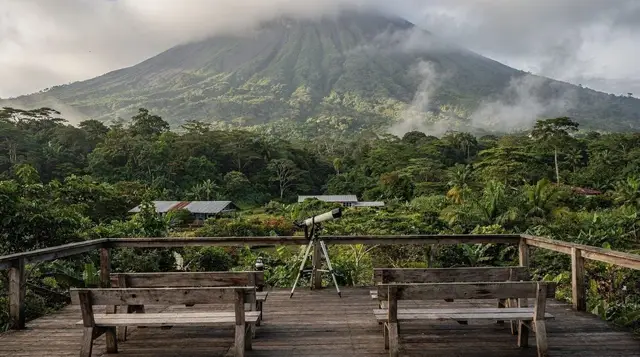
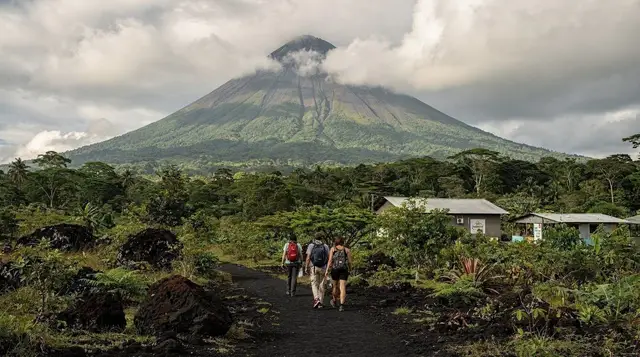
Most of Guanacaste’s volcano photographs come from a distance — a cone on the horizon, seen from a beach or a car window. Rincón de la Vieja is the opposite kind of encounter. You park at a ranger station, walk twenty minutes through dry forest, and the ground itself starts working: grey mud pots gulping and popping, sulphur-crusted vents hissing steam, a smell that reaches you before the view does. It is one of the few places in Costa Rica where an active volcano is something you experience at close range on your own two feet, not something you photograph from a lodge terrace.
A Different Kind of Active Volcano
Rincón de la Vieja rises to 1,916 m in the Cordillera de Guanacaste, and unlike Arenal it has never settled into the postcard-cone shape most people picture when they hear “volcano.” It is broader, older, and its crater complex vents gas more or less constantly. That makes it genuinely active in the geological sense — periodic ash and steam episodes have closed park trails in past years, the same way Poás occasionally shuts its viewpoint when gas readings spike.
What it is not, and has not been in living memory, is a source of visible lava. Confusing the two is the single most common mistake in how this volcano gets described online. The activity that draws hikers here is geothermal, not eruptive: boiling mud pots, sulphur fumaroles, hot streams and mineral pools, all fed by the same underground heat that, on the Arenal side near La Fortuna, warms the hot springs at Tabacón and Baldi. If you have already spent an evening soaking near La Fortuna, Rincón de la Vieja is the version of that same geology you get to walk across in daylight, boots on, at a safe distance from anything actually dangerous.
The national park protecting the mountain has two separate entrances on opposite flanks, and which one you visit changes the day considerably.
Las Pailas: The Sector Almost Everyone Means
When a tour operator, a hotel desk or a blog says “Rincón de la Vieja,” they are almost always describing the Las Pailas sector, reached from the Liberia side of the mountain. It is the more developed and more visited half of the park, and for good reason: a well-marked, mostly flat loop trail of a few kilometres brings you past the park’s signature features in a couple of hours without technical hiking.
Along the loop you pass fumaroles — narrow vents ringed in yellow sulphur crust, exhaling steam with a low hiss — and several mud pots (las pailas literally means “the cauldrons”), grey mud bubbling and popping in slow motion behind safety railings. A side spur leads to a small waterfall and a cool river crossing, a welcome contrast after the hot, exposed ground near the vents. None of this is dangerous to visit on the marked trail, but it is genuinely hot underfoot in places, and rangers close sections without notice if gas readings rise, so build a little flexibility into your plan rather than a tight return-transfer schedule.
Las Pailas is also the trailhead for the long summit route to the crater rim — a serious, full-day hike on its own, frequently closed, and not something to bolt onto a day trip that already starts with a three-hour drive each way from La Fortuna. Treat the short fumarole loop as the realistic goal for a single day, and the summit as a reason to base yourself in Guanacaste overnight if you want to attempt it properly.
Santa María: The Quieter Side
On the far side of the mountain, the Santa María sector centres on a restored 19th-century hacienda rather than the boiling-mud scenery of Las Pailas. It is quieter, involves more driving from Liberia, and pairs its own hiking trails with hot spring pools closer to the historic buildings. Few day-trippers from La Fortuna make it out this way, simply because the extra driving on top of an already long day rarely pencils out. If Rincón de la Vieja is one stop on a longer Guanacaste loop with a night near Liberia, it is worth the detour; as a single day trip from La Fortuna, Las Pailas covers the experience most people are after.
Getting There from La Fortuna
Budget around 3 hours each way by road, heading south toward Ciudad Quesada before turning west across the plains toward Liberia and then north into the park. It is a longer drive than most excursions from La Fortuna, closer in scale to a trip to Liberia itself or a transfer to and from the airport there than to a half-day outing.
That distance shapes how the day should be planned. A guided day tour with hotel pickup handles the driving, the park entrance and usually a stop for food or a hot spring afterwards, which is the main reason most La Fortuna visitors book one rather than self-driving.
If you are renting a car, the final approach road to the Las Pailas ranger station is unpaved gravel — fine in a standard sedan through the dry season, noticeably rougher and better suited to a 4x4 once the rains set in. Either way, factor the drive into your overall trip logistics the same way you would arriving via Liberia airport: this is Guanacaste geography, not the tight cluster of sights immediately around La Fortuna town.
For travellers whose itinerary already routes through LIR airport — flying in or out of Liberia rather than San José — Rincón de la Vieja sits close enough to fold into that leg of the trip rather than as a dedicated round trip from La Fortuna. Coming or going, it is worth checking how Liberia connects to La Fortuna before deciding whether to see the volcano on the way in, the way out, or as a standalone day.
Booking the Volcano Reservation
Buy your park entrance in advance through the national reservation system rather than showing up and hoping for a spot — both sectors cap daily visitor numbers, and weekends and Costa Rican holiday weeks sell out. A guided tour typically bundles this reservation into the booking, which is the simpler route if you would rather not track ticket windows yourself.
a full-day trip that pairs the Las Pailas fumarole trail with a soak in nearby thermal pools is the closest thing to a default itinerary for visitors coming from La Fortuna, and it removes the driving and ticketing logistics in one booking. For a longer, more active day, a combined hike, waterfall stop and hot-spring visit on the mountain covers more ground than the short loop alone, including the river crossing and small falls near the trail.
What a Day There Actually Looks Like
A typical tour picks up from La Fortuna hotels in the early morning, given the length of the drive, and reaches the Las Pailas ranger station by mid-morning. The fumarole loop itself takes roughly two to three hours at an easy pace, with stops to look at the mud pots and vents and time at the small waterfall spur. Afternoons are usually given over to lunch and a hot spring or river stop before the drive back, since the return trip alone eats another three hours.
| Stop | Typical time on site | What you actually see |
|---|---|---|
| Las Pailas fumarole loop | 2-3 hours | Mud pots, sulphur vents, short waterfall spur |
| Santa María sector (alternative) | 3-4 hours | Hacienda buildings, quieter trails, its own hot springs |
| Post-hike hot spring stop | 1-2 hours | Thermal pools fed by the same volcanic system |
| Round-trip drive from La Fortuna | ~6 hours total | Ciudad Quesada, the plains, Liberia gateway |
Because the drive consumes so much of the day, few operators try to combine Rincón de la Vieja with much else. One pairing that does work, for travellers already based nearer Liberia rather than La Fortuna, is a stop at La Leona Waterfall, a swimming spot reached from the same Guanacaste corridor and covered in full on its own waterfall guide rather than here. a private trip to that waterfall with tubing and lunch included is a reasonable way to see it if you are staying in Guanacaste rather than adding the extra distance onto a Rincón de la Vieja day from La Fortuna.
Budgeting the Day
| Item | Typical cost (USD) |
|---|---|
| Guided day tour with transport, park entrance, guide | $75-130 per person |
| Self-drive: park entrance only | $15-20 per person |
| Rental car for the day (from La Fortuna) | $45-80 |
| Hot spring add-on or separate visit | $20-45 per person |
| Lunch, if not included in the tour | $10-15 per person |
Self-driving saves money on the transport side but adds the unpaved final approach road and the ticket-reservation step to your own list of things to manage — worth it if you already have a car for other days in the region, less appealing as a one-off arrangement.
Wildlife and What Not to Expect
The forest around Rincón de la Vieja is drier and more open than the cloud forest at Monteverde or the wet lowlands near Caño Negro, and its wildlife sightings tend to be more incidental than the point of the trip — coatis and howler monkeys along the trail, the occasional toucan, rather than a dedicated birding circuit.
If wildlife is the priority for your day, the park’s other national reserves cover that ground better; Rincón de la Vieja’s draw is geological, not zoological. Travellers who want both in one outing sometimes add a short guided night walk on the mountain looking for nocturnal wildlife if staying overnight nearby, since the daytime fumarole trail itself is not set up for wildlife spotting.
Rincón de la Vieja vs. Other Volcano Options Near La Fortuna
Visitors juggling several volcano stops on one Costa Rica trip often ask how this compares to the options closer to home base. Arenal is the classic cone view, its 1968 eruption long over and its lava days finished since 2010 — you look at it, you don’t walk on it. Tenorio trades volcanic drama for the turquoise optics of the Río Celeste, a chemistry story more than a geology one.
Rincón de la Vieja is the one where you walk directly past active vents and bubbling mud, at the cost of the longest drive of the three from La Fortuna. None of them replaces the others; each covers different ground, and which one earns a full driving day depends on how much of your trip is already anchored around things to do near the volcanoes versus waterfalls, wildlife or the beach side of Guanacaste.
For travellers building a broader Guanacaste day into their La Fortuna base, this stop tends to fit best on a trip already themed around adventure activities rather than a first, easy day in the region — the driving alone makes it a commitment, not a casual add-on. Combined with a stop in Liberia itself, whether for a meal, a market or simply breaking up the drive, it turns a long transit day into something closer to a full regional excursion rather than a there-and-back errand.
Practical Notes Before You Go
Wear closed hiking shoes with real grip — sandals do not belong on the fumarole trail even though the destination hot springs afterwards make them tempting to pack. Bring more water than feels necessary; large stretches of the Las Pailas loop have little shade, and the heat near the vents adds to the effort. A light rain layer earns its space in the bag even in dry season, since weather in the Guanacaste hills shifts faster than on the coast below.
Because trail sections close without much notice when volcanic gas readings rise, build slack into your schedule rather than a tight return transfer, and confirm your park reservation the same week you travel rather than assuming last month’s booking window still applies. For a broader sense of how this fits against everything else on a first Costa Rica trip through this region, the common mistakes guide and the seasonal guide are worth reading before you lock in a date.
Frequently Asked Questions About Rincón de la Vieja
Can you see lava at Rincón de la Vieja?
No. Rincón de la Vieja is genuinely active — its crater vents gas and the ground around Las Pailas is hot enough to boil mud — but no lava flow has been observed here in recent history. What you see is steam, sulphur-crusted vents and bubbling mud pots, the same kind of geothermal activity that also heats La Fortuna’s hot springs on the Arenal side.
How do you get from La Fortuna to Rincón de la Vieja?
Plan on about 3 hours by road, driving south to Ciudad Quesada and then west toward Liberia before turning north into the park. Most day tours run this route by minivan with pickup from La Fortuna hotels; if you are driving yourself, the last stretch to the Las Pailas ranger station is unpaved gravel, manageable in a standard car in dry season but easier in a 4x4 after rain.
Do you need a reservation to enter the park?
Book your entrance ticket online in advance through the national park system rather than turning up and hoping for space; capacity at both sectors is limited and popular weekends and holiday weeks sell out. A day-tour operator normally handles this for you as part of the booking.
Las Pailas or Santa María — which sector should you visit?
Las Pailas is the sector almost everyone means when they say Rincón de la Vieja: a short, well-marked loop past the fumaroles and mud pots, reached from the Liberia side. Santa María, on the opposite side of the mountain, is quieter, involves more driving, and centres on a restored hacienda and its own hot springs rather than the boiling-mud scenery — worth it if you have two days in Guanacaste, skippable on a single day trip from La Fortuna.
What should you pack for a visit?
Closed hiking shoes with real tread, long trousers for the brush near the fumaroles, a rain layer even in dry season, and more water than you think you need — the Las Pailas trail has almost no shade. Leave sandals for the hot-spring stop afterwards, not the trail itself.
Is it worth visiting if you have already done Arenal?
Yes, for a different reason. Arenal is a near-perfect cone you view from a distance, its lava days long over. Rincón de la Vieja is a volcano you walk on top of: bubbling mud, hissing vents and sulphur smell at close range. The two make a good contrast rather than a repeat of the same experience.
Can Rincón de la Vieja and La Leona Waterfall be combined in one day?
Yes — they sit in the same Guanacaste corridor near Liberia, and several guided itineraries pair a Las Pailas fumarole walk with a hike down to La Leona’s swimming hole. Coming from La Fortuna this makes for a long day (roughly 3 hours each way plus both stops), so it suits travellers already staying near Liberia more than a rushed round trip from La Fortuna.