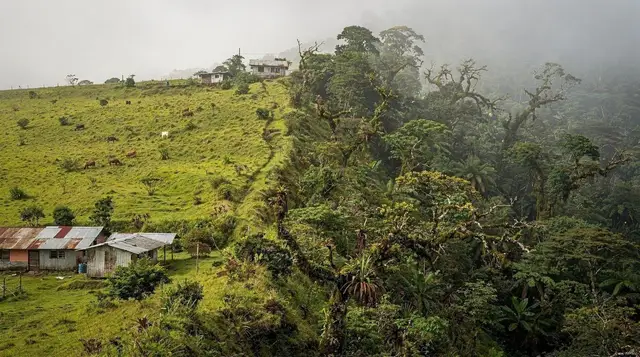
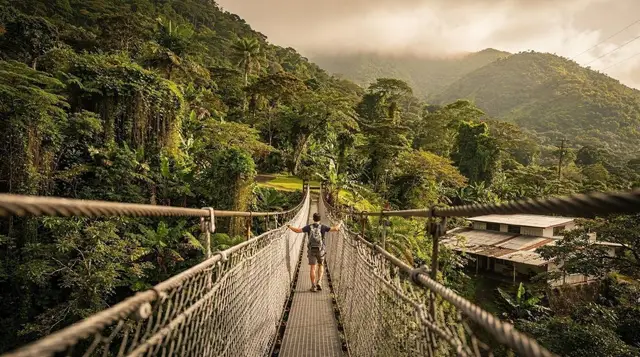
Arriving via Liberia: Guanacaste to La Fortuna in 4 Days
Why start in Guanacaste instead of San José
If your flight lands at Daniel Oduber International Airport (LIR) rather than at San José, you’re already close to a corner of Costa Rica most La Fortuna-only itineraries skip entirely: the fumaroles and mud pots of Rincón de la Vieja. This route uses that advantage. It spends your first two days around Liberia and the volcano, then drives north to La Fortuna for the Arenal Volcano National Park and the La Fortuna Waterfall.
One thing to get straight before you book anything: LIR does not make La Fortuna itself closer. Liberia is roughly 2h30–3h from La Fortuna by road, and San José’s SJO airport is about 3h from La Fortuna. Those two numbers are close enough that “fly into LIR, it’s nearer” isn’t really true — the real advantage of LIR is that it puts you within striking distance of Rincón de la Vieja on arrival day, not that it shaves hours off the trip to Arenal. Budget your time accordingly: this is a 4-day loop, not a shortcut.
This itinerary deliberately leaves out Monteverde and Río Celeste. Both are worth a trip, but neither sits on a sane line between Liberia and La Fortuna — Monteverde means a rough access road in the opposite direction, and Río Celeste (near Bijagua) is a detour that would turn four days into six. If you want either, see La Fortuna and Monteverde or La Fortuna and Río Celeste as separate trips.
Day 1: Land at Liberia, settle near Rincón de la Vieja
Most LIR flights from North America land late morning or early afternoon. Clear immigration, pick up your rental car (see the box below on why a car matters here), and drive roughly 45 minutes to an hour up into the foothills of Rincón de la Vieja, where most of the lodges for this volcano actually sit — not in Liberia town itself.
If you land early enough, an afternoon soak is a good way to reset after a flight. Several ranches on the volcano’s flanks combine hot springs with mud baths fed by the same geothermal system that powers the volcano’s fumaroles — a preview of what you’ll see up close tomorrow.
an afternoon rainforest and hot springs experience on Rincón de la Vieja is a low-effort way to spend arrival-day daylight without committing to a full hike straight off a flight.
Sleep near the park entrance so tomorrow’s early start doesn’t eat into your hiking window.
Day 2: Rincón de la Vieja’s fumaroles and mud pots
Rincón de la Vieja is an active volcano at 1,916m, and the national park’s Las Pailas sector is built around exactly the geothermal features Arenal no longer shows: bubbling mud pots, hissing fumaroles, and sulphur vents you can walk right past on a well-marked trail loop of a few hours. It’s a genuinely different landscape from the rainforest around La Fortuna — more exposed, more mineral, more obviously volcanic underfoot.
Go with a guide rather than freelancing the trail network; several routes fork toward waterfalls and viewpoints that aren’t obvious from the park’s basic map, and a guide will time the loop around when the fumarole fields are least crowded.
a guided volcano hike combining the fumarole trail with a waterfall and hot springs stop covers the park’s highlights in one outing without you having to piece together park logistics solo.
Afternoon: rinse off in another round of hot springs, or take it easy — you’ve got a long drive to La Fortuna tomorrow, and Rincón de la Vieja’s trails involve real elevation gain over uneven volcanic ground, so a lot of visitors are glad to have a lighter second half of the day.
Overnight again near the park, or drop down into Liberia town if you’d rather have restaurant options for the evening.
Day 3: Drive north to La Fortuna
Today is a driving day: Liberia to La Fortuna is about 2h30–3h, mostly on paved roads through Guanacaste’s ranch country before the landscape turns to rainforest as you approach Arenal. Leave in the morning rather than after lunch — the drive isn’t difficult, but you’ll want daylight, and you’ll want time to check in and get oriented before evening.
Watch for Costa Rica’s one-lane bridges throughout the north — whoever reaches the CEDA EL PASO sign yields, not the other way around, and this route has several.
Once you’re in La Fortuna, don’t rush into an activity. Walk the town centre, get a feel for the layout, and get dinner at one of the local sodas rather than a tourist-strip restaurant. Save your energy for the volcano tomorrow — it’s the reason most people make this whole trip.
If you’re not driving yourself, several shuttle operators run the Liberia–La Fortuna route directly; it’s worth booking that transfer a day or two ahead rather than assuming a same-day seat is available.
Day 4: Arenal Volcano and the La Fortuna Waterfall
Your last full day is built around the two things that define this region. Start early at the Arenal Volcano National Park: walk the solidified 1968 lava trail while the cone still has a chance of being visible — cloud cover tends to build through the morning, and by early afternoon the summit is often hidden regardless of season.
One thing worth being upfront about: Arenal hasn’t erupted since 2010. You will not see lava, glowing rock, or anything resembling the volcano’s postcard image from the 1990s. What you’re walking through is the hardened 1968 flow and a genuinely striking cone shape when the clouds cooperate — still worth the morning, just not for the reason older blog posts describe.
a national park hike combined with an afternoon hot springs soak pairs neatly with the rest of the day, since your legs will want the break after the trail.
Midday or early afternoon, head to the La Fortuna Waterfall — about 500 steps down into the canyon (and, unavoidably, 500 back up) to a 70m drop with a swimmable pool below it. Go earlier rather than later; the site limits entries and the light is better before midday cloud rolls in.
Round out the evening with hot springs. If your budget has room for one splurge on this trip, this is where most travellers spend it; if you’d rather save the money, the free hot river at El Choyín near Tabacón does the same basic job with none of the amenities — just watch your bag.
a hot springs day pass with volcano views is a solid mid-range option if you want a proper facility without the highest-end resort price tag.
Getting around this route
| LIR (Liberia) | SJO (San José) | |
|---|---|---|
| Distance to Rincón de la Vieja | ~45 min–1 h | ~4–4.5 h |
| Distance to La Fortuna | ~2h30–3h | ~3 h |
| Best for | Guanacaste-first routes | Central Valley-first routes |
A rental car is genuinely useful for this itinerary — the Liberia–La Fortuna drive is straightforward and having your own schedule for the Rincón de la Vieja days matters, since trailheads and lodges are spread out. If you’d rather not drive, shuttles cover the same route between fixed points; see getting around La Fortuna without a car for what that looks like once you arrive.
Want more time around the volcano?
Four days is enough to see Rincón de la Vieja properly and get a solid first look at Arenal, but it’s a tight fit if you also want the ponts suspendus-style hanging bridges, a night walk, or a rafting trip on the Balsa River. Travellers who fly into LIR and have more time on the back end often extend into our one week in La Fortuna itinerary, picking up from Day 4 of this route and adding the activities this shorter format has to skip.
FAQ: flying into Liberia for La Fortuna
Is LIR actually closer to La Fortuna than SJO?
Not meaningfully. Liberia to La Fortuna runs about 2h30–3h by road, and San José to La Fortuna runs about 3h. LIR’s real advantage is proximity to Rincón de la Vieja and the Guanacaste coast, not a shorter route to Arenal.
Do I need a rental car for this itinerary?
It helps a lot. Rincón de la Vieja’s lodges and trailheads are spread across the volcano’s foothills rather than concentrated in one town, and having your own car removes a layer of scheduling around shuttles for a route with two separate driving legs.
Can I fit Monteverde or Río Celeste into this same trip?
Not without extending it. Both sit in different directions from the Liberia–La Fortuna line, and either would add a full extra day or two of driving. This route sacrifices them deliberately to keep the four days realistic.
Will I see lava at Arenal on this trip?
No. Arenal has been dormant since October 2010, with no visible lava or lava flow activity since then. What you’ll see is the volcano’s cone (when cloud cover allows) and the hardened 1968 lava trail.
How many days should I add if I want to see more of the Arenal area?
At least three more. The one week in La Fortuna itinerary picks up where this one leaves off and adds hanging bridges, a night walk, and river activities that this four-day format doesn’t have room for.
Is Rincón de la Vieja worth two days on its own?
For most travellers, one full day of hiking is enough to see the park’s fumarole and mud pot trail properly; the second day in this itinerary is really a travel buffer that also allows for a relaxed hot springs stop before the drive north.
What’s the best time of day to see the Arenal cone?
Early morning, generally before mid-morning cloud buildup. This holds in both the dry season (December–April) and green season (May–November) — La Fortuna sits on the windward side of the volcano and gets cloud cover year-round.
tours.4 days
Verified deep-linked GetYourGuide tours. Book through these links and we earn a small commission at no cost to you.
GetYourGuide does not provide a product photo for this activity — the image shows the meeting point, photographed by us.