La Fortuna and Monteverde: 5 Days of Volcano and Cloud Forest
Most first-time visitors to northern Costa Rica try to fit in everything the region offers, and end up rushing all of it. This route picks two destinations that sit close together on the map but feel completely different — a volcano base town built around heat and adrenaline, and a cool, damp cloud forest built around silence and canopy — and gives each one enough time to actually land.
Why La Fortuna and Monteverde work as a pair
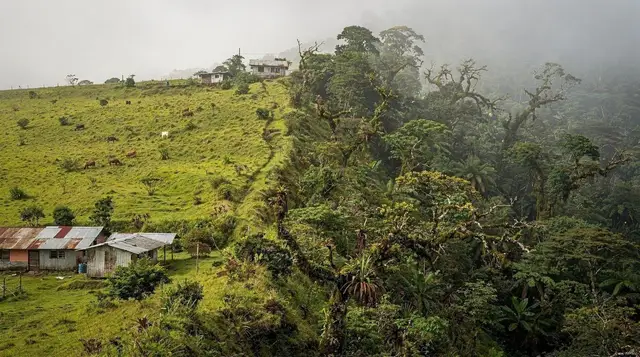
La Fortuna and Monteverde are only about 35 km apart as the crow flies, but Lake Arenal sits between them, and there’s no road that crosses it directly. That geography is exactly why this pairing works so well logistically: instead of a long backtrack through San José, you cross the lake itself, and you land in a second ecosystem entirely — from steamy lowland rainforest at 250 m to cool cloud forest at 1,400 m — in about three hours.
The trade-off is that this itinerary skips Río Celeste and Caño Negro on purpose. Both sit roughly north and east of La Fortuna, in the opposite direction from Monteverde, and trying to squeeze them in means long backtracks that undercut the whole point of a relaxed five-day trip. If a turquoise river matters more to you than a cloud forest, our La Fortuna and Río Celeste itinerary is the better fit — read our La Fortuna vs Río Celeste comparison if you’re torn.
Day 1: Arrive and settle into La Fortuna
However you arrive — via San José’s SJO airport (about 3 hours by road) or via Liberia’s LIR airport (about 2.5–3 hours) — plan for most of day one to be travel. Check into La Fortuna town, a compact grid of sodas, tour desks and small hotels that’s easy to walk in an hour.
Spend the afternoon getting oriented rather than booking a big excursion. Walk the town centre, eat at one of the local sodas rather than a hotel restaurant, and get an early night — the volcano is usually clearest in the first hour or two after sunrise, before clouds build up around the cone.
One thing worth saying clearly here: nobody sees lava at Arenal anymore. The volcano’s last eruptive activity ended in October 2010, after 42 years of near-continuous strombolian eruptions following the catastrophic blast of 29 July 1968. What you’re visiting today is a dormant, near-perfectly conical stratovolcano — beautiful, but quiet. For the full story, see the lava lie about Arenal.
Day 2: Waterfall, hot springs, and the volcano’s shadow
Start early at the La Fortuna waterfall, a roughly 70 m drop reached by about 500 steps down into the canyon — and, on the way out, back up. The stairs are the real workout of this itinerary; wear shoes with grip. You can swim in the pool downstream of the falls, not underneath it, since the current at the base is genuinely strong.
Spend the afternoon at Arenal Volcano National Park, walking the solidified 1968 lava trail. This is where the eruption’s real scale is visible: boulder fields and forest regrowth over the flow that destroyed Tabacón, Pueblo Nuevo and San Luis, and killed around 87 people. A guided walk through this landscape does more to explain the volcano than any viewpoint photo, which is why we’ve built this day around it:
a guided walk across the 1968 lava trail with a naturalistIn the evening, soak the stairs and the trail out of your legs. If you want a full resort experience with pools, swim-up bars and landscaped grounds, budget 60–115 USD; if you’d rather spend that money elsewhere, El Choyín, the free public hot river near Tabacón, is a genuinely good alternative — just watch your belongings, since it’s unsupervised. Either way, don’t expect to see the volcano’s summit at night; it’s more often in cloud than not.
Day 3: Hanging bridges and the lake
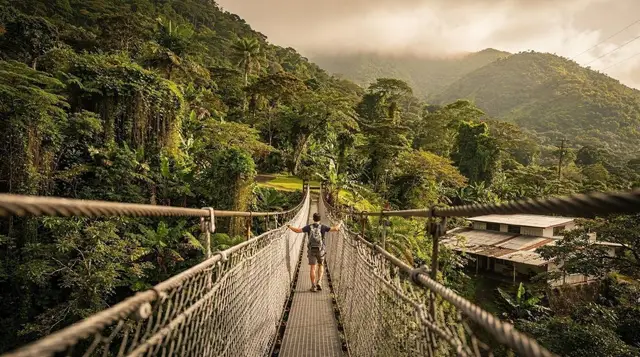
Devote the morning to a hanging bridges walk — this is the single most-repeated activity in La Fortuna, and for good reason. Several different parks offer it, and their names get confused constantly, so it’s worth knowing which one you’re booking:
a rainforest hanging bridges walk near El CastilloFor the full breakdown of Mistico, Sky Adventures and the Arenal Hanging Bridges park, see our hanging bridges parks compared guide before you book — the three are genuinely different experiences at different price points.
In the afternoon, get out onto Lake Arenal itself. The lake is entirely artificial — a dam completed in 1979 flooded the valley and the original villages of Arenal and Tronadora, which were rebuilt higher up as Nuevo Arenal. A boat trip gives you the closest thing to a “picture-postcard” volcano view of the whole trip, with Arenal’s cone reflected in open water on a clear day:
a Lake Arenal boat tour combined with hot springsPack for the crossing tomorrow tonight, since morning departures are early and tight on time.
Day 4: The jeep-boat-jeep crossing to Monteverde
This is the logistical hinge of the whole itinerary, so it’s worth explaining properly. There are two ways to get from La Fortuna to Monteverde:
| Option | Time | Notes |
|---|---|---|
| Jeep-boat-jeep | About 3 hours | Minibus to the lake, boat across, minibus to Santa Elena |
| Driving via Route 702 | 3.5–4 hours | ~130 km, largely unpaved, single-lane bridges |
Jeep-boat-jeep is faster, usually cheaper than a private transfer by road, and comes with the best lake views of the whole trip. It’s also how nearly every independent traveller without a rental car makes this move — read the full comparison in jeep-boat-jeep vs driving to Monteverde if you want the details on both.
The one real trap: book your crossing with a buffer, not for the same-day departure time you’d cut it closest to. Boat departures across the lake are fixed and don’t wait. If a morning activity in La Fortuna runs long, or your hotel pickup is late, you can miss the connection entirely and lose most of a travel day rebooking. Build your last La Fortuna morning around the crossing, not the other way round.
If you’re driving yourself instead of taking the shuttle-boat-shuttle package, Route 702 is unpaved for a long stretch, and a 4x4 is genuinely useful from May to November. Watch for single-lane bridges throughout the north — the vehicle facing the CEDA EL PASO sign is the one that yields.
By late afternoon you should be settling into Santa Elena or Monteverde proper, at around 1,400 m — noticeably cooler and damper than La Fortuna. Monteverde itself was founded in 1951 by a small group of Quaker families from Alabama who came here as conscientious objectors; that history still shapes the town’s quiet, community-run feel.
Day 5: Cloud forest and canopy
Spend your last full day in the cloud forest itself. The Monteverde Cloud Forest Reserve, established in 1972 and covering around 40 km², is the original and best-known reserve; Selvatura Park offers a different, broader canopy experience with its own hanging bridges network. They’re not interchangeable — our Monteverde cloud forest reserves compared guide breaks down which suits which traveller.
For a hanging bridges walk on this side of the crossing, with a good shot at spotting sloths along the way:
a Selvatura Park hanging bridges and wildlife walkOr, for a walk through Selvatura’s trail network on foot with a naturalist guide:
a guided hike across the Selvatura Park hanging bridges
Keep expectations realistic on wildlife: resplendent quetzals are a genuine Monteverde draw, but they’re most reliable from February to July, not year-round. Cloud forest means cloud — a hazy, misty canopy is normal here even in the dry season, and it’s part of what makes the ecosystem what it is rather than a sign of bad luck with the weather.
From Monteverde, most travellers connect onward to San José, Liberia, or the Pacific coast rather than looping back to La Fortuna. Shuttle operators in Santa Elena run daily connections to both airports and to Manuel Antonio and Guanacaste beach towns.
What this itinerary leaves out, and why
Skipping Río Celeste and Caño Negro isn’t a quality judgment — both are excellent destinations in their own right. It’s a geography judgment: they sit north and east of La Fortuna, while Monteverde sits southwest across the lake, and a five-day trip doesn’t have room for a there-and-back to both sides. If your priority is turquoise water over cloud forest canopy, swap this route for La Fortuna and Río Celeste instead. If you have more time, one week in La Fortuna can fit both.
FAQ: planning La Fortuna and Monteverde together
Do I need a rental car for this itinerary?
No. This route is built entirely around shuttles, the jeep-boat-jeep crossing, and walkable town centres, and it works well without a car. See getting around La Fortuna without a car for more on this approach.
Is jeep-boat-jeep safe and reliable?
Yes, it’s the standard way independent travellers make this crossing, run daily by several operators. The main risk isn’t safety — it’s timing. Book with a buffer before your onward connection, and confirm your La Fortuna pickup time the night before.
Can I see lava on this trip?
No. Arenal’s last eruptive activity ended in October 2010. Any tour or listing promising visible lava today is out of date or misleading — see the lava lie about Arenal.
How many nights should I spend in each place?
Three nights in La Fortuna and two in Monteverde is a comfortable balance for this itinerary — enough time at the volcano for one weather-dependent activity to be rescheduled, and enough in Monteverde for at least one reserve without rushing.
What should I pack for the temperature change?
La Fortuna sits around 250 m and is warm and humid year-round; Monteverde sits around 1,400 m and is noticeably cooler and often misty. Bring a light rain jacket and a layer for evenings in Monteverde even in the dry season.
Will it rain during this trip?
Likely, at least in La Fortuna — it’s on the windward side of the mountains and gets rain year-round, usually in the afternoon. December to April is the drier season regionally; May to November is greener and wetter. Plan outdoor activities for mornings where possible.
Can I do this route in reverse, starting in Monteverde?
Yes, the jeep-boat-jeep crossing runs both directions on a similar schedule. Basing the trip on which airport you’re flying into (SJO favours starting in La Fortuna via the lowlands; LIR favours starting nearer Monteverde or Guanacaste) is usually the deciding factor.
Is this itinerary suitable for families with kids?
Yes, with adjustments — the waterfall stairs and longer forest walks are more manageable for kids aged 7 and up. See La Fortuna with kids for a family-paced version of a similar route.
tours.5 days
Verified deep-linked GetYourGuide tours. Book through these links and we earn a small commission at no cost to you.
GetYourGuide does not provide a product photo for this activity — the image shows the meeting point, photographed by us.