The Lava Lie About Arenal
What I Actually Went There For
I booked my first trip to La Fortuna because of a photograph. It showed the Arenal cone at night, a thin ribbon of orange running down one flank, the kind of image that ends up on the covers of Costa Rica guidebooks and the home pages of half the hotels in town. I didn’t check the date on the photo. I didn’t think to. I just assumed that if a tour company was still selling a “lava viewing” evening at a restaurant with a deck facing the volcano, there was still lava to view.
There wasn’t. There hasn’t been since October 2010.
That gap between what gets sold and what’s actually happening on the mountain is the reason I’m writing this. Not to complain about a wasted evening — I’ve had worse — but because I watched other travelers make the same mistake I did, sitting on hotel decks after dark, waiting for a glow that was never coming, missing what was actually in front of them during daylight.
The Volcano That Stopped
Arenal erupted violently on 29 July 1968, an event that destroyed the villages of Tabacón and Pueblo Nuevo and killed around 87 people. What followed wasn’t a single event but four decades of it: near-continuous eruptive activity, strombolian bursts, glowing rockfall, the kind of live-volcano spectacle that put La Fortuna on the map and built the entire tourism economy of this corner of the country.
Then, in October 2010, it stopped. Quietly, without a final dramatic eruption to mark the end — the activity simply tapered off and never resumed. The volcano has been dormant since. Not extinct, not guaranteed to stay silent forever, but dormant in every way that matters to a visitor standing at a viewpoint hoping for a show: no incandescent flow, no ash plume, no rumble carrying across the valley at 2am.
I didn’t know any of this before I arrived. What I knew was what the marketing had told me, implicitly, by continuing to sell an experience built around an event that was already a decade in the past by the time I booked my ticket.
The Night I Waited For Nothing
My first evening, I did what half the guidebooks suggested: I found a restaurant with a volcano-facing terrace, ordered a plate of food I barely tasted, and watched the dark shape of Arenal against a slightly less dark sky. I kept waiting for the moment. Other tables were doing the same — phones half-raised, conversations trailing off every time someone thought they saw something.
Nobody saw anything, because there was nothing to see. At one point a guide two tables over gently told a couple that the volcano “doesn’t really do that anymore,” and I remember feeling almost embarrassed, like I’d shown up to a concert years after the band broke up and hadn’t gotten the memo.
That’s the part that frustrates me now, looking back. Not that Arenal is quiet — that’s just geology, and nobody owes me an eruption. What frustrates me is how much of that first trip I spent oriented toward something that wasn’t going to happen, instead of toward what actually was.
What Was There the Whole Time
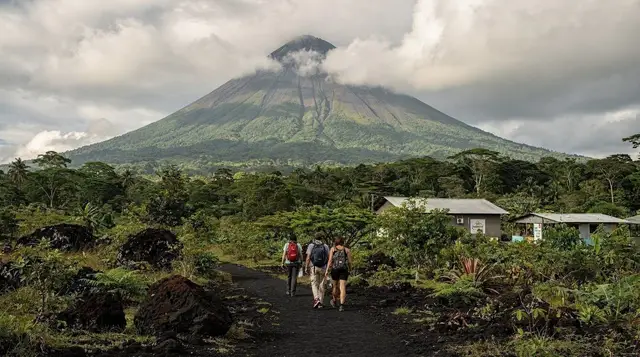
The next morning, without the pressure of a “show” to wait for, I walked the trail across the 1968 lava field for the first time. This is not a metaphor or a consolation prize — it’s a genuinely strange landscape. Chunks of solidified rock, some the size of cars, thrown out by the eruption that destroyed Tabacón, now sitting still under a canopy that’s had over fifty years to grow back around them. You can put your hand on rock that was liquid within living memory. That’s not nothing.
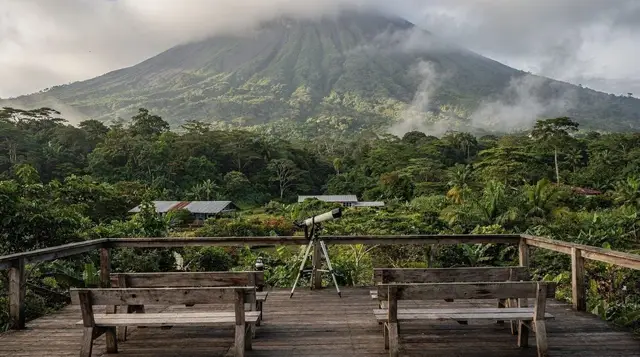
The cone itself, when the clouds cooperated — and they don’t always, this is a wet part of the country most of the year — was its own reward: a near-perfect stratovolcano shape, 1,670 metres, rising out of rainforest. And the heat is still there, just underground instead of on the surface. It’s the same geothermal system that keeps the hot springs around the base of the volcano warm, water that’s been heated by the same mountain that used to light up the sky, just delivered differently now.
None of that made it into the version of the trip I’d planned around a lava show. It should have been the headline. Instead it was the thing I stumbled into once I stopped waiting for something else.
No Hotel Fixes This
I want to be direct about one thing, because I’ve seen it implied often enough that I think it needs saying plainly: there is no room with a better view, no better night to time your visit, no upgraded tour package that will let you see lava at Arenal. The volcano isn’t performing on a schedule that a concierge can work around. It stopped in 2010, and whether or not it starts again is not something any hotel booking or itinerary tweak has any influence over.
If a listing implies otherwise — “best chance of lava viewing,” rooms marketed by their volcano-facing angle as though timing were the variable — that’s marketing outrunning the geology by about fifteen years.
Go in With the Right Expectations, and It’s Still Worth It
I’m not telling you to skip Arenal. I’m telling you to go for what’s actually there. The cone on a clear morning. The walk across the 1968 field, boots on rock that was once fire. The hot springs, still fed by heat with nowhere else to go. That’s a real volcano experience — just not the one still being sold on old photographs.
For the practical side of visiting — trail options, opening hours, what a national park ticket covers versus a private reserve — that belongs on the volcano’s own destination page, not here. Start with the private guided walk across the Arenal lava fields if you want a naturalist explaining exactly what you’re standing on, or the small-group hike to the base of the volcano with a local guide if you’d rather split the cost.
Combine it with the Volcano Base hiking route inside the national park, or pair your volcano morning with the half-day hanging bridges walk if you want the rest of the day covered too. Full details on all of it live on the Arenal Volcano destination page and the Arenal Volcano National Park guide.
If you want to see the eruption era up close on the ground rather than just read about it, the 1968 lava trail guide covers the walk I did that first morning, and the Arenal 1968 trail destination page has the entry details. Curious what the cone actually looks like on an average day, clouds included? The cloudy Arenal, what to expect guide is the honest version of that answer. And if you’ve heard you can hike to the crater lake at Cerro Chato — you can’t, not since 2018 — the Cerro Chato closed guide explains why that listing still shows up anyway.
I’ve since gone back to La Fortuna twice more, and both times I skipped the volcano-view dinner deck entirely. I went to the Arenal Observatory Lodge trails instead, early, before the clouds came in — and wrote up what I actually saw from up there once I stopped expecting fire.
If you want the hot springs that heat comes from, the hot springs comparison guide and the Tabacón hot springs destination page are the place to start — or the free alternative at El Choyín, which I now think is a better story than any dinner terrace ever was. For the wider question of whether this town has changed too much around all of this, I wrote about that separately in has La Fortuna gotten too touristy, and for timing your whole trip around clear mornings rather than lava evenings, see best time to visit La Fortuna.
FAQ: Is There Still Lava at Arenal Volcano?
Can you still see lava flowing at Arenal Volcano?
No. Arenal’s eruptive activity stopped in October 2010, after 42 years of near-continuous eruptions that began with the 1968 disaster. There has been no visible lava, no incandescent flow, and no nighttime glow since then.
Why do so many tours and websites still mention lava?
Some are simply out of date, written when the volcano was still active. Others use the word loosely to describe the solidified 1968 lava field, which is real and walkable, but is rock, not molten lava.
Is there any chance of seeing an eruption if I stay long enough?
No booking, hotel view, or extra night changes this. Arenal has been in a dormant phase for over a decade, and there is no predictable timetable for it to resume — this is a matter of geology, not scheduling.
What can I actually see at Arenal today?
The cone itself on a clear morning, the 1968 lava trail you can walk across, geothermal heat still rising from the ground near the base, and the hot springs the volcano continues to warm.
Is the volcano dangerous to visit now?
Arenal National Park is open and monitored, and the marked trails are considered safe under normal conditions. The volcano is dormant, not extinct, and access rules can change if activity is reassessed.
Where should I go for practical visiting information, tickets, and trail options?
That belongs on the dedicated Arenal Volcano destination page and the national park guide, not here — this piece is about managing expectations, not logistics.
Is Arenal still worth visiting if there’s no lava?
Yes, but for different reasons than the marketing suggests: the cone’s shape, the geothermal landscape, the hot springs, and the forest and wildlife around the park.
Volcano hikes on GetYourGuide
Verified deep-linked GetYourGuide tours. Book through these links and we earn a small commission at no cost to you.
GetYourGuide does not provide a product photo for this activity — the image shows the meeting point, photographed by us.