Arenal Volcano National Park Guide
What is Arenal Volcano National Park and can you still see lava there?
It is a 120 km2 park created in 1991 around the 1,670 m Arenal volcano, with two separate trail sectors, Peninsula and El Silencio/1968. The volcano has been dormant since October 2010, so no lava or incandescent flows are visible today — only the cone, the solidified 1968 and 1992 lava fields, and the geothermal heat that feeds the area's hot springs.
Two ticket booths, one volcano, and a lot of confusion
Say “Arenal Volcano National Park” and most first-time visitors picture a single gate, a single trail, and a single ticket. It isn’t that simple, and getting it wrong is the most common planning mistake around La Fortuna.
The national park itself was created in 1991 and covers roughly 120 km2 of forest, lava fields, and the volcano’s lower slopes, all inside the wider Arenal-Tempisque conservation area. It is run by SINAC, Costa Rica’s national parks service, and its official entrance — known as the Peninsula sector — sits on the lake side of the volcano. That’s one ticket, one trail network, one mirador looking out over the 1992 lava flow.
Right next door, on the older, western side of the volcano, is a completely separate operation: a cluster of privately owned reserves collectively referred to as El Silencio, home to the trail that follows the 1968 flow. Different entrance, different ticket booth, different price, and — this trips people up constantly — a different opening schedule. The two are geographically close but administratively unrelated. A ticket to one does not get you into the other.
This guide covers the park as a whole: what each sector actually offers, how they compare, and the one fact that should shape every expectation you bring here. For the practical detail of walking the 1968 trail specifically — hours, price, what the path is like underfoot — the dedicated 1968 lava trail guide covers it properly; there’s no need to duplicate it here.
The volcano is asleep — and that changes what you’re actually paying to see
Here is the fact that matters more than any trail map: Arenal has not produced lava since October 2010.
For 42 years before that, it was one of the most reliably active volcanoes on the planet. The eruption of 29 July 1968 blew out the western flank without warning, destroyed the villages of Tabacón, Pueblo Nuevo, and San Luis, and killed around 87 people. What followed was decades of near-continuous strombolian activity — explosions, ash columns, and, after dark, the incandescent flows that built La Fortuna’s entire tourism industry. Photos from the 1990s and 2000s of glowing rock tumbling down a black cone are what most people still associate with this destination.
That activity stopped. Since 2010, Arenal has been in a resting phase. There is no lava, no incandescent flow, no rumble at night, and no orange glow to photograph from a hotel balcony. Anyone promising you’ll “see the lava” — a tour listing, a taxi driver, an old blog post — is either wrong or working from outdated information.
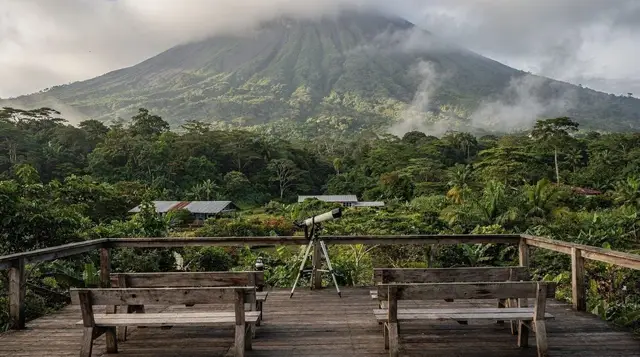
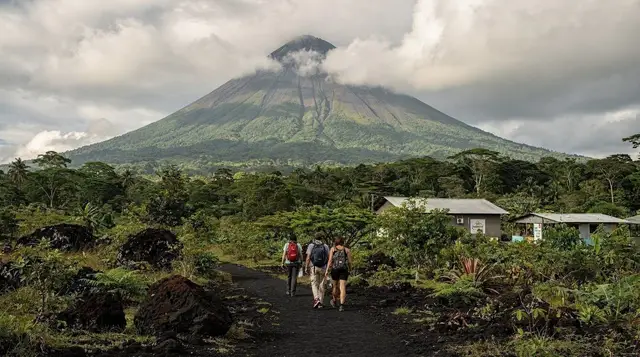
What you can see, on a clear day, is genuinely worthwhile on its own terms: the volcano’s near-perfect cone, roughly 1,670 m high and about 7,000 years old, visible from town when the clouds lift, usually earliest in the morning. Inside the park, the solidified black lava fields from 1968 and 1992 are still there to walk across, stark and slow-growing-back-to-forest in a way that makes the scale of the old eruptions obvious without any pyrotechnics.
And underground, the same geothermal system that once powered the eruptions still heats the water flowing into every hot spring in the valley, from the resort pools to the free river at El Choyín. The heat didn’t go anywhere; it just stopped reaching the surface as lava. If you want the fuller story of how this misconception took hold, it’s laid out in The Lava Lie About Arenal.
The Peninsula sector: the park’s own official trails
This is the national park in the strict sense — the SINAC-run entrance and trail system on the lake-facing side of the volcano.
The main draw is a loop through secondary forest that opens onto a mirador with a direct view of the 1992 lava field, one of the more recent flows before the volcano went quiet. The path is mostly flat to gently rolling, well maintained, and doesn’t require any technical scrambling, which makes it accessible to most fitness levels — though the tropical humidity means it’s rarely described as “easy” by anyone doing it at midday.
| Peninsula sector (official park) | |
|---|---|
| Run by | SINAC (national park service) |
| Trail focus | 1992 lava field mirador, forest loop |
| Typical duration | 1.5–2.5 hours |
| Terrain | Mostly flat, well-marked, some uneven volcanic rock |
| Guide required | No, but recommended for wildlife |
| Booking | SINAC online booking recommended in advance |
Wildlife is a real reason to slow down here, not just a side note. Howler and white-faced monkeys, toucans, and — with luck and a sharp-eyed guide — sloths turn up along the forest sections. If spotting a sloth is a priority for your trip, the Bogarín Trail closer to town has a notably higher success rate; this park is more about the landscape than a guaranteed wildlife checklist.
For a longer, quieter alternative with its own private trail network and a well-regarded restaurant, the Arenal Observatory Lodge sits within the same conservation area and is covered in its own trails guide.
El Silencio and the 1968 trail: a separate reserve, a separate ticket
On the volcano’s other side sits El Silencio, a private reserve built specifically around the historic 1968 eruption. Its trail runs directly across the lava field that eruption produced — a stark, sun-exposed landscape of jumbled black rock, decades of regrowth pushing through the cracks, and views up toward the cone that are, on a clear day, some of the closest and most dramatic in the area.
Because it sits on private land next to, not inside, the national park, it operates on its own schedule with its own admission fee, and that fee is not interchangeable with a park ticket. Many first-time visitors assume buying into one covers the other; it doesn’t, and turning up at the wrong gate with the wrong ticket is a common, avoidable frustration.
This guide won’t re-walk the trail in detail — that belongs to the dedicated Arenal 1968 lava trail guide, which covers opening hours, pricing, what the surface is like underfoot, and how it compares to the Peninsula sector point by point. If you’re deciding between the two, Hanging Bridges Parks Compared and the 1968-specific guide together will settle it faster than reading this page twice.
What’s no longer on the table: Cerro Chato
Older trip reports still mention hiking up to Cerro Chato, the extinct satellite cone with a crater lake, as a half-day add-on to a park visit. That hike has been closed since 2018, following years of erosion damage and several accidents on the increasingly unstable summit trail, and it sits on a mix of private and national park land that no longer permits ascents. If you see it offered as a current activity, that’s outdated information — the full explanation is in Cerro Chato Closed: What to Know, worth a read if only to understand why it disappeared from every reputable itinerary.
Guided walk or independent visit?
Both sectors allow independent entry with a valid ticket, but the value of a guide here is higher than in most parks, mainly because of wildlife. A trained naturalist guide, working with a spotting scope, routinely finds sloths, snakes, and birds that an independent visitor would walk straight past. For a first visit, a guided park walk is generally worth the extra cost.
A few of the guided options actually operating in the park:
a guided walk through the Peninsula sector’s forest trails and lava-field mirador, run with a small group and a naturalist focus rather than a fitness challenge, is the closest match to what most visitors picture.
For something a little more active, a hike toward the volcano’s base pushes further into the park’s terrain and takes longer. There’s also a guided hike across the lava fields with a local guide, which leans into the geology and the story of the 1968 and 1992 flows rather than just the walk itself.
If your priority is specifically the historic 1968 flow on the private reserve side, the two-day 1968 volcano trails experience covers that ground in more depth than a standard half-day visit — though for most travelers a single well-guided afternoon is plenty; the dedicated 1968 trail guide linked above will help you judge which pace suits your trip.
Getting there, timing it right, and what to bring
Both entrances sit a short drive from La Fortuna town centre — under 30 minutes to either gate, depending on which hotel you’re staying at and which side of the lake it’s on. Most tours include transport; if you’re driving yourself, expect the final stretch on either side to be narrow and, on the El Silencio side in particular, occasionally unpaved.
Morning departures are worth prioritizing. Cloud tends to build over the summit through the day, and a visit that starts by 8 or 9am has a meaningfully better chance of a clear cone than one starting after lunch. This is true across the whole best time to visit La Fortuna question, dry season or green season alike — see Cloudy Arenal: What to Expect for a realistic read on your odds either way, and don’t build a trip around the assumption of a guaranteed clear summit.
Pack for tropical trail conditions rather than a technical hike: closed-toe walking shoes with grip (lava rock and wet leaf litter are both slippery), a light rain layer even in the dry season, water, and insect repellent. The terciopelo, or fer-de-lance, is present in this region, which is one more reason sandals aren’t a good idea on any of these trails. If you’re planning several outdoor days back to back, the wider travel mistakes to avoid guide covers the recurring gear and timing errors that catch first-time visitors here.
Where this fits into your La Fortuna time
For most itineraries, the national park earns a single dedicated morning or afternoon — it’s not something to rush between two other bookings, but it also doesn’t need a full day unless you’re combining it with the 1968 trail on the other side.
If you’re mapping out how many days to give the area overall, How Many Days in La Fortuna and the one-day and two-day itineraries both slot a park visit in alongside hot springs or a waterfall walk without overloading the day. For the fuller menu of hiking options across the wider area, the volcano hikes category page lays out how this park compares to the region’s other trail options.
Arenal Volcano National Park: your questions answered
Can you see lava in Arenal Volcano National Park today?
No. Arenal’s last eruptive activity was in October 2010. There is no lava, no glowing rock, and no night-time volcanic glow anywhere in or around the park, whatever a tour description implies.
What are the two sectors of the park, and do they use the same ticket?
Peninsula is the official national park entrance run by SINAC, with the mirador over the 1992 lava field. El Silencio, home to the 1968 trail, is a separate, privately run reserve next door with its own ticket booth and its own price.
Can I still hike to the Cerro Chato crater lake?
No. Cerro Chato has been closed to hikers since 2018 due to erosion and safety concerns, regardless of what older blog posts or some guides still suggest.
How long does it take to walk the Peninsula sector trails?
Most visitors cover the main loop and the 1992 lava field mirador in 1.5 to 2.5 hours at an easy pace, longer with a naturalist guide who stops often for wildlife.
Is a guide required to enter the national park?
No, independent entry is allowed, but a certified guide is required for the private El Silencio/1968 reserve and genuinely improves wildlife spotting in both sectors.
What is the best time of day to see the volcano’s cone clearly?
Early morning, generally before 9 or 10am, before cloud builds up over the summit. Afternoon visits more often mean a cloud-wrapped cone rather than clear views.
Do I need to book park tickets in advance?
Booking ahead through SINAC is recommended, especially in the December to April dry season and around holidays, since daily entry numbers are capped.
Volcano hikes on GetYourGuide
Verified deep-linked GetYourGuide tours. Book through these links and we earn a small commission at no cost to you.
GetYourGuide does not provide a product photo for this activity — the image shows the meeting point, photographed by us.