When Arenal Is Cloudy: What to Realistically Expect
Will I be able to see the top of Arenal volcano during my stay?
Often, but never guaranteed on a single day. The cone sits inside a cloud belt that lifts most reliably in the early morning, so staying two or three nights instead of one clearly improves your odds. Even on a fully clear day, there is no lava to see — Arenal has been dormant since October 2010.
Why the Volcano Hides So Often
Almost every visitor to La Fortuna asks some version of the same question on their first evening: where’s the volcano? It’s a fair question, because for a mountain that dominates every postcard of the region, Arenal spends a surprising amount of its time wrapped in cloud from the base of the cone upward. This isn’t bad luck or a quirk of your particular week. It’s geography, and understanding it will do more for your trip than checking a weather app obsessively ever will.
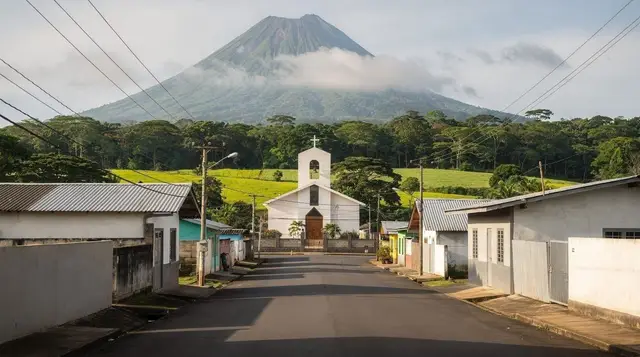
La Fortuna sits on the northeastern, windward flank of the volcano, directly in the path of moisture-laden trade winds blowing in off the Caribbean lowlands. As that air is forced up and over the slopes of Arenal, it cools, and cooling air condenses into cloud. The volcano is, in effect, manufacturing its own weather system on top of itself, independent of whatever the sky looks like over the town or the lake. You can be standing in bright sun at your hotel and still find the summit sealed under a lid of grey.
This mechanism runs all year. It intensifies in the green season, from May through November, when the region’s overall rainfall and humidity are higher, but it never fully switches off in the dry season either — December through April brings clearer general skies without eliminating the local cloud that clings specifically to the cone. If you’ve read that the dry season “guarantees” volcano views, treat that claim skeptically; it improves the odds only at the margins. What actually moves the needle is far simpler and easier to plan around: the time of day.
Morning vs Afternoon: The Pattern That Actually Matters
Cloud on Arenal builds through the course of a typical day rather than sitting there uniformly from dawn to dusk. Overnight and into the very early morning, the air is at its coolest and calmest, and convective cloud — the kind driven by daytime heating — hasn’t had a chance to form yet. That’s the window when the cone is most often visible: roughly the hour or two around and after sunrise, commonly before 8am.
As the sun climbs and the ground warms, humid air starts rising off the forest canopy and the lake, and cumulus cloud builds against the slopes through the late morning. By early-to-mid afternoon, in most seasons, the summit is obscured more often than not, and afternoon rain — a near-daily feature of this side of the country — finishes the job. Evenings occasionally clear again briefly, but by then it’s dark, and a floodlit cone (there isn’t one) wouldn’t help you anyway.
| Time of day | Typical chance of a clear cone | Why |
|---|---|---|
| Before 8am | Best of the day | Cool, stable air; convective cloud hasn’t built yet |
| Mid-morning to noon | Declining | Rising heat starts pushing cloud up the slopes |
| Afternoon | Lowest of the day | Convective buildup, frequent rain across the region |
| Evening | Occasionally clears | Air stabilizes again, but visibility is moot after dark |
The practical takeaway is almost embarrassingly simple: if seeing the cone matters to you, look early, and don’t wait for a “better” moment later in the day that statistically tends not to arrive. Set an alarm, have coffee on a balcony or a hotel terrace that faces the volcano, and check before you commit to anything else that morning.
Does Staying Longer Actually Help?
Yes, and this is the single most useful piece of practical advice in this guide. A one-night stay in La Fortuna gives you exactly one early-morning window to catch the cone clear. If that morning happens to be cloudy — which, given everything above, is entirely plausible regardless of season — you leave without having seen it, full stop.
Extend that stay to two or three nights and you’re no longer betting everything on one roll. You get two or three separate mornings, each an independent chance. It doesn’t take a statistician to see why this matters more than chasing the “right” season or the “right” tour package. Several itineraries on this site build in that buffer deliberately — see three days in La Fortuna or the broader planning notes in how many days in La Fortuna for how to structure a stay that isn’t entirely dependent on one morning’s luck.
This is also a reason not to treat La Fortuna as a rushed overnight stop squeezed between San José and Monteverde or the beaches of Guanacaste. The region rewards a slightly longer, unhurried stay — not because the volcano owes you a view, but because more mornings simply means more chances at one.
Even on a Perfectly Clear Day, There’s No Lava
This needs to be said plainly, because it’s the most common misconception visitors arrive with. Arenal was genuinely spectacular for decades: after the catastrophic eruption of 29 July 1968, which destroyed the villages of Tabacón, Pueblo Nuevo, and San Luis and killed roughly 87 people, the volcano entered a period of near-continuous strombolian activity — visible glowing lava, audible rumbling, the whole postcard image people still associate with it. That activity ran for 42 years.
It stopped in October 2010. Since then, Arenal has been in a resting phase. There is no lava, no glow, no nighttime rumble, whether the sky is clear or not. A guide, a photo, or a tour listing that implies otherwise is either out of date or simply wrong, and it’s worth reading the lava lie about Arenal if you want the fuller story of how that misconception persists. What a clear morning actually shows you is the mountain itself: a near-perfect cone rising to 1,670m, still geologically active enough to power the region’s hot springs, but visually dormant.
That distinction changes what “success” should mean on this trip. You’re not hoping to witness an eruption. You’re hoping to see a striking, symmetrical volcanic cone against blue sky, ideally with a wisp of steam at the crater rather than a blanket of grey cotton wool. That’s a genuinely worthwhile thing to see — just don’t let a tour operator’s marketing set your expectations for something the mountain hasn’t done in over a decade.
What to Do When It’s Cloudy (Which Is Often)
The good news is that almost nothing else in the region depends on the summit being visible. La Fortuna’s best-known draws work regardless of what’s happening above the treeline:
The area’s hot springs are geothermally heated by the same volcanic system, and a cloudy cone overhead doesn’t change the water temperature one degree. Whether you go upmarket or budget, the springs are arguably more atmospheric under an overcast sky, with steam rising off the water into cooler, greyer air. See the hot springs comparison guide for how the main options — Tabacón, Baldi, Ecotermales, and the free river at El Chollín — stack up.
La Fortuna waterfall tumbles into its canyon whatever the sky is doing, and if anything a light drizzle only adds to the scene. The various hanging bridge parks near El Castillo sit inside cloud forest that’s meant to be misty; a socked-in morning there feels correct rather than disappointing. And night walks looking for frogs, sloths, and insects are, by definition, unaffected by daytime cloud cover entirely — read night walks in La Fortuna for what those tours actually involve.
The larger point: build a day around an activity that delivers on its own merits, and treat a clear volcano as a bonus that might happen alongside it, not the plan itself. Checking the notes on rainy afternoons and how to plan your day is a good habit for the region generally, since afternoon rain is a near-daily near-certainty here regardless of what the cone is doing.
Best Spots to Try for a Clear View
Not every vantage point in the region has the same odds, mostly because of how far it sits from the immediate cloud belt hugging the cone itself.
| Location | Why it can work | Notes |
|---|---|---|
| Arenal Observatory Lodge | Elevated position with a direct, close sightline to the cone | Best tried early morning; grounds and trails covered in the Observatory Lodge trails guide |
| La Fortuna town centre | Convenient, several rooftop bars and cafés face the volcano | Same cloud pattern as everywhere close to the base |
| Lake Arenal shoreline near Nuevo Arenal | Distance from the cone sometimes puts the summit below the cloud base as seen from across the water | Worth combining with a paddle or a scenic drive |
| Arenal 1968 trail | Close-up views of the lava field with the cone rising directly behind | Best when cloud has lifted; still worthwhile hiking regardless — see the 1968 lava trail guide |
If your morning at one spot is a bust, don’t assume the whole region is fogged in — cloud can sit stubbornly over the immediate cone while clearing a few kilometres away across the lake, and vice versa. A short drive is sometimes all it takes.
Building a Trip That Doesn’t Depend on the Weather
The most reliable strategy isn’t a secret viewpoint or a lucky app — it’s sequencing. Put your volcano-watching attempts in the early mornings of whichever days you’re in the region, treat every one of them as optional, and fill the rest of each day with activities that don’t care what the sky is doing. A short volcano-adjacent hike like the 1968 lava trail walk works well as a first-morning activity — you’re there early regardless, and the walk itself is worthwhile whether or not the summit cooperates.
For an afternoon or evening slot, when the odds of a clear cone are already lowest, lean into activities where visibility isn’t the point at all. An evening firefly walk like the Cautiva firefly night tour turns the day’s cloud cover into a non-issue, since you’re out after dark looking for glowing insects rather than mountain views. On a clearer, calmer morning, paddling out onto Lake Arenal gives you both a pleasant outing and, if you’re lucky, one of the better lake-side sightlines back toward the cone described above.
If you’re deciding how many nights to allocate here in the first place, read first time in La Fortuna and best time to visit La Fortuna alongside this guide — both address the volcano-visibility question as one factor among several, not the only one. And if your trip falls in the wetter months, La Fortuna in green season covers the wider trade-offs of visiting outside the traditional dry-season window, including lower prices and thinner crowds that can offset a lower chance of clear mornings.
Finally, keep your expectations calibrated against what the volcano can actually offer. It’s a genuinely beautiful, geologically young cone that’s worth seeing clear if the timing works out — and it’s a mountain that stopped producing lava in 2010, cloud or no cloud. Plan for the first, don’t chase the second, and you’ll leave satisfied either way. A few travelers have written about exactly this recalibration after the fact; the weather app that lies about the volcano is one honest account of a trip built, and eventually rebuilt, around that lesson.
Cloudy Arenal: Questions Travelers Actually Ask
Why is Arenal volcano so often covered in cloud?
La Fortuna sits on the windward, Caribbean-facing side of the mountain, and moist trade winds push cloud against the cone almost continuously. The volcano also builds its own weather: as air rises up its slopes it cools and condenses, wrapping the summit in cloud even on days that look clear from town.
What time of day gives the best chance of seeing the cone clear?
Early morning, generally before 8am, before the day’s heat builds convective cloud. Skies tend to cloud over through the late morning and stay obscured most afternoons, especially in the green season from May to November.
Does staying more nights in La Fortuna really help?
Yes. A single overnight stay leaves you at the mercy of one morning’s weather. Two or three nights give you two or three separate early-morning windows, so a stretch of cloud on your first day doesn’t have to define the whole visit.
Will I see lava if the volcano is clear?
No. Arenal’s last visible eruptive activity ended in October 2010, after 42 years of near-continuous strombolian eruptions that followed the 1968 disaster. A clear day shows the cone itself, not lava or glow of any kind.
Is the dry season a better bet for clear views than the green season?
It helps at the margins, but La Fortuna’s location on the windward slope means cloud on the summit is common in every month. The practical fix is timing within the day — early morning — rather than timing within the year.
Where is the best place to try for a clear view of Arenal?
Arenal Observatory Lodge and the shoreline around Lake Arenal near Nuevo Arenal both sit far enough from the immediate cone to catch it clear when La Fortuna’s own view is fogged in. Both are worth a detour on a promising morning.
Should I build my whole day around waiting for the volcano to clear?
No. Treat a clear cone as a bonus, not a plan. Book activities that deliver on their own terms — hot springs, the waterfall, hanging bridges, a night walk — and let a clear morning be a pleasant surprise rather than the thing your trip depends on.
Seasonal experiences on GetYourGuide
Verified deep-linked GetYourGuide tours. Book through these links and we earn a small commission at no cost to you.
GetYourGuide does not provide a product photo for this activity — the image shows the meeting point, photographed by us.