A private reserve on the volcano’s shoulder
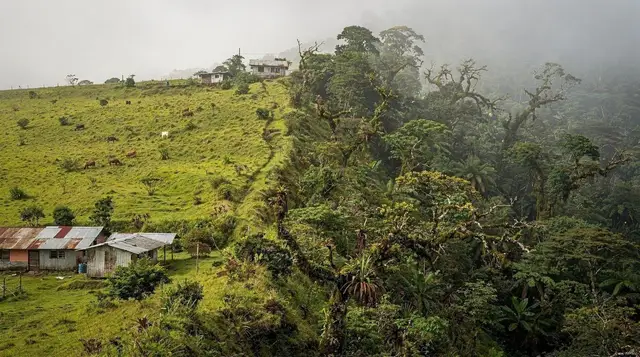
Arenal Observatory Lodge sits on the site of a former Smithsonian and university research station, built in the 1970s to study the volcano while it was still actively erupting. Scientists needed to be close enough to observe the cone but far enough to be safe if it turned violent — which is exactly why the property still occupies one of the nearest legal vantage points to the crater anywhere in the region. Today it operates as a hotel with its own restaurant and gardens, but its real draw for day visitors is what surrounds the rooms: a network of private trails through rainforest, secondary growth and old pasture, threaded along the Arenal Volcano’s southern flank.
This is a different experience from the Arenal Volcano National Park itself. The park has its own entrance, its own SINAC ticket booth and its own official trails, covered in a separate guide. The lodge is a neighbouring but entirely distinct property, with its own gate, its own day-use fee and its own trail map. Guides and drivers sometimes blur the two together in casual conversation — “we’re going up to see the volcano” — but if you book a lodge trail pass expecting park infrastructure, or a park ticket expecting the lodge’s closer views, you’ll be in the wrong place.
The trail network
The lodge maintains several loop and out-and-back trails of varying length and difficulty, most starting a short walk from the reception building. None require technical skill, but a few climb steadily enough to raise a sweat in the humidity.
| Trail | Approx. distance | Terrain | What it’s known for |
|---|---|---|---|
| Waterfall Trail | 2–3 km round trip | Moderate, some steps | A forest waterfall and stream crossings |
| Peninsula Trail | 3–4 km round trip | Easy to moderate | Lake Arenal views and open pasture birding |
| Lava Trail (private, near 1968 flow) | 1–2 km | Easy | Cooled 1968 lava rock, low forest cover |
| Heliconia Trail | 1 km | Easy | Dense flowering understorey, hummingbirds |
| Danta Trail | 4–5 km round trip | Moderate | Longer forest walk, best birding |
These are separate from the national park’s own 1968 lava trail, which sits inside the park boundary and requires a park ticket. The lodge’s version of a lava trail covers a similar type of terrain — the same 1968 eruption’s cooled flow — but on land the lodge itself manages, with its own access and its own pace of maintenance.
Trail difficulty is generally forgiving; this is not a technical hike. What varies is humidity and mud, especially outside the dry season, when several sections turn slick after the afternoon rain that La Fortuna receives most days of the year, whatever the official season. Closed shoes with real tread matter more here than on paved viewpoints elsewhere in town.
The volcano view — and the honest odds of getting it
This is the detail every lodge review sidesteps: the summit of Arenal is in cloud far more often than it’s clear. The mountain sits at 1,670 m in a landscape where warm, moist air off the northern plains rises and condenses against the cone almost daily. Even from a property positioned as close and as favourably as this one, there is no guarantee, no schedule and no refund for an obscured view.
What tips the odds in your favour, slightly, is timing. Cloud typically builds through the morning and afternoon as the day heats up, so the first two or three hours after sunrise — roughly 6am to 9am — offer the best (not certain) chance of an unobstructed cone. Guests who stay overnight get first crack at this window before day-trippers arrive; day-trip visitors who want the same odds need to plan an early departure from La Fortuna.
When the cone does clear, what you’re seeing is a dormant, cooled volcano — not the glowing crater some older articles and word-of-mouth still describe. Arenal’s last visible eruptive activity was in October 2010; the 42 years of near-continuous lava flow and incandescent rock that followed the 1968 eruption are over. For a fuller account of what happened in 1968 and why the volcano still gets described inaccurately online, see our piece on the lava lie about Arenal.
Wildlife on the trails
Because the lodge’s trails see less foot traffic than the busiest paths inside the national park, wildlife spotting tends to be quieter and more rewarding, particularly with a guide. Sightings are never guaranteed, but the mix of forest, pasture edge and lake-adjacent habitat around the property is genuinely good for:
- Sloths, both two-toed and three-toed, moving slowly through canopy along the Waterfall and Danta trails
- Coatis and agoutis foraging near the lodge grounds, especially early morning
- A wide range of birds, including toucans, oropendolas and — with luck — trogons, in the denser forest sections
- Poison dart frogs and other amphibians close to stream crossings, more visible after rain
- Howler and white-faced capuchin monkey troops, heard well before they’re seen
If wildlife is your main reason for visiting, a guided walk covers far more ground than wandering the trails alone, and a private naturalist guide will typically also stop at points along the way that overlap with the national park boundary. One option worth comparing against a self-guided lodge visit is the guided sloth and monkey walk near Arenal, which runs on trails purpose-built for slow, careful spotting rather than distance covered.
Getting there and tickets
The lodge sits roughly 20–30 minutes by car from central La Fortuna, along a paved then partly gravel access road that climbs steadily from the highway. Rental cars manage it without difficulty in dry conditions; after heavy rain, potholes and washouts are more common, and a higher-clearance vehicle helps. Taxis and organised tours are the simpler option if you’d rather not navigate the access road yourself, especially after dark.
Day-use trail passes are sold separately from overnight stays and from meals, and are usually payable at the gate or bookable in advance through the lodge directly. Combined tickets that bundle trail access with lunch at the on-site restaurant are common and, given the drive back into town, often worth the modest premium over doing both separately.
For visitors who want the closest thing to a guaranteed elevated vantage point rather than a forest trail, the region also offers an aerial tram option that climbs toward a viewpoint nicknamed the “Hand of Arenal.” It’s a different kind of experience from the lodge’s walking trails — seated, mechanical, and quick — and worth considering as an alternative on a day when low cloud makes a long hike less appealing: an aerial tram ride toward the Hand of Arenal viewpoint.
Lodge trails versus the national park
Visitors often ask which to prioritise if time only allows one. Both are worthwhile for different reasons, and neither replaces the other.
| Arenal Observatory Lodge trails | Arenal Volcano National Park | |
|---|---|---|
| Ownership | Private property | SINAC-managed national park |
| Ticket | Separate day-use pass | Separate park entrance fee |
| Proximity to cone | Very close, weather permitting | Close, from designated viewpoints |
| Crowds | Generally quieter | Busier, especially midday |
| Official 1968 trail | No — private equivalent only | Yes, the park’s own 1968 lava trail |
| Facilities | Restaurant, restrooms, gift shop | Ranger station, restrooms, parking |
A full day that combines both is entirely possible given the short drive between them, and many visitors do exactly that: an early trail walk at the lodge for the best light and the best odds of a clear cone, followed later by the park’s official 1968 lava trail. For a deeper comparison of what the park itself covers, see the Arenal Volcano National Park guide.
Combining a lodge visit with the rest of your day
Because the lodge sits between La Fortuna and the national park entrance, it slots naturally into a wider day rather than standing alone. Popular pairings include:
- A morning trail walk at the lodge, followed by an afternoon soak at a hot spring closer to town — Tabacón and the free Río Chollín are both a short drive from the lodge access road
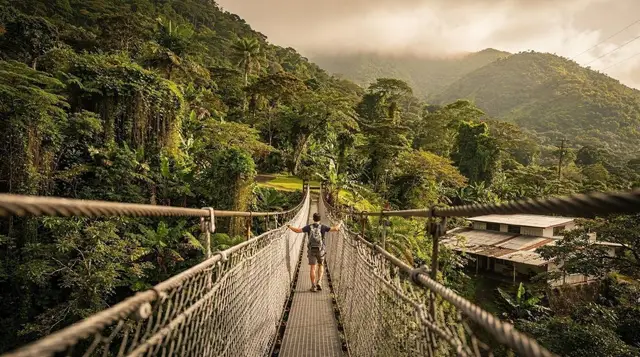
- The lodge’s trails paired with the Mistico Hanging Bridges, which sit on the opposite, northwestern side of Lake Arenal and take roughly 30–40 minutes to reach from the lodge
- A hike-and-swim combination that covers both volcano-adjacent terrain and a hot spring stop in one booking, such as the Arenal volcano hike with a hot springs swim, which removes the need to plan transport between the two separately
- A longer, more structured route through the 1968 lava terrain and surrounding forest for travellers with two days rather than a single afternoon, such as the two-day Arenal 1968 volcano trails experience
If your priority is simply the volcano-base terrain itself rather than the lodge’s specific grounds, a standard base hike is also available separately: a guided hiking experience to the Arenal volcano base.
Practical tips
Timing. Arrive as close to opening as your schedule allows if a clear cone matters to you. Afternoons bring both more cloud and more heat.
Footwear. Closed shoes with grip, not sandals. Several trail sections turn muddy after rain, which falls on most days of the year here regardless of season.
Rain gear. A light rain jacket earns its space in your bag even in the dry season; this is still rainforest.
Binoculars. Worth carrying if birdwatching interests you at all — much of the best activity happens well up in the canopy.
Water and snacks. The on-site restaurant covers meals, but bring water for the trail itself; refill points are limited once you’re away from the main buildings.
Photography. A zoom lens helps far more than a wide-angle for the cone itself, since even on a clear morning the summit remains a distant subject from trail level.
Budget expectations. A day-use trail pass alone sits at the low end of the day-budget range noted above; adding a guided walk, lunch, or a combined tour pushes it toward the higher end.
The honest bottom line
Arenal Observatory Lodge earns its reputation as one of the better vantage points on the volcano, and its private trails are genuinely quieter and often better for wildlife than the busiest sections of the national park. What it cannot do — what nothing in this region can do — is promise you a clear summit or a glowing crater. Go for the trails, the forest, and the chance of a clear morning view, not for a guarantee. If low cloud settles in for your visit, it settles in on every property on this side of the volcano, lodge included.
For planning a wider itinerary around the volcano and beyond, see how many days you actually need in La Fortuna and our notes on what to expect when Arenal is cloudy.
Arenal Observatory Lodge: frequently asked questions
Is Arenal Observatory Lodge worth visiting if I’m not staying overnight?
Yes. The lodge sells day-use trail access separately from its rooms, and its private reserve sits closer to the crater than the national park’s own trailheads. It is not a substitute for the park, and it does not guarantee a clear view of the cone — cloud cover on the summit is the norm, not the exception, at any hour.
Is Arenal Observatory Lodge the same as the Arenal Volcano National Park?
No. They are separate properties with separate entrances, separate tickets and separate trail systems. The lodge sits on private land bordering the park’s southern edge, on the old research-station site that gives it its name.
Will I definitely see lava at Arenal Observatory Lodge?
No. The volcano has been dormant since October 2010 and has produced no visible lava since. You’ll see the cone itself when clouds allow, and the solidified 1968 lava field, but never a flow.
How much does day-use trail access cost?
Day passes typically run in the 15–30 USD range per adult, separate from any guided tour or meal package, though prices change and are best confirmed directly before your visit.
Can I hike Cerro Chato from the lodge?
No. Cerro Chato’s crater trail has been closed to hikers since 2018 regardless of which property or entrance you approach it from, including the lodge’s grounds. For more on why, see our note on why Cerro Chato is off-limits.
Do I need a guide on the lodge’s trails?
Self-guided hiking is allowed on most lodge trails and they are well maintained and signed, but a guide roughly doubles what you’ll notice — sloths, snakes, frogs and birds are far easier to find with a trained eye.
What is the best time of day to see the volcano’s cone from the lodge?
Early morning, generally before 9am, gives the best odds, because cloud tends to build over the summit as the day warms. Even then, a clear cone is a matter of luck, not schedule.
Can I combine the lodge with hot springs or other activities on the same day?
Yes. Most visitors pair a morning at the lodge’s trails with an afternoon at a hot spring park closer to La Fortuna, since the drive back into town takes well under 30 minutes.