Arenal Observatory Lodge Trails Guide
Are the Arenal Observatory Lodge trails free to visit?
No. Non-resident visitors pay a day-use fee at the gate, roughly 8-10 USD, to walk the lodge's private trail network. This is separate from Arenal Volcano National Park admission, and it applies even if you are only stopping for an hour and have no intention of staying overnight.
A Front-Row Seat on a Volcano That Isn’t Erupting
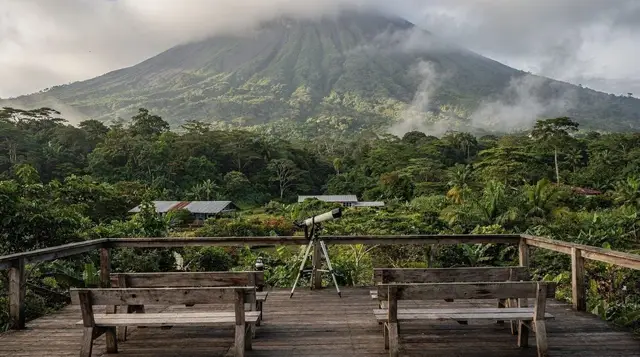
Of every vantage point around Arenal Volcano, the one from the grounds of the Arenal Observatory Lodge is the most direct. The property was built where it stands because it once housed a working seismological observation station, close enough to the cone to monitor it during the volcano’s active decades, and the alignment that made it useful for scientists is the same one that makes it good for photographs today. On a clear morning, the summit sits almost dead ahead, with none of the roadside trees and power lines that crowd other viewpoints around La Fortuna.
That alignment is also the trap. Marketing photos of this view are everywhere, and it is easy to arrive assuming the trails that lead to it are part of the national park, or that they are open to anyone who wanders up the access road. Neither is true. This guide covers what the Observatory Lodge trail network actually is, what it costs to walk it as a day visitor, and how it differs from the trails inside Arenal Volcano National Park itself, which has its own dedicated guide if that is what you are looking for.
What You’re Actually Paying For
The trails belong to the lodge, not to the national park system. They sit on private reserve land adjoining the park’s Peninsula sector, and access is controlled at the lodge’s own gate, separately from the park entrance you would use to walk the marked route to the 1992 lava flow overlook.
That means a day-use fee applies to every non-resident visitor, whether you are staying at the lodge or not. It is not folded into a park entrance ticket, it is not covered by a SINAC reservation, and it is not waived for a quick look around. Expect a fee in the rough range of 8 to 10 USD per adult, paid in cash or by card at reception, with the amount and hours posted at the gate. Guests with a room booked at the lodge generally have trail access included as part of their stay, but a casual visitor who is not staying overnight, even someone who has booked a table at the restaurant, should assume the trail fee is separate and plan for it.
This is worth stating plainly because it is the single most common misunderstanding about this stop: these are not free, open-access forest trails on public land. They are a paid attraction with a gate, much like Mistico Hanging Bridges or Sky Adventures Arenal, and treating them as a free add-on to a day already built around the national park will mean an unplanned line item at the till.
How These Trails Differ From the National Park’s Own Trails
The confusion is understandable, because both trail systems sit in the same stretch of forest, both face the same volcano, and both are reached from roughly the same direction out of town. The table below lays out the practical differences.
| Arenal Observatory Lodge trails | Arenal Volcano National Park (Peninsula sector) | |
|---|---|---|
| Managed by | The lodge, privately | SINAC, the national park service |
| Entrance | Lodge’s own gate and reception | Separate park entrance, further along the same road |
| Fee | Day-use fee, paid at the gate | Park admission, reservable in advance via SINAC |
| Main draw | Frontal view of the cone from the old observatory site | Marked overlook of the 1992 lava flow |
| Terrain | Forest loops, a canyon and waterfall trail, garden paths | A single well-trodden trail to the park’s main lookout |
| Typical crowd level | Quieter, especially on weekday mornings | Busier, particularly with midday tour groups |
| Booking | No advance booking needed, pay on arrival | Online reservation recommended, especially in high season |
If your priority is the 1968 lava trail and the park’s own official overlook, that is a separate outing with its own entrance fee, covered in full in the Arenal 1968 lava trail guide. If your priority is the closest frontal view of the volcano and a quieter walk through private forest, that is what the Observatory Lodge trails are for. Plenty of visitors do both on the same trip, as two distinct paid stops rather than one combined ticket.
Getting There and Through the Gate
The lodge sits along the road that leads out toward the Peninsula sector of Arenal Volcano National Park, on the way that also passes El Castillo and skirts the edge of Lake Arenal. Drivers coming from the La Fortuna town centre follow the same road used for the national park entrance, then continue past it to the lodge’s own access track and gate. There is no public bus service to the gate, so most car-free visitors either rent a vehicle for the day or join a guided tour that bundles the transport in.
At the gate, staff take payment for the day-use trail fee, log you in, and point out the current state of the trail network, since sections occasionally close for maintenance or after heavy rain. Opening hours generally run from early morning into the mid-afternoon; arriving as close to opening as your schedule allows gives the best odds of a clear summit, since cloud tends to build over the volcano as the day warms up. The old observation deck, the spot most people are really coming for, is a short walk from reception rather than deep into the trail network, so even a visitor short on time can reach it without committing to the full loop.
What You’ll See on the Trail Network
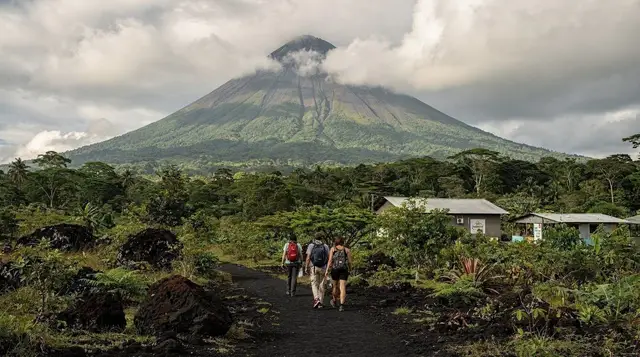
Once through the gate, the trails fan out from the lodge grounds through secondary forest that has regrown since the volcano’s active decades. A short loop near reception and the old seismology viewpoint is enough for the signature view when conditions cooperate. Visitors with more time can continue onto longer sections that drop into a forested canyon, pass a waterfall, and cross a suspension bridge over the ravine, all inside the private reserve rather than the national park itself.
Wildlife sightings along the way are a genuine bonus rather than a guarantee: howler and white-faced monkeys move through the canopy, toucans and other birds are frequent, and there is a reasonable chance of spotting a sloth if you go slowly and look up rather than ahead. None of this substitutes for a dedicated night walk or wildlife tour, covered in the La Fortuna wildlife spotting guide, but it adds texture to what is fundamentally a viewpoint walk.
What you will not find here is any route up the volcano itself. This is not a hike onto Arenal’s slopes, and it does not lead anywhere near the summit. It is a forest walk to a fixed vantage point that happens to face the cone, at ground level, from a comfortable distance. If cloud has settled in for the day, the trails themselves, the canyon, and the waterfall are still worth the walk, but the headline view will simply not be there, and no amount of waiting at the gate changes that.
Staying Overnight vs a Day Visit
The trails work either as a stand-alone paid stop or as part of an overnight stay, and the value proposition shifts depending on which one you choose.
| Day visit | Overnight stay | |
|---|---|---|
| Trail access | Paid separately at the gate | Usually included in the room rate |
| Volcano view | Limited to daytime hours, whatever the cloud allows | Multiple chances across a stay, including early morning |
| Restaurant terrace | Open to day visitors, priced separately | Often included or discounted for guests |
| Cost overall | Lower total spend for a short stop | Higher total spend, more time to catch clear conditions |
| Best for | Travellers passing through on a wider La Fortuna day plan | Travellers building a night around a good-weather bet |
Staying does not guarantee a clear view any more than a day visit does; the volcano’s summit is often wrapped in cloud regardless of the hour. What an overnight stay buys is more attempts, particularly around dawn, when the sky over the Arenal area is statistically more likely to be clear than it is by early afternoon. A day visitor gets one window during opening hours and takes what the weather gives.
Combining a Trail Walk With a Guided Hike
The Observatory Lodge trail pass gets you through the gate and onto the paths, but it does not include a guide. Several operators run guided outings that either focus on this specific viewpoint or combine it with other trail systems nearby. An observatory-focused tour that includes transport from La Fortuna and a guide who knows which trails to prioritise if the summit is clouding in is the simplest way to see this spot without renting a car or navigating the gate alone.
For visitors who want the volcano story told properly rather than just photographed, a guided hike across the lava field with a local guide who explains the 1968 eruption and the decades of activity that followed pairs naturally with a stop at the Observatory Lodge, since one covers the geology and the other the view. Travellers with two days to give the volcano proper attention sometimes book a longer two-day trail experience that strings together several vantage points and trail systems around Arenal, which spreads the cloud-cover gamble across more than one morning.
Practical Tips for Visiting
- Go early. The volcano is most likely to be visible in the first hours after the trails open, before afternoon cloud builds in; see the cloudy Arenal expectations guide for what to plan around when it doesn’t.
- Bring cash and card. Small operations at rural gates in this area do not always have reliable card connectivity; carrying both covers the day-use fee either way.
- Wear closed shoes. The canyon and waterfall sections involve uneven, sometimes damp ground, not sandals-and-camera terrain.
- Pack rain gear regardless of season. This is the wet side of the country even in the dry months, and the forest canopy does not stop a passing shower.
- Do not expect lava. The last visible eruptive activity here was in 2010; what you are paying to see is the cone itself, not an eruption.
- Check trail status at the gate. Sections close periodically for maintenance or after heavy rain, and staff will tell you what is open that day.
How This Fits Into a Wider La Fortuna Itinerary
Most visitors treat the Observatory Lodge trails as one stop among several on a volcano-focused morning or afternoon, rather than a full day on their own. It pairs naturally with a visit to the national park’s own 1968 trail, and travellers deciding how much time to give the volcano area overall will find that question addressed directly in the how many days in La Fortuna guide. Anyone building a trip around wildlife rather than geology alone should also look at the La Fortuna for wildlife itinerary, since the canyon and forest sections here overlap with that theme without duplicating a dedicated wildlife tour.
If the cone stays stubbornly hidden on the day you visit, that is not a wasted trip so much as a common one. The lava lie about Arenal piece and one visitor’s account of what they actually saw from the observatory lodge are both useful reading before you go, precisely because they set expectations honestly rather than promising the postcard shot every operator’s photo suggests is guaranteed.
Arenal Observatory Lodge Day Trails: Common Questions
Are the Arenal Observatory Lodge trails free to visit?
No. The trails sit on private land belonging to the lodge, and a day-use fee applies to every non-resident visitor, whether or not you are staying there. Overnight guests typically have trail access included in their room rate; day visitors pay separately at the gate.
Do I have to stay at the lodge to walk the trails?
No, day access is sold to non-guests, but it is not automatic or free. You pay the day-use fee at the gate, sign in, and are free to walk the marked trails during opening hours, usually from early morning to mid-afternoon.
How is this different from Arenal Volcano National Park?
The national park’s Peninsula sector, managed by SINAC, has its own entrance, its own fee, and its own trail to a marked overlook of the 1992 lava flow. The Observatory Lodge trails are a separate, privately managed network on adjoining land, with a different gate, a different fee, and a different vantage point.
Will I actually see the volcano’s crater from here?
Only when the summit is clear of cloud, which is common early in the morning and far less reliable by midday. The lodge grounds and the old seismology viewpoint face the cone almost head-on, which is the main reason people come, but no operator anywhere can guarantee a clear view.
Is there still lava to see on these trails?
No. Arenal’s last visible eruptive activity was in October 2010. What the trails show today is the intact volcanic cone on a clear morning, the solidified 1968 flow field nearby, and forest that has grown back over four decades of dormancy.
How long does it take to walk the trail network?
A short loop near the lodge grounds can be done in under an hour. Adding the canyon and waterfall trail, plus time at the old observation deck, turns it into a half-day outing for most visitors, longer if you stop often for birds and monkeys.
Can I visit without a rental car?
It is easier with one. The lodge sits off the road that runs toward the Peninsula sector of the national park, past the main park entrance, and there is no public bus that stops at the gate. Most car-free visitors join a guided tour that includes transport.
Is reservation required in advance?
No online booking is needed for the day-use trail pass itself; you pay at the gate. Weekends and the first clear mornings after a run of cloudy days tend to be busier, so arriving early is more useful than booking ahead.
Volcano hikes on GetYourGuide
Verified deep-linked GetYourGuide tours. Book through these links and we earn a small commission at no cost to you.
GetYourGuide does not provide a product photo for this activity — the image shows the meeting point, photographed by us.