La Fortuna for Wildlife: A 6-Day Itinerary
Most La Fortuna itineraries are built around the volcano and the hot springs, with wildlife squeezed into a single night walk. This one flips that order. Six days, four wildlife habitats, and almost nothing that requires an adrenaline rush to enjoy. If you came here for zip lines and canyoning instead, the La Fortuna for adventure itinerary is the better fit — this route sacrifices Sky Adventures and the big thermal complexes on purpose, because neither adds anything to a trip organised around watching animals rather than moving fast past them.
Why build a trip around wildlife here
La Fortuna sits at the edge of several very different habitats within a two-hour radius: dry secondary forest around town, wetlands to the north at Caño Negro, slow tropical river at Peñas Blancas, and cloud forest an inconvenient but worthwhile drive away at Monteverde. No single day covers all of it. Spreading the search across six days and four habitats is what actually raises your odds of seeing sloths, caimans, waterbirds, and — if timing and luck cooperate — a resplendent quetzal, which lives at cloud-forest elevation and simply does not occur around La Fortuna itself.
A guide who tells you what you will see, and when, is guessing. A good guide tells you what is likely, given the season, the time of day, and what has been reported in the last week. That distinction matters more on this trip than on any other kind here.
What this itinerary is not
It is not a checklist of Instagram animals guaranteed in a fixed time slot. Wildlife tourism that promises a specific sighting is telling you what you want to hear, not what the forest is doing. It is also not a shortcut through Cerro Chato — the crater trail has been closed to hikers since 2018 for erosion and safety reasons, regardless of what an older blog post says, and it plays no role in a wildlife-focused week anyway. And it deliberately skips the hot springs and the big canopy parks: they are worth doing on a different trip, but they add sensation, not sightings.
One non-negotiable across every day below: closed shoes on every trail. The fer-de-lance (terciopelo), one of Costa Rica’s more dangerous pit vipers, is present in this region, and sandals are not an option on any of the walks in this itinerary.
Trip at a glance
| Day | Focus | Habitat |
|---|---|---|
| 1 | Arrival, orientation walk | La Fortuna town edge |
| 2 | Bogarín Trail sloth walk | Riverside secondary forest |
| 3 | Caño Negro boat safari | Wetland refuge |
| 4 | Peñas Blancas river float | Slow tropical river |
| 5 | Travel to Monteverde, cloud forest walk | Cloud forest |
| 6 | Quetzal search, return or onward travel | Cloud forest |
Day 1: Arrival and orientation
However you arrive — via SJO or LIR — treat the first afternoon as a buffer, not a sightseeing slot. Settle into La Fortuna town, and use the late afternoon for an easy loop through Ecocentro Danaus, a small private reserve close to town with a short interpretive trail, a lagoon, and a resident sloth or two that are more reliably visible here than on an open forest trail, precisely because the reserve is small and well mapped by its guides.
It is a gentle way to calibrate expectations for the rest of the week: a guide who points out a motionless grey shape thirty metres up a cecropia tree is doing their job well, even when the shape barely moves the whole visit.
Have an early dinner in town and get to bed early. Day 2 starts before most of La Fortuna wakes up.
Day 2: Bogarín Trail, sloths in daylight
The Bogarín Trail is a private reserve on the edge of town built specifically around sloth spotting, and it is the most consistent sloth location in the La Fortuna area — better odds than a random forest trail, because its guides walk the same loop daily and know which trees have been active. Go with a small guided group in the morning, when both two-toed and three-toed sloths are more likely to be visible and active before the day heats up.
a guided morning sloth walk on the Bogarín Trail typically runs a little under two hours and covers a flat, easy loop — suitable for most fitness levels, though the ground can be muddy in green season. Binoculars help enormously here; a guide’s spotting scope helps more. Toucans, various herons, and the occasional caiman in the trail’s ponds round out the walk, but sloths are the reason to come.
Keep the afternoon light. A short rest, then an early dinner — Day 3 means an early wake-up call for the drive north.
Day 3: Caño Negro, caimans and waterbirds by boat
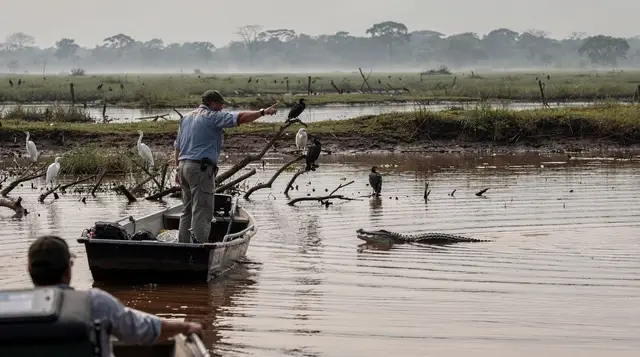
Caño Negro Wildlife Refuge is roughly two hours from La Fortuna by road, and it is a different kind of habitat entirely: a Ramsar-listed wetland fed by the Río Frío, with a seasonal lake that swells in green season and shrinks dramatically by the end of dry season. A slow boat safari along the river is the way to see it — spectacled caimans sunning on the banks, jabiru storks in season, roseate spoonbills, kingfishers, and howler and white-faced monkeys in the gallery forest along the banks.
Most operators run this as a full-day trip from La Fortuna, combining the drive with a few hours on the water in the morning, when animal activity is highest before the heat sets in. Bring sun protection — the boat offers little shade — and expect the water level, and therefore what’s visible, to look noticeably different depending on whether you’re visiting in dry or green season. Sightings here genuinely vary week to week; a guide who lists twelve species she “usually” sees is being honest, not evasive.
Return to La Fortuna in the evening, tired, sunburnt in the good way, and ready for an earlier, gentler day next.
Day 4: Peñas Blancas river, a slower float
Where Caño Negro is a broad wetland covered by boat, the Peñas Blancas river safari float is narrower and slower — a flat-water inflatable float rather than a motorised boat, drifting close to the banks with a guide paddling and spotting. It’s calm enough to bring binoculars and actually use them, unlike a whitewater run. Look for sloths draped in streamside trees, basilisk lizards (“Jesus Christ lizards”) skittering across the water, herons, kingfishers, and river otters if you’re fortunate.
This is a half-day activity, which makes it a good pairing with a slow morning and an easy afternoon back in town — laundry, a proper lunch, maybe a browse through La Fortuna’s town centre restaurants. Save your energy: tomorrow involves the longest drive of the trip.
Day 5: To Monteverde, cloud forest arrival
Monteverde sits at roughly 1,400 metres, a different climate and a different forest from anything around La Fortuna, and it’s the only place on this itinerary where a resplendent quetzal is genuinely possible. Two ways to get there: drive the mountain road, which takes three and a half to four hours over partly unpaved terrain, or take the jeep-boat-jeep crossing over Lake Arenal, which takes about three hours and is the more scenic — and often cheaper — option if you don’t need the rental car in Monteverde itself.
Once you arrive, don’t try to pack in a full reserve visit the same afternoon you’ve been travelling. A shorter guided walk is a better use of remaining daylight:
a guided suspension bridge walk through the Monteverde cloud forest canopy gets you into the habitat quickly, with a naturalist guide scanning for movement in the mid-canopy, which is exactly where quetzals tend to be seen when they’re around at all.
Settle into Santa Elena for the night. Quetzal season runs roughly February to July, tracking their breeding cycle and the fruiting of wild avocado trees they feed on — outside that window, the odds drop substantially, and no operator can promise otherwise.
Day 6: The quetzal search, and heading onward
Quetzals are most active and most visible in the very early morning, so this day starts before sunrise. A dedicated birding guide who knows which fruiting trees are active this week is worth far more here than a general reserve entry ticket — ask your accommodation or a local operator about a small-group early-morning birding walk rather than joining a general one. Alongside quetzals, listen and look for toucanets, motmots, and hummingbirds, all considerably easier to actually find.
If the morning search comes up empty, that’s not a failure of planning — it’s how wildlife tourism works outside a zoo. A cloud forest morning is worthwhile even without the headline bird, and Monteverde’s mix of ferns, epiphytes, and near-constant mist is its own reward.
Depending on your onward plans, spend the rest of the day easing back toward La Fortuna via the jeep-boat-jeep, continuing on to San José for a flight out, or extending toward the Pacific coast. If you’re flying out of SJO, build in the three-hour drive time (or the crossing plus onward transfer) rather than cutting it close.
What this trip does not include, on purpose
No hot springs day, no ziplining, no Mistico hanging bridges, no white-water rafting. All of those are worth doing on a different trip; none of them meaningfully improve your odds of seeing wildlife, and cramming them in dilutes the early mornings and quiet observation this itinerary depends on. If a mix of sensation and sightseeing sounds more like your trip, the La Fortuna for adventure itinerary or a shorter La Fortuna and Monteverde combination will suit you better.
Practical notes
- Footwear: closed shoes on every trail, every day — Bogarín, Caño Negro’s boat launch, the Peñas Blancas put-in, and every Monteverde path. The fer-de-lance is present in this region.
- Binoculars: bring your own if you can. Guides carry spotting scopes, but a personal pair means you’re not waiting your turn to see something that might move on in seconds.
- Timing: mornings are non-negotiable for this itinerary. Sloths, caimans, and quetzals are all more active before the heat of midday.
- Season: green season (May–November) means more active rivers and lusher forest, but also murkier water and lower visibility at Caño Negro late in the season. Dry season (December–April) drops water levels at Caño Negro but generally offers clearer skies for the drive to Monteverde. Quetzals need February–July regardless of rain.
- Rental car: useful for the Bogarín Trail and getting to river put-in points, but not required — most operators include hotel pickup for Caño Negro and Peñas Blancas.
FAQ: planning a wildlife-focused trip from La Fortuna
Are sloth sightings guaranteed on the Bogarín Trail?
No. The Bogarín Trail offers better odds than most locations because its guides track resident sloths daily, but sloths move and no reputable operator guarantees a sighting on any given visit.
Can I see quetzals in La Fortuna itself?
No. Quetzals live at cloud-forest elevation and are not found around La Fortuna. Monteverde, at roughly 1,400 metres, is the nearest realistic location, and even there they’re most likely from February to July.
Is Caño Negro worth a full day from La Fortuna?
Yes, if wildlife is your priority. The round trip takes most of a day given the two-hour drive each way, but the wetland habitat — caimans, waterbirds, monkeys — is different from anything closer to La Fortuna and not replicated elsewhere on this itinerary.
How does the Peñas Blancas float differ from the Caño Negro boat trip?
The Peñas Blancas safari float is a slower, narrower river drift close to the banks, better for spotting sloths and basilisks. Caño Negro is a broader wetland covered by motorised boat, better for caimans and larger flocks of waterbirds. They complement rather than duplicate each other.
Do I need a car for this itinerary?
It helps but isn’t essential. Most wildlife tour operators include La Fortuna hotel pickup for Caño Negro and Peñas Blancas. A car matters more for flexibility getting to Monteverde by road, though the jeep-boat-jeep crossing is a practical alternative that doesn’t require one.
What should I wear on these trails?
Closed shoes at all times — sandals are not appropriate given the presence of the fer-de-lance viper. Light, quick-dry clothing, a hat, and sun protection for the boat days; a light rain layer for Monteverde, where mist and drizzle are common even in dry season.
Is this itinerary suitable for families?
The Bogarín Trail and Ecocentro Danaus are both easy and family-friendly. The Caño Negro and Peñas Blancas boat days involve more heat, sun exposure, and sitting time, which works better for children old enough to stay patient and still. The early Monteverde mornings are the hardest sell for younger kids.
Should I skip Monteverde and stay closer to La Fortuna instead?
If quetzals aren’t a priority, yes — a shorter five-day version staying entirely around La Fortuna, Caño Negro, and Peñas Blancas is easier logistically and skips the long drive or lake crossing. But quetzals genuinely don’t occur around La Fortuna, so cutting Monteverde means cutting that species from the trip entirely.
Wildlife tours on GetYourGuide
Verified deep-linked GetYourGuide tours. Book through these links and we earn a small commission at no cost to you.
GetYourGuide does not provide a product photo for this activity — the image shows the meeting point, photographed by us.