Peñas Blancas River Safari Float: The Calm Way to See Sloths and Monkeys
What is the Peñas Blancas River safari float?
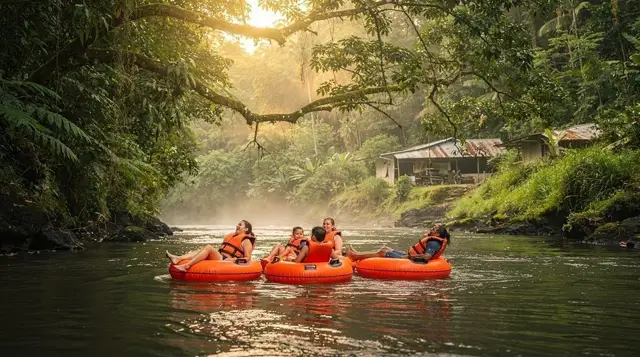
It's a slow, guided drift in an inflatable raft down the calm Peñas Blancas River, close to La Fortuna, aimed at spotting sloths, monkeys, caimans and birds rather than running rapids. It has no whitewater and needs no paddling experience, unlike rafting on the nearby Balsa River.
A River Trip Built for Watching, Not Paddling
The Peñas Blancas River sits close enough to La Fortuna that most operators list it as a half-day option, and it does one thing very well: it puts you at eye level with the riverbank where sloths, monkeys and birds actually spend their day, without asking anything of you but to sit still and look up. This is a raft, not a kayak, and a guide steers while you watch. Nobody paddles, nobody gets thrown around, and the water rarely rises above a gentle current.
That calm is the whole point, and it’s also where confusion creeps in. “Safari float” and “rafting” both mean an inflatable boat on a river near La Fortuna, and travellers sometimes book one thinking they’re getting the other. They are not the same trip, and mixing them up either wastes a rafting trip’s adrenaline on a wildlife float, or drops an unprepared group into a whitewater run they didn’t sign up for. This guide is about the calm option, why you’d choose it, and where it sits next to the two trips people confuse it with.
Safari Float vs Rafting: Two Rivers, Two Levels of Effort
The single biggest mix-up in La Fortuna’s river tours is treating “float” and “raft” as interchangeable marketing words. They describe different rivers and different physical demands.
| Peñas Blancas Safari Float | Balsa River Rafting | |
|---|---|---|
| Water | Flat to gently moving | Class II-III whitewater |
| Effort | None — you don’t paddle | Active paddling required |
| Focus | Wildlife spotting | Whitewater rapids |
| Typical duration on water | 1.5-2 hours | 1.5-2.5 hours |
| Minimum age | Around 4-5 years | Usually 12 years |
| Good for | Families, non-swimmers, photographers | Adventure seekers, fitter travellers |
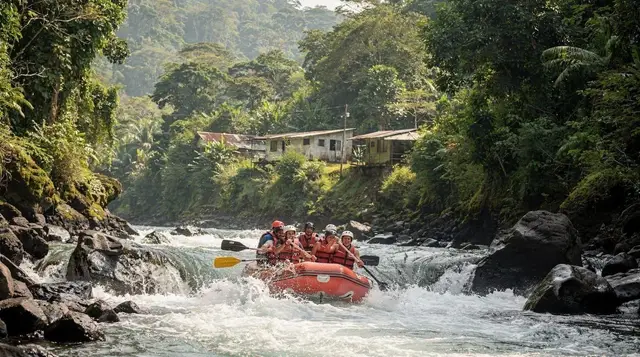
If rapids, splashing and a workout are what you want, the Balsa River is the better booking — see the Balsa River rafting guide for what that trip actually involves. If you want a slow drift with binoculars in hand, the Peñas Blancas float is the one to choose. Our rafting vs. safari float comparison goes deeper into which one suits a given traveller, and the wider tubing vs. rafting vs. safari float breakdown adds the river-tubing option some hotels also sell.
a half-day safari float on the Peñas Blancas River is the standard version of this trip, with hotel pickup and a naturalist guide included in most packages.
Safari Float vs the Caño Negro Boat Safari
There’s a second, gentler confusion worth clearing up: the Peñas Blancas float against the boat tour at Caño Negro. Both are slow wildlife-watching boat trips on calm water, and both are marketed around sloths, birds and caimans, so it’s easy to assume one is just a longer version of the other.
They’re not quite that. Caño Negro sits on the Río Frío, roughly two hours from La Fortuna, inside a much larger Ramsar wetland reserve. The boats there are typically larger, motorised launches rather than paddle-free rafts, and the trip is built around a full morning or afternoon commitment with a longer drive on each end.
Caño Negro tends to produce more caimans and a wider spread of waterbirds simply because the reserve is bigger and the habitat is wetland rather than a forested river channel. The Caño Negro boat safari guide and the Río Frío wildlife cruise guide cover that trip in detail, and it’s also profiled as its own destination day trip.
The Peñas Blancas float, by contrast, is close, short, and easy to slot into a single La Fortuna afternoon without giving up a whole day. If your itinerary has one wildlife-boat slot and you’re deciding between the two, Peñas Blancas wins on convenience and sloth-spotting in the trees along a narrower channel; Caño Negro wins on scale, caiman numbers and total bird volume. Neither is objectively “the good one” — they answer different questions about how much of your day you want to give up.
What You’ll Actually See
Set expectations honestly: this is a wildlife float, not a zoo, and every sighting depends on the animals cooperating that morning. That said, guides who run this stretch of the Peñas Blancas River daily know where sloths tend to sit and which fig trees the monkeys favour, and sightings are frequent enough that most groups see something worth the trip.
- Sloths — both two-toed and three-toed sloths are regularly spotted in trees overhanging the water. They move so little that a trained guide’s eye matters more than luck; if you want sloths closer to a guaranteed sighting, the Bogarín Trail and its dedicated family sloth walk are a stronger bet, and our general wildlife-spotting guide explains why.
- Monkeys — howler and white-faced capuchin monkeys are common along this stretch, sometimes right over the boat.
- Birds — herons, kingfishers, toucans and the occasional trogon show up depending on season and time of day.
- Caimans and iguanas — present but less reliable here than at Caño Negro; sunbathing spots along the bank are where guides look first.
Morning departures consistently outperform midday ones, because the forest is quieter and animals that were active at dawn are still visible before the afternoon heat pushes them into deeper cover.
How the Tour Works
A typical Peñas Blancas safari float runs to a predictable shape:
- Hotel pickup in La Fortuna, usually early morning, 20 to 30 minutes to the put-in point.
- Safety briefing and life jackets — no swimming skill is assumed and no paddling instruction is needed, since guides handle the raft.
- 1.5 to 2 hours on the water, drifting rather than running rapids, with the guide pointing out wildlife and stopping the raft when something is spotted.
- Return transfer back to the hotel, often with a snack or fruit break included.
Combination packages exist and are worth knowing about before you book, since they change both the price and the length of the day:
a combined safari float and hanging bridges tour with lunch pairs the float with a walk across suspension bridges — see the hanging bridges parks compared guide and the Mistico Hanging Bridges guide if you’re deciding which bridge park to add. It’s a sensible pairing because both activities are calm, low-effort and family-friendly, and doing them back to back fills a half day without exhausting anyone.
For a different mood entirely, a floating picnic experience on the water with wine included takes the same idea of a calm drift and turns it into a more leisurely, adult-oriented outing rather than a wildlife-focused one — useful to know if the group wants scenery and a glass of wine more than a checklist of animals.
Sloth and Monkey Add-Ons
Several operators also run land-based sloth and monkey tours that complement, rather than duplicate, the river float. a guided sloth and monkey walking tour near Arenal covers forest trails on foot, which reach different tree cover and different vantage points than a boat can. Pairing a morning float with an afternoon walking tour — or vice versa — roughly doubles your chances of a sloth sighting across a single day without repeating the same activity twice.
How Guides Find Animals You Would Walk Past
Most of what makes a float worthwhile happens before you see anything. Guides read a riverbank the way a local reads a street: they look for a bundle of leaves that is too round, a branch that sags in the wrong place, a patch of canopy where the light looks broken. A sloth curled in a fork is easy to miss on your own, and a guide who has run the same stretch for years will often name the tree before you can pick out the animal. Ask them to point with a finger and then describe the spot by landmark (“second branch, left of the trunk”). It saves a minute of squinting.
Binoculars help, and so does patience. The raft drifts quietly, which is its advantage over a motorised launch: animals tend to stay put when the boat does not roar past. Keep conversation low, keep movement slow, and let the guide hold the raft when something turns up. If you want to understand what a sighting really tells you about the animal, the blog piece on what seeing a sloth actually means is worth a read before you go.
Who This Trip Suits, and Who Might Be Bored
The float suits families with young children, grandparents, nervous swimmers, photographers and anyone who wants a slow morning outdoors. It works especially well as the gentle day in a longer trip, the one that sits between a hard morning of rafting or ziplining and a long evening at the springs. Families should also look at the La Fortuna with kids guide and the family trip itinerary to see where the float fits.
It will feel slow to anyone who wants adrenaline. Travellers craving speed and splash are better served by the rafting near La Fortuna guide or the adventure itinerary. And if your main goal is birds, a dedicated outing with a specialist guide, as described in the birdwatching around Monteverde guide, will give you a longer list than a general wildlife float.
Photographing From a Moving Raft
A raft is a steady platform on calm water, but it still turns slowly in the current, so the animal you framed a moment ago may drift out of view. A few habits help:
- Shoot in bursts rather than single frames, since sloths are still but leaves and light are not.
- Use a strap on any camera or phone, and keep it on your wrist or neck.
- Do not lean out for a better angle. The guide can reposition the raft; your job is to stay balanced.
- Expect backlit shots. Animals in the canopy are often silhouetted against a bright sky, so expose for the animal and accept some blown-out sky.
A zoom lens matters more than a wide one here, because most wildlife sits well above or across the water from you.
When the Weather Turns
The green season brings afternoon rain, and the weather app that lies about the volcano is a good reminder that a forecast of rain does not mean a ruined day. A morning float often goes ahead under grey skies and gives you soft light for photos. If a storm does cancel or shorten your slot, the rainy afternoons guide has indoor and covered alternatives, and the best time to visit La Fortuna page explains how the seasons shape the whole trip.
Pairing the Float With Other Wildlife Time
One float will not exhaust the area’s animals. A night walk reveals frogs and nocturnal species that the river never shows you in daylight: see the night walks guide and what to bring on a night walk for preparation. Pairing a daytime float with an evening walk gives you two completely different views of the same forest in one day.
Cost and Timing
| Tour Type | Typical Price (USD, per person) | Duration |
|---|---|---|
| Standalone safari float | 55-85 | 3-4 hours door to door |
| Float + hanging bridges + lunch | 90-130 | 5-7 hours door to door |
| Floating picnic experience | 70-100 | 3-4 hours |
| Land-based sloth and monkey walk | 40-60 | 2-3 hours |
Prices are ordering-of-magnitude figures; operators price in USD and quotes shift with season and group size. Morning slots fill first in the December-to-April dry season, so booking a day or two ahead is enough for most weeks, but during the busier weeks around Christmas and Easter it’s worth locking in earlier.
Best Time of Day and Season
Morning departures, generally between 7:00 and 9:00, are the best combination of cooler temperatures, calmer water and more active wildlife. La Fortuna sits on the rainy side of the country, so expect showers even in the nominally dry December-to-April season, and count on them in the May-to-November green season — see La Fortuna in green season for what that means for planning.
Rain rarely cancels the float outright; the river is small enough that operators simply reroute or reschedule around a heavy downpour rather than shutting the activity down, and a modest rise in water level can actually make the float more comfortable by covering exposed rocks. What does matter is visibility: a hard rain shower will send wildlife into cover and can shorten what you see, which is one more reason morning departures, ahead of the typical afternoon rain, tend to outperform later ones.
What to Bring
- Swimsuit under quick-dry clothing
- Secure water shoes or sandals with a back strap — flip-flops are a liability on wet decking
- Reef-safe sunscreen and a hat
- Insect repellent
- A dry bag or waterproof phone pouch if you want to photograph wildlife from the raft
- A light rain jacket, packed rather than worn, for the transfer
Leave passports, large amounts of cash and anything you’d hate to drop into a river back at the hotel. Most rafts have only limited dry storage, and a spilled dry bag is the most common way a phone ends up in the water on this kind of trip.
Where the Peñas Blancas Float Fits in a La Fortuna Itinerary
Because it only needs half a day, the safari float slots naturally alongside a morning at the hot springs or an afternoon in La Fortuna town without forcing you to sacrifice another activity. It also pairs well on a wildlife-themed day plan — see La Fortuna for wildlife for a fuller sequence that stacks the float with a night walk or the Bogarín Trail.
For the broader category of river and boat-based wildlife trips around La Fortuna, the wildlife tours hub lists every option side by side, and the rafting near La Fortuna guide is the place to go if it turns out whitewater, not wildlife, is what the group actually wants.
The honest summary: the Peñas Blancas River safari float is the low-effort, high-comfort choice among La Fortuna’s river tours. It won’t give you the whitewater rush of the Balsa River, and it won’t match the sheer scale of Caño Negro’s wetlands, but for a relaxed morning spent looking for sloths and monkeys without lifting a paddle, it’s the trip built exactly for that.
Tubing and river floats on GetYourGuide
Verified deep-linked GetYourGuide tours. Book through these links and we earn a small commission at no cost to you.
GetYourGuide does not provide a product photo for this activity — the image shows the meeting point, photographed by us.