Balsa River Rafting: The La Fortuna Guide
What is Balsa River rafting from La Fortuna actually like?
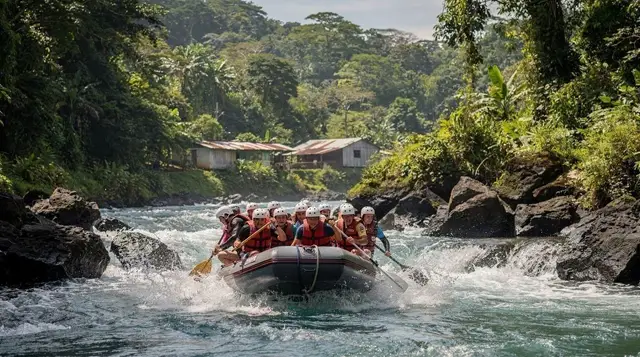
It's a roughly 2 to 2.5 hour Class II-III run, suited to beginners and intermediates, run by certified guides who provide the raft, paddle, helmet and life jacket. It is not a sedate float: every trip starts with a mandatory safety briefing and swim test, and the water is genuinely moving.
The river everyone actually rafts near La Fortuna
Ask a handful of tour desks in La Fortuna where to go rafting and most of them will point you to the same stretch of water: the Río Balsa. It isn’t the only river near the volcano — the Peñas Blancas offers a gentler safari float, and operators occasionally run the Sarapiquí for a longer day trip — but the Balsa is the default because it sits close to town, it runs at a rateable Class II-III most of the year, and it’s forgiving enough for a first-timer while still being genuinely fun for someone who’s rafted before.
For a broader look at how the Balsa compares to other rivers in the area, see the general rafting overview for La Fortuna. This page stays narrow on purpose: what an actual Balsa River descent involves, what’s provided, what isn’t, and the safety conversation that too many trip listings skip past.
What the run actually looks like
A typical Balsa River trip covers a stretch of roughly 8 to 10 kilometres, taking about 2 to 2.5 hours on the water. It’s a read-and-run river: rather than one dramatic set-piece rapid, you get a sequence of rapids separated by calmer pools where guides reset the group, point out what’s coming, and give everyone a breather. Most of the run sits at Class II, with several Class III sections that pick up the pace — enough to get you wet on every pass, enough to require real paddling, but not the technical, scout-every-drop water you’d find on a Class IV run elsewhere in the country.
| Stage | What happens |
|---|---|
| Pickup from La Fortuna | 20-40 minutes depending on your hotel |
| Safety briefing and gear-up | 20-30 minutes, mandatory, at the put-in |
| River time | 2 to 2.5 hours, Class II-III |
| Take-out and change | 15-20 minutes |
| Return transfer | 20-40 minutes back to La Fortuna |
Add it up and a half-day slot of 4 to 5 hours is the realistic block to leave free, even though the paddling itself is closer to two.
the standard Balsa River Class II-III rafting run from La Fortuna is the departure most first-time rafters end up booking, and it’s the one referenced throughout this guide unless noted otherwise.
Who this trip suits, and who it doesn’t
Class II-III is deliberately the entry tier. If you’ve never rafted before, this is where operators in the La Fortuna area steer you, and for good reason — the rapids are continuous enough to be exciting without demanding technical whitewater experience. That said, “beginner-friendly” is not the same as “no effort required.” You’ll paddle on command through every rapid, you’ll get thoroughly soaked, and there’s real current pulling at the raft the whole way down.
It suits:
- First-time rafters who want a genuine adrenaline hit without a Class IV commitment
- Groups mixing rafting veterans and complete beginners — the class level works for both
- Travellers based in La Fortuna who want a half-day activity that doesn’t eat the whole day
It’s a poor fit for:
- Non-swimmers, or anyone uncomfortable being briefly underwater
- Travellers with back, neck, or heart conditions — check with the operator directly
- Pregnant travellers, who are turned away by every operator on safety grounds
- Families with young children — most operators set a minimum age around 8 to 12; for a family-friendly alternative on the water, look at a safari float on the Peñas Blancas River instead, or read the wider rafting versus safari float comparison before deciding
Gear that’s provided, and what you bring yourself
Every legitimate Balsa River operator supplies the safety-critical equipment as standard: a raft, a paddle sized to you, a properly fitted helmet, and a Coast Guard-style life jacket. None of that is optional and none of it is negotiable — if a guide tells you to tighten your helmet strap, do it before you ask why.
What you’re expected to bring or wear:
- Quick-dry shorts or leggings and a t-shirt you don’t mind soaking — cotton stays wet and gets heavy
- Secured footwear: old sneakers or sports sandals with a back strap. Flip-flops come off in the first rapid and operators will turn you away without proper shoes
- A dry bag or leave-it-behind approach for phones and wallets — some operators offer waterproof cases for an extra fee, but nothing on a raft is guaranteed dry
- Reef-safe sunscreen, applied before you leave your hotel, not at the put-in
- A full change of clothes and a towel for the ride back
- Contact lens wearers should consider glasses instead, or accept the small risk of losing a lens in a rapid
Leave watches, jewellery, and anything you’d be upset to lose at your accommodation. Guides can’t chase a dropped GoPro downstream mid-rapid.
Certified guides — what that actually means here
Costa Rican river guides working commercially are required to hold certification through the national tourism board (ICT) and typically carry additional swiftwater rescue training specific to the river they run. In practice, that means your guide has been assessed on reading the specific rapids of the Balsa, on rescue technique if someone goes overboard, and on first aid. It does not mean the river is being controlled for you — a guide’s job is to read the water and coach the raft through it, not to guarantee nobody gets bounced around.
Ask, if it matters to you, how many seasons a guide has run this specific river. Water levels and known trouble spots shift with the season, and local experience on the Balsa specifically counts for more than a generic rafting certification from elsewhere.
The safety briefing you cannot opt out of
Every operator running the Balsa starts the same way: a safety briefing at the put-in, before anyone touches a paddle. This isn’t a formality to rush through while you’re impatient to get on the water. It covers the paddle commands you’ll need mid-rapid, what to do if you fall out (float on your back, feet pointed downstream, don’t try to stand up in moving water), how to help a fellow rafter back in, and where the pinch points and known hazards on this particular run sit. Guides will also run a swim test or at minimum confirm swimming ability directly with each guest.
Skip none of it, and don’t treat questions as a sign of weakness — a guide would rather explain the flip-and-swim procedure twice than have someone freeze the one time it matters. For a longer treatment of what a proper briefing should cover and how to judge whether an operator is cutting corners, see what a rafting safety briefing should actually include.
This is also the point to say plainly what some tour listings won’t: white-water rafting is a physical activity in moving water, and Class II-III means real rapids, not a scenic float with occasional splashes. Falls happen, even on well-run Class II-III trips with excellent guides. The mandatory briefing, the certified guide, and the standard-issue helmet and life jacket exist because the river is not risk-free — they bring that risk down, they don’t erase it. Any operator or listing that markets this as entirely safe is glossing over exactly the part you should be paying attention to.
Small-group Class III versus the standard run
Two Balsa River departures cover broadly the same river, but they’re not identical trips. The standard option runs larger groups through the Class II-III stretch at set daily departure times — it’s the more affordable, more widely available choice, and the one most first-time rafters book.
a small-group Class III run on the same river trades a lower headcount and a somewhat more technical read of the Class III sections for a higher price point and fewer available time slots. If you’ve rafted before and want a slightly punchier version of the same river, or you simply prefer fewer rafts sharing the put-in with you, that’s the one to look at.
Operators elsewhere in the valley also run a Class II-III whitewater trip on a different Arenal-area river — worth comparing on departure times if the Balsa is fully booked on your dates, though it’s a separate river with its own character, not simply a duplicate listing.
| Standard Balsa run | Small-group Class III | |
|---|---|---|
| Group size | Larger, shared departures | Smaller, capped headcount |
| Rapid intensity | Class II-III | Leans harder into Class III |
| Price (order of magnitude, USD) | Lower | Higher |
| Availability | Multiple daily slots | Fewer slots, book ahead |
| Best for | First-timers, mixed-ability groups | Rafters wanting a punchier trip |
What it costs
Prices on the Balsa River move with group size, operator, and season, so treat the figures below as an order of magnitude rather than a quote — check current pricing before you book. As a rough guide, expect the standard half-day rafting trip to sit in the USD 70-100 per person range including transfer, with the small-group Class III option running somewhat higher. Tours, hotels and parks across La Fortuna quote in US dollars as standard, though change is often handed back in colones — worth knowing before you hand over a large bill.
Building it into your day
Because the river portion only runs 2 to 2.5 hours, a lot of visitors pair a morning rafting trip with something calmer in the afternoon. The Venado Caves sit roughly an hour from La Fortuna and make a reasonable combination day if you don’t mind two wet activities back to back — just note that caving needs its own footwear, covered in what to wear for Venado Caves. Others prefer to keep rafting day separate from anything else physical and use the afternoon to recover before an evening hanging bridges walk or hot springs visit.
If you’re planning your trip length around activities like this one, how many days in La Fortuna and the broader adventure-focused itinerary both work rafting in as a half-day slot rather than a full one — useful if you’re trying to also fit in the waterfall, the Arenal volcano trails, and a hot springs evening into a short stay.
Travellers keeping costs down should also read La Fortuna on a budget, since rafting is one of the pricier half-day activities in the area and worth weighing against alternatives. First-timers to the region generally benefit from the wider context in first-time in La Fortuna before locking in an itinerary. You can browse the full white-water rafting category for every operator and river combination running near town.
Booking and cancellation basics
Book at least a day or two ahead in high season (December-April), and further ahead if you specifically want the small-group Class III departure, which sells out faster on fewer daily slots. In green season (May-November), heavier rain can raise the Balsa’s water level enough that operators reschedule or cancel a trip outright — a legitimate safety call, not an inconvenience to argue with. If rafting is a fixed priority for your trip, build a spare day into your La Fortuna schedule rather than booking it for your only free slot.
Most operators include transfer from La Fortuna hotels in the price; confirm this at booking, since a small number of listings quote river-only pricing with transport as an add-on. A light snack or lunch after the trip is common but not universal — check what’s included before you skip breakfast expecting to be fed on the riverbank.
White-water rafting on GetYourGuide
Verified deep-linked GetYourGuide tours. Book through these links and we earn a small commission at no cost to you.
GetYourGuide does not provide a product photo for this activity — the image shows the meeting point, photographed by us.