Rafting Safety and What to Bring: La Fortuna Rapids Explained
Do you need to know how to swim to go rafting near La Fortuna?
No strong swimming ability is required on the Class II-III sections run commercially near La Fortuna, since a life jacket and helmet are mandatory and provided by every reputable operator. You do need to be comfortable in moving water and able to follow the guide's commands, and most operators set a minimum age of around 8 to 12 depending on the run and water level.
Before You Book, Read This
Every operator running trips out of La Fortuna will tell you rafting here is safe. Most of them mean it. But “safe” comes with conditions that get glossed over in a five-minute sales pitch at your hotel desk: a minimum age that shifts with the water level, a swimming requirement that is more nuanced than yes or no, and a habit some smaller outfits have of treating safety gear as something you can wave off if you look confident enough.
This page exists to answer the practical questions that come up before every trip on the Balsa River or the wider rafting runs near La Fortuna, so the river-specific write-ups do not have to repeat them. If you are choosing which river or which company to book with, the Balsa River rafting guide covers the run itself; this page covers who should go, what to wear, and what to do with your phone.
Minimum Age and Who Should Sit This One Out
There is no single legal minimum age for rafting in Costa Rica. Each operator sets its own limit, and that limit depends on which section of the Balsa River they run and how high the water is that week. As a general pattern across companies operating near La Fortuna:
| Trip type | Typical minimum age | Notes |
|---|---|---|
| Half-day float, gentler stretch | 6 to 8 | Marketed as family-friendly; confirm current age limit at booking |
| Class II-III run (most common) | 10 to 12 | The standard commercial trip; age limit firms up in high water |
| Class III-IV section (experienced rafters) | 14 to 16, or prior rafting experience required | Not the default trip sold to first-timers |
A child who meets an operator’s minimum age on paper still needs to be able to sit still in a moving raft, hold a paddle without letting go of it in a rapid, and follow a shouted instruction in English or Spanish within a second or two. If that description does not fit your child yet, a safari float on the Peñas Blancas River delivers wildlife and river time without the rapids, and is a better match. Pregnant travellers, anyone with a recent back, neck, or shoulder injury, and anyone with uncontrolled heart conditions should not raft, and a properly run operator will ask about all three before you get in the raft, not after.
There is no upper age limit as such, but the honest constraint is fitness: you need to be able to climb in and out of a raft over slippery rocks, paddle continuously for stretches of a few minutes, and, in the rare event you go into the water, get yourself into a defensive floating position and swim toward the raft when told to. Most companies will discuss borderline cases by phone or email before you commit.
Do You Need to Know How to Swim?
This is the question that keeps more people from booking than any other, and the honest answer sits in the middle. You do not need to be a competent swimmer to raft the Class II-III sections run commercially out of La Fortuna. The life jacket is doing the flotation work, not you, and guides are trained specifically to recover swimmers who have gone overboard. What you do need is comfort with moving water: getting your face splashed repeatedly, being tipped sideways in your seat, and trusting a stranger shouting instructions over the noise of the rapid.
If you genuinely cannot swim at all and that makes you anxious rather than merely inconvenienced, say so when you book, not when you are already strapped into a life jacket at the put-in point. A good guide adjusts your seat position, usually toward the centre of the raft rather than the front corners, and pays closer attention to you through the trip. If a company brushes off the question, that alone tells you something about how they run trips.
For a lower-commitment introduction to moving water, the Wildlife Floating Boat Tour in Bijagua style trips and the Peñas Blancas safari float both put you on a river without rapids at all. If you want the adrenaline without any swimming component whatsoever, canyoning trades the swim risk for a harness and a guide controlling your rope, which some travellers find easier to reason about than “trust the current.” See the canyoning levels guide if that is the direction you are leaning.
What to Wear on the River
Pack for getting completely soaked and staying that way for two to three hours. The list that actually matters:
- Quick-dry shorts or leggings. Athletic or swim material, not jeans or cotton shorts, which get heavy and cold once wet and stay that way.
- A swimsuit or rash guard underneath. You will be adjusting a life jacket over your clothes, so whatever is underneath should already be secure.
- A t-shirt or rash guard on top. Sun exposure on the river is stronger than it feels, especially with the glare off the water; a full-length sleeve is worth the minor discomfort.
- Secure closed-toe footwear. More on this below, because it is the one item people consistently get wrong.
- A hat with a chin strap or none at all. A loose cap will be in the river within the first rapid.
- Reef-safe sunscreen, applied before you leave your hotel, not at the put-in point where you have five minutes before the safety briefing starts.
- A change of dry clothes left in the vehicle or with your guide, not in your daypack on the raft.
What to leave behind: jewellery you would mind losing, a good watch, prescription sunglasses without a strap, and anything electronic that is not in a genuinely waterproof case rated for submersion, not just splashes.
Footwear: The One Rule Everyone Breaks
Flip-flops and open sandals come off within the first significant current, and once a shoe is gone it is gone; it is not worth stopping the trip to look for it, and most guides will not. The terrain compounds the problem: put-in and take-out points on the Balsa and similar rivers involve scrambling over wet, algae-covered rocks, and an open sandal offers no protection against a stubbed toe or a cut on the way in.
What works: river sandals with a proper heel strap (Chacos, Tevas, and similar), old sneakers you do not mind ruining, or purpose-made water shoes. Some operators keep a small stock of river shoes to rent or lend for a few dollars if you show up in flip-flops, but do not count on your size being available. Barefoot is not an option any operator will allow, both for grip on the raft floor and for foot protection at the rocky entry and exit points.
Life Jackets and Helmets Are Not Optional
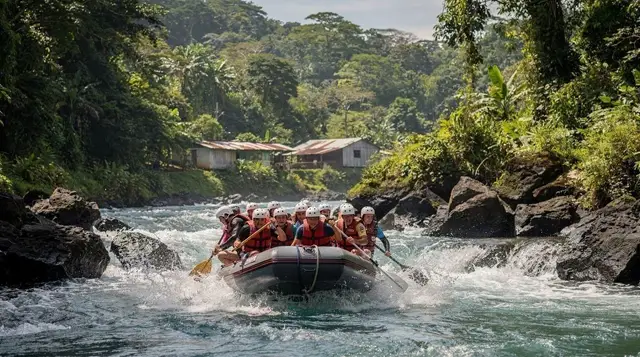
Every trip run by a licensed operator on the Balsa River or any other commercial run near La Fortuna requires a life jacket and a helmet on every person in the raft, guide included, for the entire time you are on the water. This is not a suggestion, not something that applies only to weaker swimmers, and not something a confident rafter can talk their way out of. Costa Rican tour operator regulations require it, the operators’ insurance requires it, and any guide who offers to let you skip either piece of gear because you “look like you know what you’re doing” is a signal to book with someone else.
Before departure, a properly run trip includes a safety briefing covering:
- How to sit in the raft and where to brace your feet
- Paddle commands: forward, back, stop, and how to hold the paddle if you fall
- What to do if you go into the water — feet-up, face-up, downstream position, and how to grab the raft or a thrown rope
- Where the guide sits and what their hand signals mean mid-rapid
If your trip skips this briefing entirely, or delivers it in under a minute while people are already getting into the raft, that is worth noting. A rushed briefing on a river with real currents is a bigger risk indicator than the rapids themselves.
What Happens to Your Phone, Wallet, and Valuables
The safest approach is the simplest: leave your passport, most of your cash, and anything irreplaceable at your hotel, and bring only what you need for the day. Most operators near La Fortuna offer one of two solutions for what remains:
- A dry bag carried in the raft, usually strapped down, for a phone, a small amount of cash, and room keys. Ask specifically whether it is submersion-rated or just splash-resistant before trusting a phone inside it.
- A locker or storage box at the put-in point, watched by staff while you are on the river, for anything you would rather not carry at all.
Neither option is bulletproof. Rafts do flip occasionally on higher water, and a dry bag strapped to a raft that goes over can still take on water if the seal was not closed properly. The safest version of your phone on a rafting trip is a phone that stayed in the vehicle. If you want photos, ask whether your guide carries a waterproof camera or GoPro and shoots footage for the group, which many operators now include or offer as a paid add-on — a better trade than risking your own device.
Weather, Water Levels, and Trip Cancellations
La Fortuna sits on the windward side of the country, and it rains here in some form nearly every month, heaviest from May through November. Rain that falls upstream, sometimes an hour’s drive from where you are standing, can raise a river’s level and change its character within a few hours, well before any rain reaches you personally. Operators monitor this closely, because running a raft on a river that has risen beyond the level their guides are certified for is the single biggest safety failure in the sport, and it is entirely avoidable by simply not launching.
If your trip is cancelled or postponed for water levels, take it as evidence the company is being careful rather than an inconvenience aimed at you. Ask about the refund or rescheduling policy when you book, before there is a problem to negotiate around. If rafting is a priority for your trip rather than a nice-to-have, build one spare day into your itinerary so a weather cancellation does not simply erase the activity.
Health, Medication, and Travel Insurance
Tell your guide before departure about any heart condition, recent surgery, epilepsy, or medication that affects balance or reaction time. This is not paperwork for its own sake; a guide who knows in advance can seat you accordingly and react faster if something goes wrong. Anyone who has been drinking should not raft that day, and any operator worth booking will refuse a visibly intoxicated guest regardless of how the trip was already paid for.
Check that your travel insurance covers white water rafting specifically. Some standard policies exclude “adventure sports” as a category, which can include rafting above a certain river class, and a policy that covers general travel mishaps will not necessarily cover a rafting injury. This is worth five minutes before you leave home, not a question to sort out from a hospital in Ciudad Quesada.
What a Reputable Operator Includes
Before comparing prices, compare what is actually in the package. A trustworthy rafting operator near La Fortuna includes, without extra charge:
- Life jacket and helmet, sized and inspected before each trip
- A safety briefing covering paddle commands and swimmer position
- A certified guide steering the raft, in addition to any paddling guests do
- Round-trip transport from La Fortuna hotels, in most cases
- A dry bag or secure storage option for small valuables
- Bottled water and, on longer trips, a snack or light meal afterward
What tends to be extra, and worth asking about specifically: professional photos or video, river shoe rental if you did not bring your own, and single-supplement pricing if you are travelling alone and would rather not share a raft with strangers.
Comparing the Booking Options
the full Río Balsa white water rafting run is the standard commercial trip most first-timers book, combining Class II-III rapids with round-trip transport and full safety gear. If your schedule is tighter, the half-day version of the same Río Balsa trip covers the same core rapids in a shorter window, useful if you are combining rafting with another activity that day.
Travellers looking specifically for a graded Class II-III experience with a strong safety briefing can also book the Arenal-area whitewater rafting trip rated Class II-III, which runs a comparable profile with a different pickup schedule.
If the swimming or minimum-age question rules rafting out for part of your group this trip, it is worth splitting the day rather than skipping the river entirely: non-rafters can join a guided tour through the Venado Caves for a different kind of physical adventure with no swimming involved, or wind down together that evening with a firefly night tour near Arenal, which suits younger children who are below the rafting age minimum.
Related Reading
For the river itself — rapids, put-in and take-out points, what a typical run looks like — see the Balsa River rafting guide and the broader overview of rafting options near La Fortuna. If you are still deciding between rafting and a gentler alternative, rafting versus a safari float and tubing versus rafting versus a safari float both walk through the trade-offs by intensity and age suitability.
Families weighing whether any river activity suits younger kids should also read La Fortuna with kids, and anyone drawn to moving water but wary of an open raft can compare it against canyoning near La Fortuna, a harnessed alternative covered in its own levels and expectations guide. For the caves-based alternative mentioned above, see the Venado Caves guide and what to wear for Venado Caves, and for a broader adventure-focused plan, see the itinerary built around adventure activities.
White-water rafting on GetYourGuide
Verified deep-linked GetYourGuide tours. Book through these links and we earn a small commission at no cost to you.
GetYourGuide does not provide a product photo for this activity — the image shows the meeting point, photographed by us.