Real Rapids, Not a Float
The Río Balsa is where La Fortuna’s whitewater actually lives. It’s a different river, a different boat, and a different kind of morning than the gentle safari float on the Peñas Blancas River — and the two get mixed up constantly in trip-planning conversations, partly because both leave from La Fortuna and both put you in a boat on moving water. On the Balsa, the water is genuinely moving: Class II and III rapids for most of the run, a III+ drop when levels are up, and guides who expect you to paddle hard, not sit back and photograph birds.
That distinction matters more than most rafting write-ups admit. A safari float is built around wildlife spotting and works for almost any traveller, including small children and grandparents. A whitewater run on the Balsa is built around the rapids themselves. If you’re weighing the two, read them side by side, but the short version is this: come here for the adrenaline, not for a relaxed morning on the water, and be honest about your own fitness and swimming ability before you book.
What the Río Balsa Run Actually Involves
Commercial trips put in on a stretch of the Balsa roughly 30 to 45 minutes from La Fortuna by shuttle, on the western side of the Arenal watershed toward Ciudad Quesada. The river drops through a mix of rainforest canyon and farmland, and the run typically lasts about two hours on the water, bookended by a safety briefing, gear fitting, and the transport itself — which is why most operators sell it as a half-day, door to door in roughly three to four hours.
Rafts hold six to eight people plus a guide who steers from the back and calls out paddle commands — forward, back, stop, get down — that you’re expected to follow immediately, not casually. That’s the part beginners underestimate: this isn’t sightseeing with occasional paddling, it’s active participation in reading and running the rapids as a team. Expect to get soaked in the first ten minutes, expect the guide’s commands to come fast through the bigger sections, and expect at least one moment where the raft bucks hard enough that you brace rather than paddle.
Rapids on the standard run sit at Class II to III, meaning waves, some technical maneuvering around rocks, and enough current that swimming out of the boat — if you fall in — is a real possibility the guides train you for in the briefing. When water is high, a III+ section adds a sharper, faster drop. None of this is extreme by whitewater standards elsewhere in the world, but it is unambiguously real rapids, not the flat water of a scenic float.
Who Should — and Shouldn’t — Book This
This is the piece worth being blunt about. Balsa River rafting is not a family activity for young children, and it is not a gentle introduction to being on a river for first-time travellers who have never done any physical adventure activity before. Operators enforce minimum age limits, typically starting around 12, sometimes higher when the river is running fast, along with minimum weight requirements so a life jacket actually does its job. Pregnant travellers, anyone with heart conditions, recent surgery, or significant back or joint problems are routinely turned away at the safety briefing, not out of caution theatre but because a raft in moving water is genuinely unsuited to those bodies.
“Beginner-friendly” gets used loosely in rafting marketing worldwide, and it’s worth reading carefully here. A rafting beginner who is fit, a confident swimmer, and comfortable following instructions under a bit of pressure will likely have a great time and doesn’t need prior whitewater experience — guides do the technical reading of the river for you. A beginner in the sense of someone unfit, a weak swimmer, or nervous around fast water is a different case, and no operator should be talked into taking that person onto a III+ drop. If that’s your situation, the honest move is the Peñas Blancas float instead, which delivers a river morning without demanding fitness or swimming confidence.
If you’re travelling with young kids and want everyone in the group on the water together, plan for two different mornings rather than one shared trip: the float for the family, and Balsa rafting for whoever in the group wants the harder version. Trying to force a six-year-old onto this run isn’t a compromise operators will make, and shouldn’t be one you ask them to.
Balsa vs Peñas Blancas: The Two-Minute Version
| Balsa River (this page) | Peñas Blancas River | |
|---|---|---|
| Type of water | Class II–III+ rapids | Flat, slow-moving water |
| Pace | Active paddling on command | Gentle drift, minimal paddling |
| Focus | Whitewater, adrenaline | Wildlife spotting, scenery |
| Minimum age | Around 12 (higher in high water) | Usually none, family-friendly |
| Fitness needed | Good physical condition | Minimal |
| Typical duration | ~2 hours on the water | ~2 hours, slower pace |
| Best for | Confident swimmers, adventure travellers | Families, casual sightseers, birdwatchers |
If you’ve already booked one and are deciding on the other, this is usually the deciding line: do you want to work for the experience and get an adrenaline hit, or do you want to sit back and look for sloths and herons? Some travellers with time in La Fortuna do both on separate days, and they read as genuinely different mornings, not a repeat of the same activity.
Rapids and Water Levels Through the Year
Costa Rica’s rivers respond fast to rainfall, and the Balsa is no exception. Water levels — and therefore how technical the run feels — shift meaningfully with the seasons.
| Period | Typical water level | What to expect |
|---|---|---|
| December–April (dry season) | Lower, clearer | Calmer version of the run, still real rapids, most forgiving for less-experienced rafters |
| June–July (veranillo) | Moderate | A brief mid-year dry spell gives another calmer window |
| May, August (transition) | Variable | Water can swing week to week with rain |
| September–November (wettest) | Higher, faster | Most technical, fastest version of the run; best for experienced or highly fit rafters |
Note that La Fortuna sits on the windward, rain-catching side of the Arenal volcano and gets rain in some form nearly year-round, so “dry season” here means less rain, not none. Operators monitor river levels daily and will reschedule or cancel a run rather than put rafts on water they judge unsafe — treat a same-day cancellation as the system working correctly, not as bad luck.
Getting There and What a Half-Day Looks Like
Almost every rafting operator in La Fortuna includes round-trip shuttle transport from hotels in town, since the put-in point sits on backroads a rental car would struggle to find reliably, and access shifts slightly with conditions. A typical half-day runs: pickup from your hotel, a 30–45 minute drive, gear fitting and a mandatory safety briefing at the put-in, roughly two hours on the river, a break for water and snacks at the take-out, and the return shuttle — three to four hours total, commonly scheduled as a morning departure to catch calmer water and cooler temperatures.
Bring quick-dry clothing — shorts or a swimsuit under a rash guard or old t-shirt — plus water shoes or secured old sneakers that won’t come off in current; flip-flops and loose sandals aren’t allowed on the water. Helmets, life jackets, and paddles come from the operator. Pack a dry bag or leave valuables at your hotel, since cameras and phones don’t survive an unplanned swim. Sunscreen goes on before the rash guard, not after, since you’ll be wet and paddling within minutes of launch.
After the River: Muscles That Earned a Hot Spring
Two hours of paddling against current leaves shoulders and forearms working harder than most visitors expect from a “half-day” activity, and plenty of rafters plan a hot spring for the same afternoon rather than stacking another adventure activity on top. La Fortuna’s volcanically heated pools are built for exactly this kind of unwinding — warm water on tired muscles after a morning of real physical effort.
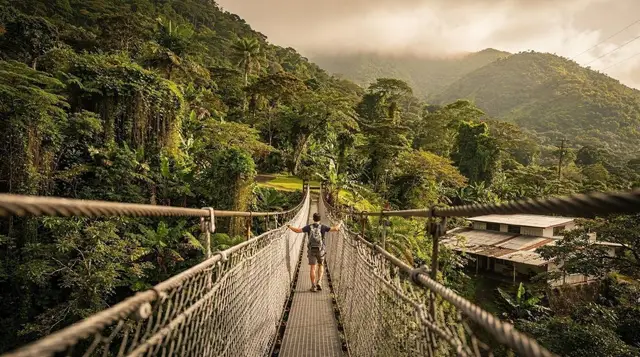
a Baldi Hot Springs day pass, with tiered pools and swim-up bars is a popular afternoon pairing, or for something quieter, the Los Lagos hot springs and wildlife park combines the soak with an easy walk. If your legs are more tired than your arms, a gentler option the next day is the Mistico Hanging Bridges guided walk, which trades paddling for a flat, guided rainforest trail — a reasonable way to keep exploring without repeating the physical demands of the river.
Alternatives If Rafting Isn’t the Right Fit
Not everyone should be on the Balsa, and that’s fine — La Fortuna has plenty of ways to get outdoors without whitewater. The Arenal Hanging Bridges half-day tour gives a comparable half-day time commitment with none of the physical risk, walking suspended bridges through rainforest canopy at your own pace.
Travellers hoping to spot wildlife rather than paddle through it often do better with a guided sloth and monkey spotting walk, which moves slowly and welcomes all ages and fitness levels. None of these substitute for the adrenaline of real rapids, but they’re honest alternatives for travellers the Balsa run genuinely isn’t built for — young kids, less mobile travellers, or anyone who’d rather not risk an unplanned swim.
Practical Notes Before You Book
Confirm your operator’s age and weight minimums when booking, not on arrival — they vary between companies and shift with water levels, and a wasted trip to the put-in helps no one. Mention any heart, back, or mobility conditions honestly during booking rather than at the safety briefing; a guide turning you away at the river after transport is a worse outcome than rebooking a calmer activity in advance. If you wear glasses, secure them with a strap or leave them at the hotel — plenty end up in the river.
Tipping guides is customary and appreciated, typically in the range used across La Fortuna’s guided tours — a few dollars per person is standard, more if the guide clearly went out of their way with instruction or safety. And build in downtime afterwards: a two-hour whitewater run is more tiring than it looks from the shore, and scheduling a second demanding activity the same afternoon is a common regret among visitors trying to pack too much into one day in La Fortuna.
Balsa River Rafting: Frequently Asked Questions
How difficult is Balsa River rafting?
The standard commercial run mixes Class II and III rapids, with a III+ section when water is up. It requires paddling on command, brief swims through moving water if you fall in, and the stamina to keep paddling for around two hours on the river. It is not a lazy float.
Can children go rafting on the Balsa River?
Most operators set a minimum age around 12, sometimes higher when water is running fast, plus a minimum weight so a life jacket fits properly. Young children are better suited to the calm Peñas Blancas safari float, which uses flat water and no rapids.
Is Balsa River rafting different from the Peñas Blancas float trip?
Yes, and the two are often confused. The Peñas Blancas trip is a slow, flat-water safari float aimed at wildlife spotting, suitable for almost anyone. The Balsa River trip is whitewater rafting with real rapids, guides shouting commands, and an expectation that you paddle hard and can handle getting wet and occasionally thrown off balance.
What should I wear and bring for rafting?
Quick-dry shorts or a swimsuit, a rash guard or old t-shirt against sun and straps, secured water shoes or old sneakers (never flip-flops), and a dry bag for anything you must keep dry. Operators provide helmets, life jackets, and paddles. Bring a change of clothes for afterwards.
Is Balsa River rafting safe?
Licensed operators run it safely for thousands of visitors a year, with certified guides, safety kayakers on faster sections, and mandatory safety briefings. It still carries real whitewater risk — falls, bruises, and occasional swims are normal, and anyone with heart, back, or mobility conditions should not go.
What time of year has the best water levels?
December to April and the June–July veranillo tend to run lower and more forgiving. September to November, the wettest stretch in the northern lowlands, brings higher, pushier water and the most technical version of the run — great for experienced rafters, more demanding for everyone else.
How do I get to the Balsa River from La Fortuna?
Almost every rafting operator includes round-trip shuttle transport from La Fortuna hotels in the price, since the put-in is roughly 30–45 minutes away by road. Self-driving to a specific put-in is possible but rarely worth it, since access points change with water conditions and guides know the current safe entry.
Can I combine Balsa River rafting with another activity the same day?
Rafting alone fills a morning or afternoon with transport, so most people treat it as a standalone half-day and unwind afterwards at a hot spring rather than stacking a second adrenaline activity on the same day. See the rafting guide and what to pack for the river for more on planning around it, or compare it directly against the safari float option before you book.
For a broader look at adventure options in the area, see adventure itineraries for La Fortuna, the white-water rafting category, and three days in La Fortuna for how to fit it into a short trip. One traveller’s account of a run that didn’t go to plan is worth reading before you book: why we turned back on the Balsa River.