A Slow Float, Not a Whitewater Run
If you’ve read about rafting near La Fortuna and pictured yourself gripping a paddle through churning rapids, the Peñas Blancas River safari float is a different trip entirely — and it’s worth getting the distinction right before you book anything. The Peñas Blancas is a gentle, mostly flat river on the northern edge of the Arenal-Tempisque conservation area, and the “safari float” trips that run on it are built around watching wildlife from a stable raft, not around navigating whitewater. Guests don’t paddle. A local guide, standing at the stern with a pole or a single paddle, steers the raft slowly downstream while narrating what’s moving in the trees and along the banks.
This is the calm counterpart to the Balsa River, which sits closer to La Fortuna and hosts the region’s actual whitewater rafting trips, with real rapids rated for people who want an adrenaline morning.
Tour listings and hotel desks sometimes blur the two together under the words “river tour,” which is how travelers occasionally end up on the wrong one — a family expecting a quiet birdwatching float shows up for Class II–III rapids, or a group looking for a thrill ends up drifting past herons at walking pace. If you want the sport, read the Balsa River rafting guide instead and book that trip. If you want a calm morning on the water with binoculars in hand, this is your page.
What Actually Happens on the Water
A typical safari float starts with pickup from your La Fortuna hotel in the early morning, since wildlife is most active before the day heats up and before afternoon rain moves in. The drive out to the put-in point takes 30 to 45 minutes along rural roads through farmland and patches of rainforest. Life jackets go on, the guide gives a short safety briefing that’s mostly common sense — stay seated, keep hands inside the raft near overhanging branches — and then the raft eases into a slow current.
From there it’s genuinely unhurried. The river’s gradient is mild, so the raft moves at a walking pace or slower, drifting past riverside vegetation where the guide will point out whatever is moving: a sloth curled in a cecropia tree, a troop of howler monkeys crossing the canopy, a basilisk lizard skittering across the water’s surface (they’re sometimes called “Jesus Christ lizards” for exactly that reason), or a heron standing motionless in the shallows. Guides on this river tend to know the resident birds well, and a decent pair of binoculars — or a willingness to borrow the guide’s spotting scope — makes a real difference to what you actually see versus what you glimpse and miss.
The float covers roughly 2 to 2.5 hours on the water, after which the raft pulls out and a shuttle brings the group back to La Fortuna. Some operators fold in a light breakfast or fresh fruit at the end; check what’s included before you book, since pricing varies more on this point than on the float itself.
What You’ll See — and What You Might Not
It’s worth being honest about wildlife-watching before you go: nobody can promise you a sloth, a toucan, or a caiman on any given morning. What guides can promise is that they know where to look and what’s usually around. On a typical outing, expect a good chance of:
- River birds — herons, kingfishers, anhingas, and occasionally a Amazon kingfisher or a roadside hawk overhead
- Monkeys — howler troops are common, white-faced capuchins less predictable
- Reptiles — basilisk lizards and green iguanas along the banks are frequent
- Sloths — possible but not guaranteed on this particular river; if a sloth sighting is your top priority, pair this trip with the Bogarín Trail, where sloths are spotted far more reliably
- Caimans — occasional, more often in the slower, deeper stretches
If birds are the main draw for you, it’s worth reading the broader La Fortuna wildlife-spotting guide before you go, since it covers which species show up where and when across the whole area — the Peñas Blancas float is one good option among several, not the only one.
Peñas Blancas Safari Float vs. Balsa River Rafting
Because these two rivers get lumped together so often in marketing copy, a direct comparison is more useful here than anywhere else on this site.
| Peñas Blancas safari float | Balsa River rafting | |
|---|---|---|
| Water | Flat, slow current | Rapids, Class II–III typical |
| Who paddles | Guide only | Guests paddle as a team |
| Focus | Wildlife-watching | Whitewater sport |
| Fitness needed | Minimal | Moderate; some swimming ability expected |
| Typical age range | 3/4 years and up | Usually 8 or 10 years and up |
| Duration on water | ~2–2.5 hours | ~1.5–2 hours |
| Typical price | $45–75 USD | $75–100 USD |
| Best for | Families, birders, calmer travelers | Adventure travelers wanting a thrill |
If you’re planning both a wildlife morning and an adventure morning during your stay in La Fortuna, they pair well as two separate half-days rather than one long day — the Peñas Blancas float is a relaxed start to a morning, while the Balsa River trip is better tackled with full energy. For a broader read on how to decide between the two before booking anything, see rafting vs. safari float: which to choose.
Timing, Transport and What to Bring
Morning departures are worth prioritizing on this river for two reasons: wildlife is more active in the cooler hours after dawn, and in the green season (May to November) afternoon rain is a near-daily event that can raise water levels and cut a float short. Most operators run departures between 6am and 9am, with pickup from La Fortuna hotels included in most packages.
What to bring:
- Light, quick-dry clothing in neutral colors — bright colors and dark clothing both make wildlife spotting slightly harder for everyone in the raft
- Closed-toe water shoes or sandals with a back strap; flip-flops tend to come off in the mud at the put-in and take-out points
- A hat and reef-safe sunscreen — there’s little shade once you’re on the water
- Insect repellent, applied before you leave the hotel
- Binoculars if you have them; not essential but genuinely useful
- A dry bag or waterproof phone case for cameras and phones
- Cash in small denominations if the tour doesn’t include breakfast and you want to buy something at a stop along the way
Because it’s a flat, no-splash trip, you generally won’t get soaked the way you would on the Balsa River — but a light change of clothes for the ride back is still a reasonable precaution.
Price and Whether It’s Worth It
Expect to pay roughly $45 to $75 USD per person for the float itself, with combined packages that include hotel transport and a light meal running $70 to $130 USD for a half-day. That puts it in the same general price bracket as a morning at one of the area’s smaller hot springs, and noticeably less than a full-day combo tour.
Whether it’s worth the money comes down to what you’re after. As a pure wildlife outing, it’s a reasonable value — a naturalist guide for over two hours, low physical demands, and genuinely decent odds of seeing birds and monkeys even on an average morning. It is not the trip to book if you want guaranteed sloth photos or an adrenaline story to tell later; for the former, the Bogarín Trail is the more reliable bet, and for the latter, the Balsa River delivers real rapids.
If you’re weighing it against the region’s other float-and-wildlife options, Caño Negro and the Río Frío both run longer, more remote boat safaris with a stronger reputation for caimans and waterbirds, though at a longer drive and a higher price — the Caño Negro boat safari guide and Río Frío wildlife cruise guide lay out how those compare.
Season and Water Levels
The Peñas Blancas float runs year-round, but conditions do shift with the seasons. In the dry season (December to April), water levels are lower and the current is at its calmest, which makes for the smoothest, most predictable float — though very low water in the driest weeks (February–March) can occasionally mean the guide has to pole through shallower stretches. In the green season (May to November), the river carries more water and moves a bit faster, which isn’t dangerous on a trip built for calm floating but can occasionally trigger a same-day cancellation after a heavy overnight downpour upstream. Morning departures, before the daily afternoon rain arrives, are the more reliable choice from May through November.
Who Should Book This — and Who Shouldn’t
This trip earns its place on a lot of itineraries precisely because it asks so little of the people on it. It suits families with children too young for rafting, older travelers who still want to get out on a river, birdwatchers who’d rather look than paddle, and anyone easing into their first days in the rainforest who isn’t ready for whitewater. It also works well as a lower-key alternative on a trip that already includes something more physical, like the 1968 lava trail or the Mistico Hanging Bridges.
It’s the wrong choice, though, if what you actually want is a whitewater story — book the Balsa River instead. It’s also not the trip for travelers chasing a guaranteed sighting of one specific animal; treat any wildlife tour, this one included, as a chance rather than a promise.
Combining It With Other La Fortuna Wildlife Outings
Because the safari float only takes up a morning, it pairs naturally with a second activity the same day or an easy afternoon back in town. Popular combinations include:
- A stay at the Arenal Observatory Lodge, whose grounds and trails are known for their own resident wildlife and volcano views
- An afternoon at El Castillo, a quieter village with its own small attractions and restaurants
- A night walk back in La Fortuna itself, which turns up an entirely different set of nocturnal species — frogs, insects, and sometimes sleeping birds — covered in the site’s wildlife-spotting guide
Travelers building a wildlife-focused stay from the ground up may also want to look at the La Fortuna for wildlife itinerary, which sequences outings like this one against the rest of the area’s parks and trails. Families specifically should check the La Fortuna with kids itinerary for how a float like this slots in around nap schedules and shorter attention spans.
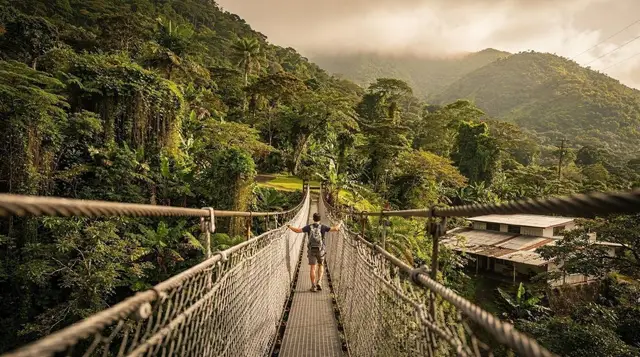
Some visitors also treat this float as a warm-up before the region’s more strenuous nature walks, which cover a very different kind of terrain — on foot and up in the canopy rather than at water level — but share the same instinct for slow, careful wildlife-watching. a guided walk across the Mistico Hanging Bridges, which moves through the canopy on a network of suspension bridges rather than along a riverbank, is a natural pairing for the same trip.
Travelers who’d rather stay focused on animals specifically, rather than scenery, sometimes prefer a dedicated spotting tour over a bridge walk. For that, a guided sloth and monkey spotting tour on land complements the float well, since it targets exactly the animals the river safari sometimes misses.
And for the afternoon after a float, when the goal shifts from wildlife to simply unwinding, an afternoon pass to Baldi Hot Springs is a straightforward way to close out the day — a short drive back into La Fortuna and a change from binoculars to warm water.
Practical Planning: Where This Fits in Your Trip
Most travelers slot the Peñas Blancas safari float into their second or third morning in La Fortuna, after they’ve settled in but before the trip moves on toward Monteverde or the Río Celeste. Because it only occupies a half-day and doesn’t require any particular fitness or river experience, it’s easy to build around — pair it with a relaxed lunch in La Fortuna’s town centre and an easy afternoon, or with a second, more active outing if energy allows.
If this is your only wildlife-focused activity of the trip, it’s a reasonable single choice. If wildlife is a bigger priority for your itinerary as a whole, it’s worth reading how this float stacks up against the region’s other boat safaris — the Caño Negro boat safari guide in particular covers a longer, more remote trip with different odds on caimans and waterbirds, and is worth comparing before you commit a morning to either one.
Whichever you choose, the one thing worth remembering is what this trip is not: it’s not rafting, it’s not guaranteed sightings, and it’s not a sport. It’s a slow, guided drift through riverside forest with someone who knows what to point at — which, for a lot of travelers, turns out to be exactly the right pace for one morning in La Fortuna.
Peñas Blancas River Safari Float: Frequently Asked Questions
Is the Peñas Blancas safari float the same as rafting?
No. The safari float is a slow, flat-water trip aimed at wildlife-watching, with a guide doing the paddling and no rapids to navigate. Whitewater rafting in this area happens on the Balsa River, a separate activity with real rapids and a different skill level.
How long does the Peñas Blancas float take?
The float itself runs about 2 to 2.5 hours on the water. With hotel pickup, a short drive, and drop-off back in La Fortuna, plan on a half-day, roughly 3 to 4 hours door to door.
Is it safe for young children?
Yes, it’s one of the gentler wildlife outings near La Fortuna. There’s no swimming, no rapids, and guests sit low in a stable raft. Most operators accept children from around age 3 or 4, though it’s worth confirming the minimum age when booking.
What wildlife will I actually see?
Sightings vary by day and season, but common finds include herons, kingfishers, and other river birds, howler and white-faced capuchin monkeys, basilisk lizards, iguanas, and occasionally caimans or a sloth in the riverside trees. No guide can guarantee a specific animal.
Does the float run during the rainy season?
Usually, yes, but a spike in water level after heavy rain can push the river too high or fast for the float, and operators will reschedule or cancel for safety. Morning departures in the green season (May to November) are generally the more reliable bet before afternoon rain arrives.
How much does it cost?
Expect roughly $45 to $75 USD per person for the float itself, depending on operator, group size, and whether transport is included. Combined half-day packages with transport and sometimes breakfast or lunch tend to run $70 to $130 USD.
How do I get to the Peñas Blancas River from La Fortuna?
Most visitors book a tour that includes round-trip transport from their La Fortuna hotel, since the put-in point is a rural road roughly 30 to 45 minutes outside town. Self-driving is possible with a rental car, but without a local guide there’s no easy way to arrange the raft itself.