Río Frío Wildlife Cruise: Birds, Caimans and How It Pairs With Caño Negro
Is a Río Frío wildlife cruise different from a Caño Negro tour?
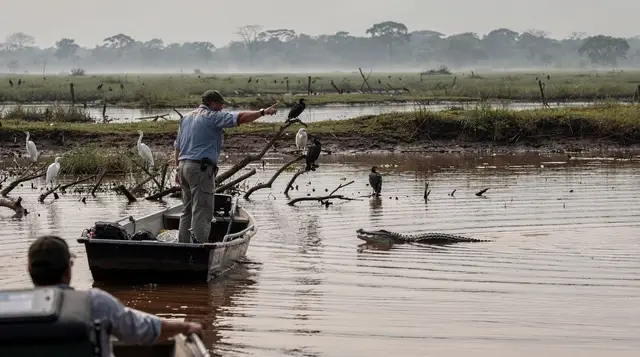
Not usually. Most operators run one flat-bottomed boat along the Río Frío and into the Caño Negro wetland as a single half-day or full-day trip. The river stretch itself, with its steep banks and overhanging trees, is often where you see the most caimans and wading birds close to the boat.
What a Río Frío Wildlife Cruise Actually Involves
The Río Frío is the river that feeds the wetlands of the Caño Negro refuge, and for wildlife-watching purposes the two are close to inseparable. A flat-bottomed boat, usually carrying between eight and twenty passengers, motors slowly upriver from a dock near Los Chiles or a point closer to La Fortuna depending on the operator, then cuts its engine and drifts or paddles through the narrower channels where the animals actually are.
The river stretch has steep, forested banks and low-hanging branches right at eye level from the boat, which is exactly the kind of terrain where spectacled caimans bask and where herons, kingfishers and anhingas perch close enough to photograph without a long lens.
This is not a separate product from a Caño Negro tour in most cases. It is the same boat, the same guide and often the same three-hour block of time. Understanding that up front saves confusion when comparing prices between operators: a listing that says “Río Frío cruise” and one that says “Caño Negro boat tour” are frequently describing the identical route, just named after different halves of it.
Why It’s Almost Always Sold Bundled With Caño Negro
Nearly every operator running boats out of the northern lowlands treats the river and the refuge as one continuous route rather than two separate destinations. The boat leaves the dock, travels along the Río Frío for anywhere from twenty minutes to an hour depending on the launch point, and then enters the Caño Negro wetland system, where the channel widens into lagoon and seasonal flood plain.
Water levels dictate how far into the refuge the boat can go: in the wetter months from roughly May to November the lagoon is more accessible and birdlife tends to be more spread out across a larger flooded area, while in the dry months from December to April the water retreats and animals concentrate in the remaining channels, which can mean denser sightings in a smaller area.
Because of this, it rarely makes sense to think of “should I do Río Frío or Caño Negro” as a real choice. The more useful questions are how far your hotel is from the launch point, whether you want a half-day or full-day version, and whether lunch and a second stop, such as a stroll through a nearby community or a Maleku cultural visit, is bundled in. For the ecology, geography and access details of the refuge itself, including its Ramsar wetland status and how the seasonal lake behaves, that belongs to its own dedicated write-up rather than repeating it here.
a combined Río Frío and Caño Negro boat safari is the version most travellers end up booking, precisely because it covers both stretches of water without asking you to choose between them.
A small number of operators based closer to Los Chiles or directly on the Río Frío itself run a river-only cruise that does not continue into the refuge proper. These tend to be shorter and cheaper, and can be a reasonable option if your schedule genuinely cannot fit a full day, but they trade away the wider lagoon habitat where species diversity is usually highest.
What You’ll Actually See: Birds and Caimans Along the Banks
The wildlife on this stretch of water divides fairly cleanly into two groups, and it helps to know what to look for in each.
Along the riverbanks themselves, spectacled caimans are the headline species. They bask on mudbanks and floating logs, especially in the morning and late afternoon when the temperature is manageable, and a good guide will spot the pale eye-shine or the flat snout profile from well before most passengers notice anything at all. Sizes vary widely, from juveniles under a metre to older animals that can stretch past two metres, and it is common to see several individuals of different ages within a single short stretch of bank. Green iguanas and basilisk lizards, the ones known locally for running across water, also turn up regularly along the same banks, along with the occasional river turtle hauled out to sun itself.
The birdlife is where a Río Frío cruise earns comparisons to some of the best wetland birding in the country. Species seen with real regularity include roseate spoonbills, wood storks, snowy and great egrets, several species of heron including the boat-billed heron on night-adjacent tours, jabiru storks in the dry season, anhingas drying their wings on branches in a distinctive spread-winged pose, and northern jacanas walking across floating vegetation on their long toes.
Kingfishers, both the large ringed kingfisher and the smaller green kingfisher, are near-constant companions along the river edge, darting ahead of the boat from perch to perch. Howler monkeys are frequently heard and often seen in the trees along the banks, and sloths turn up on some cruises, though less predictably than at Bijagua or on the Bogarín trail in La Fortuna itself.
None of this is guaranteed in the way a zoo exhibit is guaranteed. This is a working wild river, and sightings shift with water level, time of day, recent weather and simple luck. What experienced guides can promise is a high probability of caimans and a strong variety of water birds on almost any cruise, with the more sought-after species like jabiru storks or a resting sloth being a bonus rather than the baseline.
Best Time of Day and Season
| Factor | Better window | Why |
|---|---|---|
| Time of day | Early morning, before 8am | Coolest temperatures, most active feeding birds |
| Second-best window | Late afternoon | Caimans emerging to bask as heat drops |
| Wet season (May to Nov) | Wider lagoon access | More area flooded, birdlife more spread out |
| Dry season (Dec to Apr) | Denser sightings in narrower channels | Water retreats, animals concentrate |
| Weather | Overcast mornings | Animals often more active than under full midday sun |
A cruise booked for the middle of the day, roughly 11am to 2pm, tends to disappoint compared with an early departure. Heat pushes animals into shade and reduces movement, and the boat itself becomes uncomfortable under direct sun with no real shelter on most vessels. If your operator offers a choice of start time, take the early one.
Combining Río Frío With the Rest of Your Trip
Because the launch points sit roughly two hours from La Fortuna by road, this is realistically a full-day commitment once transfers are included, even though the time actually on the water is closer to two or three hours. Most travellers pair it with one of the following:
- A stop in or near Guatuso or the Maleku indigenous reserve, which sits close to the same route north from La Fortuna
- Lunch in Ciudad Quesada on the way back for travellers taking a full-day package rather than a direct transfer
- A quieter following day, since an early departure and a long day on and off boats is a fuller day than it first appears
Travellers heading toward Sarapiquí or Puerto Viejo de Sarapiquí sometimes ask whether that region’s boat tours can be tacked onto the same day. They cannot in practice: Sarapiquí sits in a separate river drainage well to the east, reached by a different road, and is best treated as its own stop, whether that means a standalone day trip or an overnight on the way toward the Caribbean side. A
a Sarapiquí night walk with a wildlife guide is a reasonable pairing if your itinerary already routes you through that area separately, but it is not a same-day add-on to a Río Frío cruise.
For travellers who want more wildlife time without an early wake-up call, a
twilight wildlife safari closer to La Fortuna covers different terrain and different species, mostly nocturnal frogs, insects and forest mammals rather than river birds and caimans, and works well as a complementary evening activity on a different day of the same trip.
Booking Options Compared
| Option | Typical length | What it includes | Best for |
|---|---|---|---|
| Half-day river and lagoon combo | 4 to 5 hours | Río Frío stretch plus Caño Negro wetland, hotel pickup | Most travellers, best balance of time and sightings |
| Full-day with lunch and extra stop | 7 to 8 hours | River, lagoon, lunch, sometimes a community or cultural stop | Travellers who want to make one trip out of the whole day |
| River-only cruise | 2 to 3 hours | Río Frío stretch only, no refuge entry | Shorter schedules, usually cheaper |
| Extended overnight or multi-day camp | 2 to 3 days | Wetland access plus additional wildlife activities from a fixed camp | Serious birders and photographers wanting more time |
Travellers with more flexibility and a strong interest in birding sometimes look at a longer stay rather than a single day trip. A
three-day tent camp experience in the northern wetlands gives far more time on and around the water than a single boat trip can, at the cost of a much bigger chunk of the itinerary.
What to Bring
- Binoculars, if you own a pair. Boat-supplied optics are rare and shared binoculars slow the whole group down.
- A hat and reef-safe sunscreen. There is little to no shade on most boats once the sun is up.
- A light rain layer even in the dry season. River weather changes faster than forecasts suggest.
- Insect repellent applied before boarding, not after. Mosquitoes are more of an issue near the banks than mid-river.
- A dry bag or waterproof phone case for cameras. Splashing is uncommon but not impossible.
- Closed shoes rather than sandals for the walk to and from the dock, which is sometimes muddy.
How the Río Frío Fits Against Other Wildlife Options Near La Fortuna
Travellers deciding how to spend a single wildlife-focused day sometimes weigh this cruise against the safari float on the Peñas Blancas river, which is closer to La Fortuna and runs on a smaller river with a different mix of species, more focused on riverine birds and the occasional sloth than on caimans and wetland waders. Both are worth doing on a longer stay; on a short one, the Río Frío and Caño Negro combination generally delivers the larger species count and the more reliable caiman sightings, while the Peñas Blancas float is the shorter, closer option when time near La Fortuna itself is tight.
For a broader sense of what wildlife-watching in the area covers beyond river cruises, including night walks, sloth trails and where quetzals actually are (not La Fortuna, despite what some itineraries imply), it is worth reading more generally about wildlife spotting in the region before deciding how many separate outings to schedule across a trip.
Frequently Asked Questions About the Río Frío Wildlife Cruise
Wildlife tours on GetYourGuide
Verified deep-linked GetYourGuide tours. Book through these links and we earn a small commission at no cost to you.
GetYourGuide does not provide a product photo for this activity — the image shows the meeting point, photographed by us.