A community, not a checkbox stop
Tucked into the flat, green country between Guatuso and the Tenorio volcano, the Maleku territory rarely makes it onto a first-pass itinerary of La Fortuna. It should. This is one of the few places in the northern lowlands where you can spend a few hours with Costa Rica’s Indigenous history instead of just reading a paragraph about it in a museum. But it works differently from almost everything else on this coast-to-volcano circuit, and getting that difference wrong is the easiest way to have an awkward, disappointing visit — or no visit at all.
The single thing to understand before anything else: this is inhabited land, home to real families going about ordinary life, not a heritage site with opening hours and a ticket window. You do not drive up and wander in. Every respectful visit is arranged ahead of time with the community itself or with an operator who has an ongoing relationship with the palenques, and it happens on a schedule the community sets, not one a brochure invents. Treat it the way you’d treat an invitation into someone’s home, because that is closer to what it is.
Where the territory sits
The Maleku territory occupies land within the canton of Guatuso, roughly along the corridor that connects La Fortuna to Bijagua and the Río Celeste side of the Tenorio volcano national park. It is split across three palenques — Tonjibe, El Sol, and Margarita — each a distinct community with its own leadership, rather than one continuous “reserve” you drive through. Tonjibe, the largest and the one most commonly involved in guided cultural visits, lies a short distance from the town of Guatuso itself.
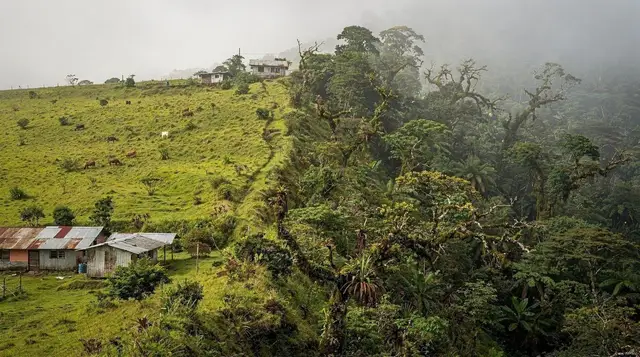
The setting is the same warm, wet lowland landscape as the rest of this region: flat farmland, patches of secondary forest, and the kind of one-lane bridges you get used to fast in this part of Costa Rica. It’s a working agricultural area as much as anything, with cattle and small farms alongside the community land — a reminder that daily life here doesn’t revolve around tourism, tourism fits around it.
If you’re weighing up a stop here against a day built around Río Celeste or a night at a Bijagua sloth sanctuary, it helps to know the geography lines up conveniently: Guatuso, Tonjibe, and Bijagua sit close enough together that a Maleku visit slots naturally into the same day as a Río Celeste hike, rather than requiring a separate trip out from La Fortuna.
Who the Maleku are
The Maleku (sometimes referred to by the older, now largely retired exonym “Guatuso”) are one of Costa Rica’s smallest Indigenous peoples — current estimates put the population at a few hundred to around a thousand people, spread across the three palenques. They are among the groups least affected by large-scale displacement compared with some other Indigenous territories in the country, partly because of the remoteness of the northern lowlands, though contact with cattle ranching, logging, and tourism has reshaped the community considerably over the past century.
Traditional Maleku life centred on subsistence agriculture, hunting, and river fishing, with a cosmology closely tied to the surrounding volcanic landscape — this stretch of the country, dominated by the presence of Arenal volcano to the east, carries spiritual weight in Maleku tradition that predates any tourism industry by centuries. Guides on cultural visits will sometimes touch on this connection between the land, the volcano, and community identity, though how much detail is shared varies by guide and by what the community is comfortable discussing with visitors that day.
Today, most Maleku families combine small-scale farming with craft production and, increasingly, income from cultural tourism — which is precisely why organised visits matter economically as well as culturally. Money spent on a guided visit or on crafts bought directly from an artisan goes to the community in a way that a souvenir-shop purchase in La Fortuna town centre simply doesn’t.
The language: Maleku Jaica
Maleku Jaica is the group’s own language, part of the Chibchan language family found across parts of Central America and Colombia. It is classified as critically endangered — fluent speakers are now concentrated among older community members, while younger generations grow up primarily in Spanish, with Maleku taught as a second language in local schools as part of ongoing revitalisation efforts.
This is one of the more meaningful things a short visit can offer: hearing the language spoken, even briefly, by people actively working to keep it alive. It is a different experience from reading about language loss in a guidebook, and it’s worth asking your guide about pronunciation or a few basic words if the moment feels open to it — most guides are glad to share this when asked respectfully, though it isn’t something to press for if the conversation doesn’t naturally go there.
What a guided visit actually involves
Programmes are not standardised across operators, and the exact content of any given visit depends on which palenque you’re visiting and who is hosting that day. That said, most guided cultural visits combine some mix of the following:
| Element | What it typically involves | Rough duration |
|---|---|---|
| Welcome and orientation talk | Brief history of the Maleku people, the three palenques, and daily life today | 20–30 min |
| Craft demonstration | Carving balsa-wood masks or figures, natural dye and paint work | 30–45 min |
| Language and tradition segment | Short introduction to Maleku Jaica, oral history, or cosmology | 15–30 min |
| Hands-on activity (varies) | Trying archery, helping paint a mask, or a simple craft attempt | 20–30 min |
| Craft purchase time | Buying directly from the artisans who made the pieces | Open-ended |
| Shared meal (some programmes) | Traditional lowland Costa Rican food, sometimes with Maleku elements | 30–45 min |
A typical visit runs half a day once you count the drive from La Fortuna, though some operators run shorter stops as part of a combined itinerary that also covers hanging bridges or a wildlife-focused stretch near Bijagua.
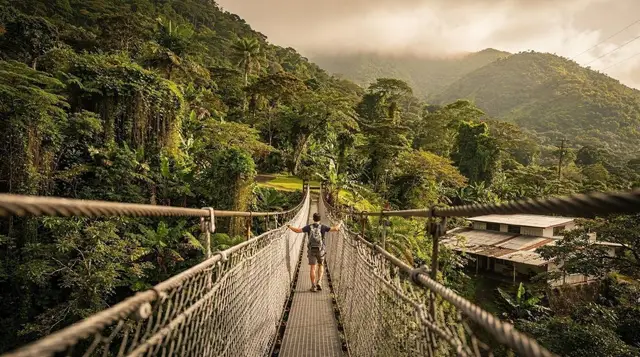
For visitors approaching from the Guatuso side, the Heliconias Hanging Bridges guided tour covers ground close to the territory and is a common way operators structure a day that also touches on the surrounding rainforest — worth asking your operator whether a cultural stop can be added to a similar itinerary.
Craft and artisanry
Maleku craftwork is one of the most distinctive things to come out of this part of Costa Rica, and it’s worth understanding what you’re looking at before you buy. The best-known pieces are carved from balsa wood — light, fast-growing, and easy to work — and painted with bold geometric patterns and figures representing animals, spirits, and elements of Maleku cosmology. Masks are the signature item, alongside carved birds and jaguars, small bows and arrows, and woven items using natural fibres and dyes drawn from local plants.
Prices for hand-carved pieces are typically far lower than what similar craftwork fetches in souvenir shops in San José or La Fortuna, simply because there’s no retail markup between the artisan and you. This is genuinely one of the better ways to put tourism money directly into the community rather than into a distribution chain — buy from the artisan in front of you, in cash, and ask if they’ll tell you about the piece before you decide.
Combining the visit with Río Celeste or Bijagua
Because the Maleku territory sits along the same general corridor as Bijagua and the Río Celeste side of Tenorio, most visitors don’t treat it as a standalone day trip from La Fortuna — they fold it into a day that also includes the turquoise river or a sloth walk near Bijagua. This is a sensible way to justify the drive, since the Río Celeste corridor is already a natural half-to-full-day excursion from La Fortuna on its own.
If Río Celeste is the centrepiece of your day, the Río Celeste rainforest and waterfall tour covers the hike itself, leaving a Maleku cultural stop as a natural add-on either before or after, depending on timing and what your guide or operator can coordinate. For a slower, wildlife-first version of the same corridor, the sloth and hanging bridges tour in Bijagua pairs well with a cultural stop for visitors who’d rather split a full day between nature and culture than pack in a longer hike.
It’s worth being upfront with a tour operator early: not every Río Celeste-focused tour includes a Maleku community stop by default, and adding one may need to be arranged separately, sometimes with a different guide entirely. Ask before booking rather than assuming it’s bundled in.
Getting there from La Fortuna
The drive from La Fortuna to the Guatuso area, where most Maleku visits are based, runs roughly 1h15 to 1h30 depending on road conditions and exactly which palenque you’re headed to. The route is mostly paved as far as Guatuso itself, with shorter unpaved stretches on some approaches to the palenques — passable in a standard rental car in dry season, more comfortable in a 4x4 during the green season months of May to November.
| From La Fortuna | Approx. time | Notes |
|---|---|---|
| Guatuso (town) | 1h–1h15 | Mostly paved; nearest reference point |
| Tonjibe palenque | 1h15–1h30 | Final stretch may be unpaved |
| Bijagua | 1h–1h15 | Common pairing for a combined day |
| Upala | 1h30–1h45 | Further north; not part of this visit |
Some operators running trips further north, toward Upala, stop en route at a wildlife sanctuary — the Upala transfer with a Las Pumas sanctuary stop is one option if your travel plans already have you passing through this corridor, though it is a transfer service rather than a Maleku cultural visit itself. Check specifically with any operator whether a Maleku community stop is included, since transfers through the region don’t automatically involve one.
Self-driving is workable if you’re comfortable with rural Costa Rican roads and one-lane bridges, but because access to the palenques themselves depends on prior arrangement with the community, a self-drive visit still needs the same advance booking as a guided tour — you’re not saving yourself the coordination, just the driver.
What to bring and how to behave
A few practical points make a real difference to how a visit goes, both for you and for your hosts:
- Cash in small denominations. Craft purchases are usually paid directly to the artisan, and change for large bills isn’t always available.
- Ask before photographing people. Photos of crafts, activities, and landscapes are almost always fine; photos of individuals, especially children, should be asked about first.
- Dress modestly and practically. Closed shoes, light layers, and rain protection — the same lowland weather rules as the rest of the region apply here.
- Expect Spanish as the primary working language, with some Maleku Jaica woven in by guides who choose to share it. English fluency among community guides varies more than it does in La Fortuna or Monteverde, so a tour with English-speaking guiding, if you need it, should be confirmed at booking.
- Come with time, not a fixed schedule. Cultural visits don’t run to the minute the way a zipline circuit does; building in flexibility avoids frustration on both sides.
Planning at a glance
| Question | Short answer |
|---|---|
| Can I visit without a guide or booking? | No — every visit is arranged in advance with the community or an operator |
| How long does a visit take? | Roughly half a day including travel from La Fortuna |
| What does it cost? | Typically USD 35–70 per person, depending on programme and operator |
| Best time of year? | Year-round; dry season (Dec–Apr) makes the drive easiest |
| Good to combine with? | Río Celeste, Bijagua sloth sanctuary, or a Guatuso-area transfer |
| Is it child-friendly? | Generally yes, especially craft-demonstration formats |
FAQ: visiting the Maleku indigenous territory near La Fortuna
Can you just drive up and visit the Maleku territory on your own?
No. The palenques are inhabited communities, not tourist sites, and there is no public entrance or ticket booth. Every legitimate visit is organised in advance with a community guide or a registered tour operator, and shows up to escort you — turning up unannounced is not an option and would not be welcomed.
Who are the Maleku?
The Maleku are one of Costa Rica’s smallest Indigenous peoples, with a few hundred to around a thousand members living across three palenques (community territories) in the Guatuso canton of Alajuela province, in the northern lowlands near the Río Celeste and Arenal region.
What actually happens on a guided visit?
Programmes vary by community and operator, but most combine a short talk on Maleku history and cosmology, a demonstration of traditional crafts such as balsa-wood carving, and time to buy handmade pieces directly from the artisans. Some visits add traditional dance, archery, or a shared meal.
Is the Maleku language still spoken?
Maleku Jaica is still spoken by part of the community, mostly older generations, and is considered critically endangered by linguists. Schools within the territory now teach it alongside Spanish, and cultural visits are one of the few settings where visitors hear it used in context.
How is a visit to the Maleku territory different from Río Celeste or Bijagua?
Río Celeste and Bijagua are nature stops — a river, a waterfall, a sloth sanctuary — that most people can walk into on a paid ticket. A Maleku visit is a scheduled cultural encounter with a living community; it runs on the community’s terms, not a fixed park schedule, and needs booking days ahead, not just a morning start.
Can you buy crafts directly from Maleku artisans?
Yes, and it is the most direct way for money from a visit to reach the community. Painted balsa-wood masks, carved animal figures, bows and arrows, and woven pieces are typically sold on-site at prices well below what similar items cost in souvenir shops in La Fortuna.
Do I need a car to get to the Maleku territory?
A rental car or private transfer is the most practical option, since public transport does not reach the palenques directly. Most visitors book a guided tour that includes transport from La Fortuna, or combine the stop with a private transfer heading toward Upala or the Río Celeste corridor.
Is a Maleku community visit suitable for children?
Generally yes — craft demonstrations and short cultural talks tend to hold children’s attention well, and some operators build in a hands-on element like trying archery or helping paint a mask. Confirm the format and length with the guide beforehand, since programmes are not standardised.