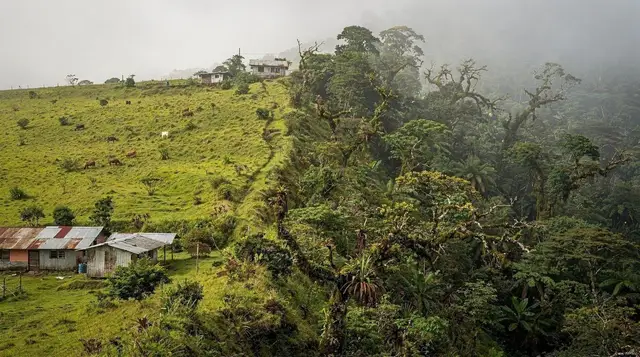
A Village on the Quiet Side of the Volcano
Most visitors to Río Celeste drive up from La Fortuna, do the waterfall, and drive back the same day. Fewer of them notice that there’s a small town sitting almost at the park’s north gate, and that staying there changes the whole shape of the visit. That town is Bijagua — a farming village strung along the road between the Tenorio volcano and the Guanacaste lowlands, in the district that also takes in Upala and the Maleku indigenous territory.
Bijagua isn’t a resort town, and it doesn’t try to be. There’s a small plaza, a school, a handful of sodas, a few dozen lodges and cabins scattered along the access roads, and a lot of farmland and secondary forest in between. What Bijagua has instead of nightlife is proximity: to the north entrance of Tenorio Volcano National Park, to several well-run sloth reserves, and to a slower, greener stretch of the northern lowlands that most La Fortuna itineraries never touch.
This page covers the village itself — what it’s for, how to get there, where to base yourself, and how it compares to La Fortuna as a jumping-off point. For the river and its color, see the Río Celeste destination page. For the sloth refuges specifically, see the dedicated Bijagua sloth sanctuary page — this one only touches on them in passing.
Why Base Here Instead of La Fortuna
The honest case for Bijagua comes down to geography and pace, not amenities. La Fortuna has far more hotels, restaurants, tour operators, and things to fill an evening; Bijagua has almost none of that. What it does have is a shorter drive to Tenorio’s north sector, a genuinely rural feel, and prices that run lower than La Fortuna’s hot-springs-town rates.
| Bijagua | La Fortuna | |
|---|---|---|
| Distance to Río Celeste (north entrance) | 20–30 min | 1 h 30–2 h |
| Village size | Small, rural | Larger, tourism-focused |
| Lodging options | Limited — book ahead in high season | Extensive, all budgets |
| Restaurants | A handful of sodas and lodge kitchens | Dozens, wide range |
| Evening activity | Very quiet | Bars, sports bars, night markets |
| English spoken | Patchy outside lodges and tours | Common in tourism-facing businesses |
If your priority is convenience for Río Celeste and a quieter, more agricultural version of Costa Rica, Bijagua earns its place on the itinerary. If you want a wide choice of restaurants, an active evening scene, or a big menu of tours to choose from each morning, La Fortuna still does that better — read the fuller comparison in La Fortuna vs. Río Celeste before deciding where to sleep.
Sloths Without the Production
Bijagua’s other claim to fame, alongside the river, is sloths — both two-toed and three-toed, spotted with enough regularity that several small operations have built guided walks around finding them. This page won’t repeat the detail already covered on the dedicated Bijagua sloth sanctuary page, but it’s worth flagging here because it changes how you plan a stay: rather than one big activity, a Bijagua base tends to fill with a string of smaller, slower ones.
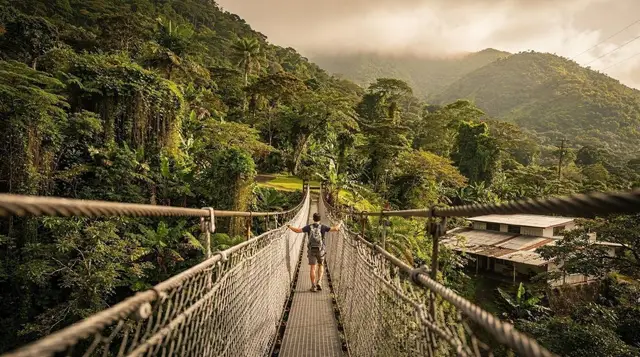
A typical option is a guided walk that pairs a sloth search with a hanging-bridge trail through the forest canopy near the village — a couple of hours, low physical demand, and a reasonable chance (never a guarantee) of a sighting. For travelers who want something more private and less rushed, a small-group lagoon safari focused specifically on sloth habitat runs at a gentler pace and works well for photographers or families with older kids.
Sloths aside, this is decent birdwatching country too — the forest edge around Bijagua sits at a lower, warmer elevation than Monteverde but still pulls in a good range of species, and it’s a reasonable stop if you’re building a wider northern-zone birding trip; see birdwatching in Monteverde and around for how the regions compare.
Reaching Río Celeste’s North Side
The main reason most people come to Bijagua at all is Río Celeste, and the north-side approach is the real advantage of basing here. Tenorio Volcano National Park has a single trail system, and Bijagua sits close enough to the entrance that you can be on the trail at opening time without the early wake-up a La Fortuna base requires. Given that the park limits daily entries and the trail can close in the afternoon, that extra margin matters more than it sounds.
This page won’t re-explain the trail, the color science, or the entrance logistics — that’s covered fully on the Río Celeste page and in the Río Celeste day trip from La Fortuna guide, which works just as well in reverse for a Bijagua-based visit. What’s worth repeating here is the seasonal caveat: after heavy rain the river runs brown, not turquoise, and no base — Bijagua included — changes that. If the color is the whole reason for the trip, build in a flexible day and check recent conditions before committing; the blog post The Day the Río Celeste Was Brown is a useful reality check on how often this happens.
Beyond the Waterfall
Bijagua’s other draw is what surrounds it: rolling dairy and coffee farms, patches of primary forest, and a rural pace that’s easy to underrate on a first pass through the region. A morning spent on a coffee-and-chocolate farm tour combined with a short rainforest walk gives a sense of the working landscape that most Río Celeste day-trippers drive straight past.
The Maleku indigenous territory sits within reach of Bijagua as well, in the flatter country toward Guatuso, and the wider district takes in the towns of Upala and Katira further north and west — mostly agricultural, rarely visited by tour buses, and better suited to travelers with their own transport and a couple of extra days than to a quick add-on. None of these places are set up for casual drop-in tourism; visits are best arranged through a local operator or lodge rather than attempted independently.
For a canopy-level look at the forest without committing to a full day trip, a guided walk across the Heliconias hanging bridges is a shorter, calmer alternative to the larger bridge parks near Arenal, and it pairs naturally with an afternoon in the village. If you’d rather end the day with wildlife rather than start with it, a farm visit followed by a rainforest night walk is a good way to close out a Bijagua stay — frogs and insects are considerably easier to find after dark than sloths are by day.
Getting to Bijagua and Getting Around
Bijagua sits on Route 6, the road that runs along Tenorio’s western flank between the Interamerican Highway and the La Fortuna–Upala corridor. From La Fortuna, the drive takes roughly an hour and a half to two hours depending on road conditions and whether you route via Muelle or via Tilarán; renting a car gives the most flexibility, and the practicalities are covered in renting a car for La Fortuna, which applies equally to a Bijagua-based loop. Coming from Liberia’s airport instead, Bijagua is actually the shorter drive of the two — see getting from LIR to La Fortuna for the comparable Guanacaste-side routing.
Public transport to Bijagua exists but is limited and slow, with infrequent buses connecting through Upala or San Rafael de Guatuso. Most independent travelers who don’t rent a car arrange transfers through their lodge or a tour operator instead — this isn’t a village set up for spontaneous hitchhiking between sights. Once you’re in Bijagua itself, distances are short enough to cover on foot or by the shuttle most lodges provide for their own tours, but there’s no local taxi rank or ride-hailing coverage to fall back on, unlike in La Fortuna.
Roads in and around Bijagua are mostly paved on the main route but turn to gravel or dirt on side roads toward some lodges and trailheads, and single-lane bridges are common throughout this part of the north — yield to whichever vehicle reaches the “CEDA EL PASO” sign first. A 4x4 isn’t strictly required for the main village and most lodges, but it’s a real advantage in green season if your accommodation sits down one of the unpaved side roads.
Where to Stay and Eat — and Why to Book Ahead
This is the point where it’s worth being direct: Bijagua is not a smaller version of La Fortuna with the same range of choice. It has a real but limited stock of accommodation — a scattering of eco-lodges, family-run cabins, and a couple of mid-range hotels, most with fewer than twenty rooms. In high season (December through April, and especially around Christmas, New Year, and Easter week), the village fills up fast precisely because it’s small, and a same-day search for a room can come up empty even when La Fortuna, twenty times the size, still has vacancies. Book ahead if your dates are fixed.
Food follows the same pattern. Restaurant choice is a handful of sodas serving casados and simple Costa Rican staples, plus the dining rooms attached to the larger lodges — nothing like La Fortuna’s range of international menus, breakfast cafés, and late-night options. Plan on eating where you’re staying, or at one of the two or three sodas near the plaza, rather than expecting to restaurant-hop across an evening. None of this makes Bijagua a poor choice — it simply asks for a bit more planning than a La Fortuna stay does, and it rewards travelers who came for the quiet rather than the options.
When to Come
Bijagua shares the north’s two-season pattern: a drier stretch from December to April and a wetter one from May to November, with the wettest months typically September and October. Trails around Tenorio firm up in dry season, which makes the approach to Río Celeste noticeably easier underfoot, and mornings are more likely to start clear before afternoon cloud builds in.
Green season brings fuller rivers and a much greener landscape, along with the standing risk of the Río Celeste turning muddy after a hard rain — worth weighing if the blue water is the centerpiece of your trip. For a broader read on how the seasons play out across the wider region, see La Fortuna in green season, most of which holds true for Bijagua as well.
Planning a Bijagua Stop
A single night in Bijagua is usually enough to cover the Río Celeste hike and one sloth-focused activity without rushing either. Two nights leaves room to add a coffee farm morning, a night walk, or a slower loop through the surrounding farmland before continuing on toward Monteverde or back to La Fortuna. Because Bijagua sits roughly between the two, it works well as a stopover on a La Fortuna and Río Celeste itinerary rather than as a full base for an entire trip — few travelers spend more than two nights here, and that’s by design, not a shortcoming.
Frequently Asked Questions About Basing Yourself in Bijagua
How far is Bijagua from La Fortuna?
By road it’s roughly 1 h 30 to 2 h, depending on the route and road conditions. There’s no boat shortcut here the way there is toward Monteverde — it’s a straight drive along Route 6.
Can I see sloths in Bijagua without a guided tour?
Wild sightings do happen along the roadside and in lodge gardens, but the reliable option is a guided walk on private reserve land, where guides know current locations and use spotting scopes. Independent searching along public roads is possible but far less consistent.
Is Bijagua closer to Río Celeste than La Fortuna is?
Yes. Bijagua sits close to Tenorio National Park’s entrance, roughly 20–30 minutes away, compared to 1 h 30 or more from La Fortuna. That shorter drive is the main practical reason to base here.
Does Bijagua have hotels and restaurants like La Fortuna?
No — Bijagua is a much smaller village with a limited number of lodges and a handful of sodas, not the extensive range of accommodation and dining La Fortuna offers. Book lodging ahead, especially in dry season, since options fill quickly.
Do I need a 4x4 to reach Bijagua?
Not for the main route, which is paved. A 4x4 helps if your lodge sits down an unpaved side road, particularly in green season when those roads soften.
What language is spoken in Bijagua?
Spanish is the everyday language. English is spoken at lodges and by tour guides but is far less common in the village itself than in La Fortuna or Monteverde.
Is Bijagua worth an overnight stay, or just a day trip?
Most visitors treat it as a one- or two-night stopover rather than a full base — enough time for the Río Celeste hike plus one or two of the village’s own activities, on the way between La Fortuna and Monteverde.