The Day the Río Celeste Was Brown
Four days of rain, then a river the colour of coffee
I’d seen the photos for months before I ever booked a flight — that impossible blue-green water threading through green forest, the kind of colour that looks corrected in Photoshop even when it isn’t. So when I finally stood at the Río Celeste trailhead inside Tenorio Volcano National Park, I was not prepared for what I actually got: a river running the flat, opaque brown of a flooded ditch.
It had rained hard for four straight days before that morning, the kind of rain that turns the gravel road into Bijagua into a slow crawl and drums on a tin roof loud enough to wake you at 3am. I knew, vaguely, that this mattered. I did not know how completely it would matter until I reached the Tenidero, the exact spot where two rivers meet and the colour is supposed to appear, and found nothing but ordinary, silty water moving fast and low over the rocks.
What actually makes the water blue — and why it stops
Here’s the part almost nobody explains before you go: the Río Celeste isn’t blue because of a dye, a mineral spring, or anything you could point to and say “that’s the source.” It’s an optical trick. At the Tenidero, two separate rivers converge, and the mixture carries extremely fine particles of aluminosilicate in suspension. When conditions are right, those particles are exactly the right size to scatter blue wavelengths of light back at you while absorbing the rest of the spectrum — the same basic physics that makes the sky blue, just happening in water instead of air.
That’s a delicate mechanism. It depends on the water being clear enough, and the particle concentration being within a narrow range, for the scattering to work the way it’s supposed to. Heavy rain upstream changes both of those things at once: it dumps far more sediment into the system than the effect can handle, and it clouds the water enough that the optical trick simply stops happening. The particles that cause the blue in good conditions are still there after a storm — there’s just too much other sediment drowning them out. The result isn’t a paler blue. It’s brown, full stop, and it can stay that way for days.
The one fact worth knowing before you book anything here
I want to be blunt about something, because most trip-planning content treats this as a footnote and I think that’s backwards: whether the Río Celeste is blue on the day you visit is not a minor detail among many. For this specific site, it is the single most important variable in your trip — more important than which company you book with, what time you start, or whether you hire a guide.
You can control almost everything else about a Río Celeste day. You cannot control this. A tour operator with five-star reviews and a driver who shows up on time will still deliver you to a brown river if it rained hard the night before, and no amount of planning around logistics changes that. If you take away one thing from this piece, take away this: treat the colour as a genuine coin flip in wet conditions, not a background detail you’ll deal with if it comes up.
No app can tell you the colour in advance
I want to head off a mistake I nearly made myself. Before the trip, I spent a stretch of one evening searching for some kind of live tracker — a webcam, a colour-status page, anything that would tell me what the river looked like that week. There isn’t one. Nobody is monitoring water clarity at the Tenidero in real time and publishing it for tourists, and I’d be skeptical of any site or app that claims otherwise.
The only honest proxy you have is rainfall itself: has it rained heavily in the Tenorio area over roughly the last day or two? Less recent heavy rain is a genuinely better sign. But it is still just that — a sign, not a prediction. I’ve read accounts of people arriving after a dry week to find clear water, and others who hit brown water after what looked like a minor shower. There is no substitute for accepting the uncertainty going in. If you’d rather understand seasonal patterns before you commit to dates, our breakdown of green season here and general notes on the best time to visit are the place for that — not this page.
What we did instead
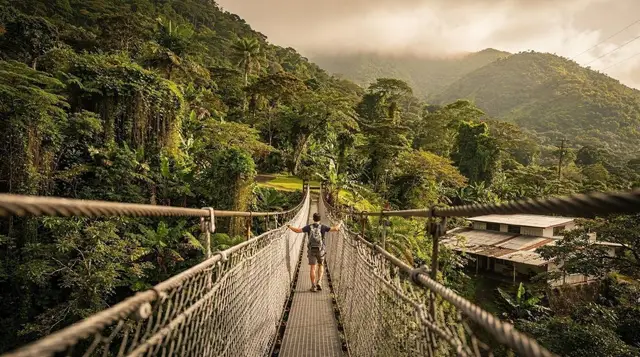
We’d already paid for a guided morning, so we walked the trail anyway — past the hanging bridge, down toward the waterfall viewpoint, through forest that stayed genuinely beautiful regardless of what colour the water was doing. The waterfall itself still dropped with real force. The Blue Lagoon and hot spring pools further along the trail were, ironically, unaffected — geothermally heated groundwater doesn’t care about surface runoff the way the Tenidero mixture does.
That afternoon, instead of dwelling on it, we pivoted to a nearby sloth sanctuary, which is a far more reliable bet in this part of the country — a guided walk like the Río Celeste, sloth sanctuary and Llanos de Cortez waterfall combo stacks a couple of weather-proof stops onto the same day, which in hindsight is exactly the kind of itinerary I’d recommend to someone nervous about the gamble.
If hot water is more your speed than a maybe-blue river, an evening soak with dinner included, like the Río Celeste hot springs dinner experience, or a simpler Los Lagos hot springs admission ticket, delivers regardless of what the sky did the night before.
If I were planning this again
I wouldn’t skip the Río Celeste — the forest and the waterfall earned the trip on their own, colour aside. But I’d plan it differently. I’d book it early in a stay rather than late, so a brown day leaves room to try again if the schedule allows. I’d check the recent rainfall pattern for Tenorio rather than the general forecast for La Fortuna, since the two microclimates don’t always match. And I’d go in already knowing what I’m telling you now, instead of finding out standing at the Tenidero with a camera I didn’t need.
For the actual logistics — permits, timing, what to wear, how the trail is laid out — that’s covered properly in our dedicated Río Celeste day trip guide and the wider comparison of common travel mistakes around this region. This piece is just the warning I wish someone had given me first.
If you’re weighing whether to build a whole day around it versus keeping things flexible, our things to do at Río Celeste page and the La Fortuna and Río Celeste itinerary are worth a look before you commit to dates, and if you’re new to the area entirely, start with first time in La Fortuna — it covers the same “manage your expectations honestly” territory we push everywhere on this site, including on the lava that Arenal no longer has.
Questions about the Río Celeste’s colour and timing
Why does the Río Celeste turn blue in the first place?
It’s an optical effect, not a dye or a mineral tint you could bottle. Two rivers meet at a spot called the Tenidero, inside Tenorio Volcano National Park, and the mix carries fine aluminosilicate particles that grow to just the right size to scatter blue light and absorb the rest. Get the water clarity wrong and the same particles are still there, but the effect isn’t.
Can I check online whether the river is blue before I go?
Not reliably. There’s no live camera or app that reports the current colour, and anyone who tells you otherwise is guessing. The closest thing to a signal is recent rainfall in the Tenorio area — heavy rain in the last day or two is the best warning sign you’ll get, and it’s still a probability, not a forecast of the colour itself.
How long does it stay brown after heavy rain?
It varies. Sometimes the river clears within a day if the rain stops and the ground has a chance to drain; after a longer wet spell it can run cloudy or brown for several days in a row. There’s no fixed recovery time, which is exactly why this isn’t something you can plan around precisely.
Is there a best time of year to avoid this?
Dry season, roughly December to April, gives you better odds simply because there’s less rain feeding sediment into the rivers. It’s not a guarantee — the river can still run brown after an isolated storm — but your chances are meaningfully better than in the wettest months of the green season.
What should I do if I arrive and the water is brown?
Go anyway if you’ve already committed, but adjust what you’re there for. The waterfall itself, the forest, and the trail are still worth the walk even when the signature colour is missing. If you haven’t booked yet and flexibility matters more to you than seeing this specific site, weigh it against other day trips from La Fortuna before locking in a date.
Is it worth booking a tour in advance if the colour isn’t guaranteed?
The tour gets you transport, a guide, and entry logistics sorted — none of which affects the water. If seeing blue water is the entire point of your day, don’t book more than a day or two out, and go in with the understanding that this is a real possibility, not a worst-case scenario someone forgot to mention.
Are there alternatives near La Fortuna if the Río Celeste disappoints?
Yes. The hot springs around La Fortuna don’t depend on weather the same way, and a sloth sanctuary visit or the waterfall trail closer to town will deliver regardless of recent rain. A guided outing like the Arenal sloth and monkey guided walk is a solid backup day that doesn’t hinge on the sky. None of them replace the specific turquoise-water experience, but they’re not weather gambles either.
tours.Field notes
Verified deep-linked GetYourGuide tours. Book through these links and we earn a small commission at no cost to you.
GetYourGuide does not provide a product photo for this activity — the image shows the meeting point, photographed by us.