Jeep-Boat-Jeep vs Driving to Monteverde
Is the jeep-boat-jeep crossing to Monteverde faster than driving?
Yes. The jeep-boat-jeep crossing takes about 3 hours across Lake Arenal, while the direct road takes 3.5 to 4 hours for roughly 130 km, much of it on an unpaved surface. The crossing is usually cheaper than a private road transfer too.
The decision every La Fortuna to Monteverde trip comes down to
On a map, driving from La Fortuna to Monteverde looks like the obvious choice. It is a single road, roughly 130 km, and “direct” always sounds faster than involving a boat. In practice it is the opposite: the Lake Arenal crossing — a minibus to the shore of Lake Arenal, a boat across the water, then a second minibus into Santa Elena — is both quicker and, in most cases, cheaper than driving or hiring a private car for the road route. This guide compares the two properly, with real time and cost ranges, so you can pick based on what actually happens on travel day rather than on what the map implies.
Two routes, one lake in between
Both routes start in La Fortuna and end in Santa Elena, the town that serves Monteverde. The difference is what lies between them: either you go around Lake Arenal by road, or you go across it by boat.
| Jeep-boat-jeep crossing | Driving the direct road | |
|---|---|---|
| Total time | About 3 hours | 3.5 to 4 hours |
| Distance | Shorter road legs plus one lake crossing | About 130 km, mostly by road |
| Road surface | Paved on both shore legs | Long unpaved stretch near Santa Elena |
| Typical cost per person | Lower than a private transfer | Higher for a private transfer; variable if self-driving |
| Flexibility | Fixed departure times | Full control over timing and stops |
| Comfort | One boat transfer, minimal driving fatigue | Longer time behind the wheel or in a vehicle on rough surface |
The numbers in that table are the whole argument. The crossing is not a scenic detour that happens to also work — it is the faster and usually the cheaper way to make this specific move, and that is worth stating plainly before getting into the details, because plenty of older travel advice still frames the boat as the “adventurous” option and the road as the “practical” one. On this particular route, it is the other way around.
How the jeep-boat-jeep crossing actually works
The name describes the sequence. A minibus (the first “jeep,” historically an actual 4x4 but now usually a van or minibus) picks you up from your hotel in La Fortuna, El Castillo, or Nuevo Arenal and drives you to a dock on Lake Arenal — the pickup point depends on your accommodation and which operator you book with. From there, a boat crosses the lake, typically taking 30 to 45 minutes depending on wind and the exact departure point. On arrival at the far shore, a second minibus takes you the rest of the way up into Santa Elena and the Monteverde area.
The full journey, door to door, runs close to 3 hours including the wait at each transfer point. That is the headline number worth remembering: not the boat ride alone, but pickup to drop-off. Departures usually run once or twice each morning and again in the early afternoon, so there is some flexibility in timing your day, though not the total freedom of driving yourself.
What makes the crossing efficient is that it avoids the worst section of the direct road entirely. Rather than grinding along the unpaved approach to Santa Elena for over an hour, you spend that time on open water instead, on a boat that moves at a steady pace regardless of surface conditions.
Why the “direct” road route is not actually the fast option
The road route covers about 130 km, which sounds shorter and more efficient than a road-plus-boat combination. The catch is the road itself. A long stretch of Route 702 as it climbs toward Santa Elena is not asphalt — it is a maintained but unpaved surface, with the usual mix of dust in dry season and mud in green season. Vehicles slow down considerably on this section, and the road also passes over several one-lane bridges where the vehicle facing the CEDA EL PASO sign has to yield.
Add up the slower unpaved section, the elevation changes, and the general nature of Costa Rican mountain roads, and the drive comes out to 3.5 to 4 hours — half an hour to a full hour longer than the boat crossing, despite covering less ground than it might feel like. This is the single most common misconception about this trip: that “direct” and “by road” must mean “faster.” It does not, and treating the road as the default because it looks shorter on a map is how people end up losing the better part of an afternoon.
None of this makes driving a bad choice — it simply is not the fast choice. If your priority is control over timing, stops along the way, or you are already renting a car for the rest of your trip, the road can still make sense. For the full picture on renting and driving in this region, including what kind of vehicle to consider and how the roads behave in each season, see the dedicated guide on renting a car for La Fortuna rather than treating this page as a driving manual — the logistics of self-driving are covered there in depth.
Cost: the crossing usually wins here too
Pricing on both options varies by operator, season, and how many people are traveling together, but the general pattern holds consistently: the jeep-boat-jeep crossing costs less per person than a private road transfer covering the same origin and destination. A private car or van hired specifically to drive you from La Fortuna to Monteverde by road has to cover the full 130 km plus driver time on a slower road, and that gets priced accordingly. The crossing splits costs across a shared boat and two shorter road legs, which keeps the per-person price down even though it is booked as an organized service rather than a public bus.
Self-driving changes the comparison, since a rental car cost is largely fixed whether you use it for this one transfer or for a full week of touring. If a rental is already part of your plan, the marginal cost of driving yourself to Monteverde is low — but you are trading that saving for the extra hour on the unpaved section, and for arriving in Santa Elena somewhat more tired than you would from a boat ride.
For travelers without a rental car, or those who don’t want to add a long unpaved drive to their itinerary, the crossing is close to a strictly better option: faster and cheaper than paying for a private transfer on the road.
Which option actually suits your trip
Take the jeep-boat-jeep crossing if: you don’t have a rental car, you want the shorter and cheaper option, you’d rather spend the transfer time on a boat than in traffic on an unpaved road, or this is your first time making this particular trip and you’d prefer a fixed, well-run process over navigating mountain roads yourself.
Drive the direct road if: you already have a rental car for other parts of your trip and don’t want to leave it behind in La Fortuna, you want to stop along the way — at a lookout, a roadside soda, or a small farm — or your schedule doesn’t align with the crossing’s departure times and you need to travel outside those windows.
Consider a private road transfer if: you have more luggage or people than the crossing comfortably accommodates, or you’re traveling very early or late outside the crossing’s operating hours and need door-to-door timing that the shared service can’t offer.
For most travelers moving between La Fortuna and Santa Elena without their own car already in hand, the crossing is the practical default. It’s also worth reading the broader comparison of La Fortuna vs Monteverde if you’re still deciding how much time to allocate to each base, and the Monteverde day trip from La Fortuna guide if you’re considering a single-day visit rather than relocating your whole stay.
What you gain and lose with each choice
The crossing’s biggest advantage beyond time and cost is that it removes the unpaved driving experience entirely — no dust in dry season, no mud in green season, no negotiating one-lane bridges with oncoming trucks. Its downside is fixed departure windows and less control over exactly where you stop.
Driving the direct road gives you full control: you can pull over for photos of Lake Arenal from above, detour slightly, or simply travel on your own schedule. Its downside is the time cost already covered above, plus the physical experience of a long stretch of unpaved road, which is manageable in a proper vehicle but noticeably less comfortable than either the boat or a fully paved drive.
Neither choice is dramatically more scenic than the other — both offer good lake and mountain views, just from different vantage points. The boat crossing puts you directly on Lake Arenal rather than looking down at it from the road, which many travelers end up preferring simply as an experience, separate from the time and cost argument.
Practical notes for booking the crossing
Departures generally run in the morning and again around midday, timed to connect reasonably with hotel checkout in La Fortuna and check-in windows in Santa Elena. Pickup points vary — travelers based in El Castillo or on the Lake Arenal shore itself may have a shorter first leg than those staying in La Fortuna town centre. Confirm your exact pickup location and time the day before with your hotel or operator.
Luggage typically rides separately from passengers on the boat, often stowed on the roof or in a dedicated compartment, so keep anything valuable or fragile — cameras, documents, medication — in a daypack you carry yourself. A light rain layer is worth having regardless of season, since open water on Lake Arenal can be breezy even under clear skies.
If your travel plans include an evening arrival or you’d like to pair the crossing with an early wildlife walk, one option combines the lake transfer with a guided night tour: a jeep-boat-jeep crossing paired with a guided night walk on arrival is built specifically for travelers who want the transfer and an evening activity handled as one booking rather than arranged separately.
Once you’re in Monteverde
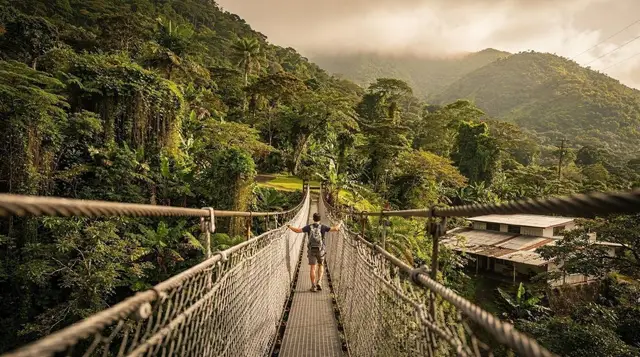
Whichever route gets you there, most visitors spend their first hours in Santa Elena settling in before heading up into the reserves themselves. A full day at the reserves is common, and a full-day pass covering the hanging bridges, canopy walkways, and gardens at Selvatura is one of the more efficient ways to see several of the park’s attractions without buying separate tickets at each one.
Travelers with a particular interest in the region’s sloths, alongside the suspended bridges, sometimes look at a combined hanging bridges and sloth-spotting visit at Selvatura Park as a way to fit both into a single outing rather than two separate half-days.
Bottom line
The jeep-boat-jeep crossing is faster than driving the direct road between La Fortuna and Monteverde — about 3 hours against 3.5 to 4 hours — because the direct route includes a long unpaved stretch that slows vehicles down far more than the shorter distance suggests. It is also generally the cheaper option compared to hiring a private car for the road transfer. The direct road remains a reasonable choice if you already have a rental car for the rest of your trip or want full control over your stops, in which case the renting a car for La Fortuna guide covers the vehicle and road logistics in detail.
For travelers without their own car, or anyone simply looking for the quickest and most economical way across, the lake crossing is the one to book. For planning the days on either side of this transfer, the La Fortuna and Monteverde itinerary and the La Fortuna without a car itinerary both build around this exact crossing as the connecting piece.
Frequently asked questions about the lake crossing to Monteverde
Is the boat crossing faster than driving to Monteverde?
Yes, typically by 30 to 60 minutes. The crossing runs about 3 hours door to door, while a car or private transfer needs 3.5 to 4 hours because part of the direct road is unpaved and slow.
How much does the jeep-boat-jeep crossing cost compared to a private transfer?
The shared jeep-boat-jeep crossing usually runs well below the price of a private road transfer covering the same 130 km, since the boat leg is shared among several vehicles’ worth of passengers and the road distance is shorter overall.
Is the road to Monteverde really unpaved?
A significant stretch of the direct route, particularly the approach into Santa Elena, is gravel and dirt rather than asphalt. This is the main reason the road route takes longer than its distance suggests.
Can I drive myself instead of taking an organized crossing?
Yes, self-driving is possible with a 4x4, especially outside the wettest months. It gives you full flexibility but takes longer than the boat crossing and requires comfort with unpaved mountain roads and one-lane bridges.
Is the lake crossing safe, and does it run in the rainy season?
The crossing operates year-round and is a routine, well-established service on a mostly sheltered lake. Departures can be delayed briefly in strong wind or heavy storms, which is more of an inconvenience than a safety concern.
Should I book the crossing in advance?
Booking a day or two ahead is sensible in the December to April high season, when boats fill up. In quieter months you can often arrange it the day before through your hotel or a local operator.
What should I pack for the boat crossing?
A light rain jacket, a dry bag or plastic bag for electronics, and a layer for the breeze on open water. Luggage typically travels in a separate compartment or on the boat’s roof, so keep valuables with you.
Is there a night version of the crossing?
Yes, some operators run the lake crossing paired with an evening wildlife walk, timed for travelers who want to combine the transfer with a night tour rather than treat it purely as transport.
Popular La Fortuna experiences on GetYourGuide
Verified deep-linked GetYourGuide tours. Book through these links and we earn a small commission at no cost to you.
GetYourGuide does not provide a product photo for this activity — the image shows the meeting point, photographed by us.