La Fortuna vs Monteverde: How to Choose (or Do Both)
Should I visit La Fortuna or Monteverde?
They cover different things. La Fortuna sits low and warm around a dormant volcano, with hot springs and waterfalls. Monteverde sits high and cool inside a cloud forest, with quetzals and canopy walks. Most itineraries with five or more days do both, connected by a roughly 3-hour jeep-boat-jeep crossing.
Two Landscapes, Not Two Versions of the Same Trip
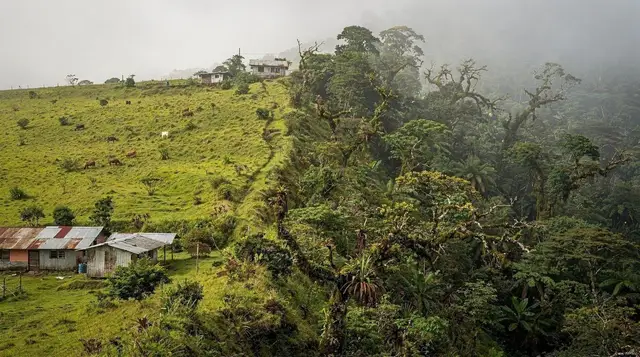
Ask around and you will hear La Fortuna and Monteverde talked about almost interchangeably, as if choosing between them were a coin flip. It is not. La Fortuna sits in the warm lowlands at the foot of a dormant volcano, built around hot springs, waterfalls, and rivers. Monteverde sits nearly 1,150 m higher, inside an actual cloud forest, built around birdwatching, canopy adventure, and a climate that asks for a jacket in the evening.
They share a region of northern Costa Rica and a widely used travel connection, but they do not share a climate, an altitude, or a signature animal. This guide compares them directly, so the choice is based on what each place actually offers rather than on which one shows up first in search results.
Climate and Altitude: The Real Difference
The single biggest reason these two destinations feel so different is elevation. Arenal Volcano and the town of La Fortuna sit around 250 m, in humid lowland forest that stays warm through the day and night. Monteverde and neighboring Santa Elena sit around 1,400 m, high enough that mist rolls through the forest canopy most afternoons and temperatures drop enough to notice, especially with wind.
| La Fortuna | Monteverde | |
|---|---|---|
| Altitude | ~250 m | ~1,400 m |
| Typical daytime feel | Warm, humid, 24-30°C | Cool, breezy, 15-22°C |
| Rain pattern | Rain most of the year; La Fortuna sits on the windward side | Persistent mist and cloud cover, especially afternoons |
| Best months for clear volcano/forest views | Dry season, December to April, early mornings | Year-round for the forest itself; clearer trails in dry season |
| Signature landscape | Rainforest, rivers, volcanic cone | Cloud forest, ridge-top mist |
Neither location is reliably sunny. La Fortuna gets rain across the calendar because it faces the prevailing weather off the Caribbean side, and the volcano’s summit is frequently wrapped in cloud regardless of season. Monteverde’s cloud forest is, by definition, built on near-constant moisture in the canopy. If your idea of a good weather day is guaranteed sun in either place, adjust the expectation rather than the destination.
Wildlife: They Do Not Overlap the Way People Assume
This is the piece most itineraries get wrong, treating the two stops as redundant wildlife-viewing opportunities. They are not.
Monteverde is the more reliable place in the country for the resplendent quetzal, particularly from February to July when the birds move to lower elevations to feed on wild avocado trees. Guided walks in the Monteverde Cloud Forest Reserve, Santa Elena Reserve, and Curi-Cancha Reserve are built around this window, and local guides know which fruiting trees to check that week. La Fortuna’s lowland forest does not have quetzals; they are a cloud-forest specialist and simply are not present at 250 m.
a guided cloud forest walk in Monteverde puts a trained spotting guide with a scope between you and the canopy, which matters more here than almost anywhere else in the country — quetzals sit still and blend in, and most independent visitors walk right past them.
La Fortuna’s wildlife strength runs the other direction: sloths along the Bogarín Trail, caimans and waterbirds on the Peñas Blancas River floating safari, and the night-walk circuit around town for frogs, snakes, and kinkajous. For sloths specifically, Bijagua, reachable on the way to Río Celeste, has a dedicated sanctuary and is a more reliable bet than a random La Fortuna trail. Neither place substitutes for the other on this front — pick your destination by which animal you actually want to see.
What You Do in Each Place
The activity lists barely overlap either, which is the clearest evidence these are complementary stops rather than duplicate ones.
| Category | La Fortuna | Monteverde |
|---|---|---|
| Signature activity | Hot springs heated by the volcano | Cloud forest canopy walks |
| Water features | La Fortuna Waterfall, river rafting, hot river pools | None — no hot springs, few large waterfalls |
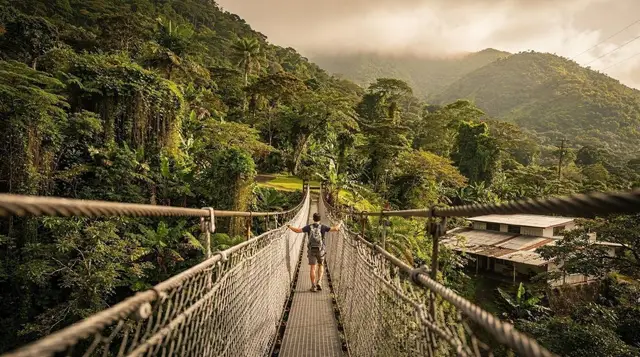
| Suspension bridges | Mistico Hanging Bridges, Sky Adventures | Selvatura Park’s forest canopy bridges |
| Ziplining | Multiple canopy parks around the volcano | The Original Canopy Tour and others, generally shorter, cooler runs |
| Night activity | Frog and wildlife night walks | Guided night hikes for owls, kinkajous, and sleeping birds |
| Horseback riding | Trails toward waterfalls and farmland | Cloud-forest and pastureland routes |
| What it lacks | Cloud forest, quetzals, cooler air | Volcanic hot springs, whitewater rafting, a visible cone |
A Monteverde canopy zipline circuit runs cooler and mistier than anything in La Fortuna, which some travelers prefer and others find less dramatic without the volcano backdrop below. If ziplining is the deciding activity rather than a bonus, either destination delivers it; the atmosphere around the ride is what changes.
For evenings, a guided night walk through the Monteverde forest covers a different set of species than La Fortuna’s lowland night tours — expect owls and sleeping birds rather than the caimans and river frogs you would find near Arenal.
Getting Between Them
The two destinations are connected by the well-used jeep-boat-jeep crossing over Lake Arenal, which takes roughly 3 hours door to door and is faster and cheaper than driving the long way around, which runs 3.5 to 4 hours over a partly unpaved road. Both directions run daily and can be booked from either town. We cover the operators, timing, and what to expect on the boat crossing in a separate guide — see jeep-boat-jeep versus driving to Monteverde for the full breakdown rather than repeating it here.
The short version: unless you have your own 4x4 and specifically want to see the northern shore of the lake by road, the boat crossing is the better use of a travel day.
If You Can Only Pick One
Travelers with fewer than five days on this side of the country often have to choose. A few honest trade-offs:
- Pick La Fortuna if hot springs, waterfalls, and a warmer climate matter more than a specific bird sighting, if you are traveling with young kids who will tire on cooler high-altitude trails, or if your itinerary already includes a beach stop and you want contrast rather than more cool-weather hiking.
- Pick Monteverde if birdwatching — quetzals especially, in season — is a genuine priority, if you prefer forest quiet over an activity-park atmosphere, or if the cooler air is a relief rather than an inconvenience.
- Skip neither if you have five or more days; see the next section.
Neither destination is a beach stop, and neither substitutes for one. The nearest Pacific coast is roughly 3 hours from La Fortuna, and Monteverde is not meaningfully closer to it. Build a coastal stretch separately if that is part of the trip.
Doing Both: A Practical Split
Most itineraries that include both destinations settle on 2 to 3 nights in La Fortuna and 1 to 2 nights in Monteverde, in either order, connected by the jeep-boat-jeep crossing. Arriving via SJO tends to favor La Fortuna first, since it is the shorter drive from San José; arriving via LIR in Liberia can work either way, though Monteverde is somewhat closer from that airport than La Fortuna is.
A sample structure:
- Fly into San José, drive roughly 3 hours to La Fortuna.
- Spend 2 to 3 nights around the volcano: hot springs, the waterfall, a hanging bridges park, a night walk.
- Cross to Monteverde by jeep-boat-jeep, about 3 hours.
- Spend 1 to 2 nights on cloud forest reserves and canopy activities.
- Continue south or fly out via Liberia, depending on the rest of the trip.
For a longer, day-by-day version of this pairing, see the La Fortuna and Monteverde itinerary. If you are deciding how many nights to allocate across the whole trip rather than just these two stops, how many days in La Fortuna covers that separately.
A horseback ride through Monteverde’s cloud-forest and pastureland trails is a good way to use a half-day if your Monteverde stop is short and you want one activity beyond the reserves themselves rather than a packed schedule.
A Note on What Not to Expect From Either
Neither stop delivers a guarantee. La Fortuna does not deliver visible lava — the volcano has been dormant since 2010, and any tour or listing implying otherwise is out of date. Monteverde does not deliver a guaranteed quetzal sighting, even in the February-to-July window; guides improve the odds substantially, but this is still wild forest, not an aviary. Build both stops around the actual activities — hot springs and hanging bridges on one side, forest reserves and canopy walks on the other — rather than around a single photograph you are hoping for.
For a wider read on the region’s most commonly repeated inaccuracies, including the volcano and the closed Cerro Chato crater, see travel mistakes to avoid in La Fortuna.
La Fortuna vs Monteverde: Common Questions
Is La Fortuna or Monteverde better for a first trip to Costa Rica?
Neither is objectively better; they answer different questions. La Fortuna is easier logistically, warmer, and closer to both international airports. Monteverde asks a bit more of you in travel time but delivers a cooler, quieter forest and a real shot at seeing a resplendent quetzal.
Can I see the same wildlife in both places?
No. Sloths, caimans, and river birds are La Fortuna’s strength, especially around Bogarín Trail and the lowlands. Quetzals, and the general density of cloud-forest bird species, belong to Monteverde, mainly from February to July.
How do I get from La Fortuna to Monteverde?
The jeep-boat-jeep combination crosses Lake Arenal by boat and takes about 3 hours; driving the long way around takes 3.5 to 4 hours over partly unpaved road. See our dedicated guide for the full breakdown of operators and timing.
Is Monteverde colder than La Fortuna?
Yes, noticeably. Monteverde sits around 1,400 m and often requires a light jacket, especially in wind and mist. La Fortuna sits around 250 m and stays warm and humid year-round.
Do I need 4x4 to drive between La Fortuna and Monteverde?
A 4x4 is not mandatory but is genuinely useful from May to November, when the unpaved sections of Route 702 turn to mud. In dry season a standard car usually manages, carefully.
How many days should I split between the two?
As a rough baseline, 2 to 3 nights in La Fortuna and 1 to 2 nights in Monteverde covers the highlights of both without rushing either. Shorter trips usually mean picking one.
Are hot springs available in Monteverde?
No. The volcanic hot springs are unique to the Arenal area around La Fortuna. Monteverde has no geothermal activity of its own.
Is it worth skipping one destination entirely?
If your trip is under five days and wildlife photography of quetzals is not a priority, skipping Monteverde to spend more unhurried time around Arenal is a defensible choice, and vice versa for travelers prioritizing cloud forest and birding.
Popular La Fortuna experiences on GetYourGuide
Verified deep-linked GetYourGuide tours. Book through these links and we earn a small commission at no cost to you.
GetYourGuide does not provide a product photo for this activity — the image shows the meeting point, photographed by us.