A Cloud Forest With Its Own Gate
Ask a tour desk in La Fortuna for “the Monteverde reserve” and you’ll almost always be booked into Monteverde Cloud Forest Reserve, the older, better-known private reserve that put this misty ridge on the map decades ago. Santa Elena Cloud Forest Reserve is a different place entirely — a short drive from the village of Santa Elena, with its own entrance, its own rangers, and its own trail network, opened in 1992 and still owned and operated today by the Colegio Técnico Profesional de Santa Elena, the community’s public high school.
That ownership matters more than it sounds like it should. Entrance fees here don’t flow to a private company or a conservation trust based elsewhere — they fund the school’s environmental education programmes directly, and pay for the rangers and trail crews who keep the reserve open. Locals in La Fortuna and Santa Elena will sometimes describe it as “the students’ reserve,” which is close to literal: student groups from the school still use parts of the property for fieldwork.
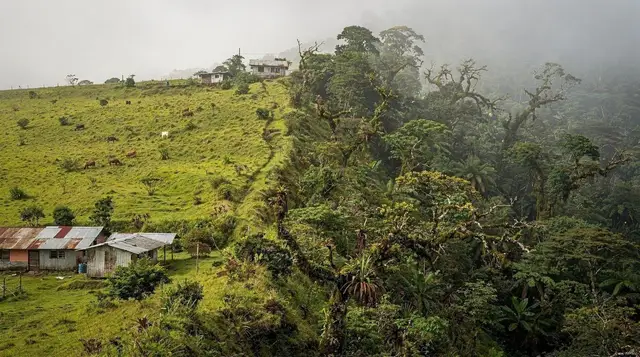
Ecologically, Santa Elena sits in the same cloud forest belt as its more famous neighbour, and the two can look confusingly alike in photos — dripping epiphytes, moss-wrapped trunks, a canopy that disappears into fog most mornings. That similarity is exactly why the piece worth repeating is the one visitors get wrong most often: Santa Elena is not an annex, overflow lot, or budget version of Monteverde Cloud Forest Reserve. It is a separate protected area with a separate ticket booth. A Monteverde Cloud Forest Reserve pass will not get you through Santa Elena’s gate, and vice versa.
Why Visitors Confuse the Two
The confusion isn’t really anyone’s fault. Both reserves protect cloud forest. Both sit within a few kilometres of the village of Santa Elena. Both are usually reached from the same roads out of Monteverde and La Fortuna. And “Monteverde” functions loosely in everyday conversation as the name of the whole area — the village cluster, the ecosystem, the general destination — long before it refers specifically to the reserve that carries that name.
Add in that several nearby operations use “Monteverde” or “Santa Elena” almost interchangeably in their marketing, and the mix-up compounds. Curi-Cancha Reserve, a third and entirely separate private reserve popular for birdwatching, and Selvatura Park, a commercial park built around hanging bridges and a canopy tour rather than conservation trails, both add to a cluster of similarly named, separately run attractions packed into a small area.
None of the four — Monteverde Cloud Forest Reserve, Santa Elena Reserve, Curi-Cancha, Selvatura — share a gate, a ticket, or a management office. Read the fine print before you book, and double-check what a driver or a package actually includes before assuming it’s the reserve you had in mind.
What the Trails Actually Feel Like
Santa Elena’s trail network is smaller and generally quieter than Monteverde Cloud Forest Reserve’s, which is its clearest practical advantage. Fewer tour buses default here, so the same early-morning window that gets crowded on Monteverde’s main trail can feel close to empty on Santa Elena’s. That quiet matters for wildlife spotting in particular: cloud forest animals are small, still, and colour-matched to bark and leaf litter, and a trail with fewer footsteps and voices on it gives resident birds and mammals more reason to stay visible rather than freeze or retreat.
Underfoot, expect mud. Elevation in this part of the Monteverde–Santa Elena ridge sits high enough, and rainfall frequent enough, that trails rarely dry out completely even in the better months. Closed hiking shoes with real grip are not optional footwear here — sandals and trainers both struggle on the wetter sections. A light rain jacket is worth carrying regardless of what the sky looks like at the gate; cloud forest weather changes within the hour, and the mist that gives the ecosystem its name can turn into steady drizzle with almost no warning.
Temperatures run noticeably cooler than the lowland heat of La Fortuna — pack a layer you’d otherwise leave in the suitcase. Trails are well marked and manageable without a guide, but self-guided visitors consistently see less: cloud forest wildlife is heard more often than spotted, and a trained local guide’s ear for calls, plus a spotting scope, routinely turns an unremarkable-looking stretch of trail into sightings of quetzals, hummingbirds, or a sloth curled in a fork of branches thirty metres up that would otherwise go completely unnoticed.
a private guided walk through Santa Elena Cloud Forest Reserve pairs a local guide’s spotting eye with the reserve’s quieter trails — for travelers who’d rather not gamble a limited window on self-guided luck.
Wildlife: What to Actually Expect
Set expectations honestly. Cloud forest wildlife does not perform on cue, and no reserve — Santa Elena included — can promise a sighting of any particular species. What Santa Elena offers is habitat: the mixed cloud forest here supports hummingbirds, toucanets, and a range of smaller birds year-round, along with the possibility — never the promise — of a resplendent quetzal, most likely between February and July when fruiting avocado trees draw them into the area. Mammal sightings tend toward the quieter end: sloths, coatis, and agoutis are realistic, while anything larger is an exceptional stroke of luck rather than a baseline expectation.
For visitors whose priority is maximising the odds of a quetzal sighting specifically, most local guides steer travelers toward Curi-Cancha Reserve instead, which has a stronger track record for that one bird. Santa Elena’s strength is a calmer, less-trafficked version of the same broader ecosystem — a fair trade for many visitors, but worth knowing before you choose.
Night brings a different set of animals out entirely — a separate window from the daytime reserve visit, and one that needs its own trip after dark.
a night walking tour through the Santa Elena wildlife refuge covers that after-dark shift: sleeping birds, tarantulas, kinkajous and other nocturnal residents that don’t show themselves during daytime hours at all.
Views of Arenal — Don’t Plan Around It
On an exceptionally clear day, parts of the Santa Elena area open toward the Arenal Volcano and Lake Arenal in the distance. It happens rarely enough that no honest guide will build an itinerary around it, and it should never be the reason you choose this reserve over another. Cloud cover at this elevation is the rule, not the exception — that’s the entire reason it’s called cloud forest. Treat any long view as a stroke of weather luck on the day, nothing more.
Suspension Bridges and Canopy Add-Ons
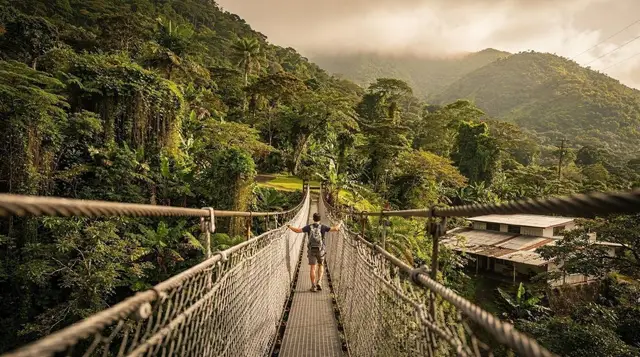
Santa Elena Reserve’s own trail network is ground-level walking trails, not suspension bridges — for a canopy-level walk through the treetops in this area, that’s a separate booking at a separate site. Selvatura Park runs one of the region’s larger hanging bridge networks nearby, and several operators offer bridge experiences branded loosely as either “Monteverde” or “Santa Elena” bridges depending on which access road they use.
a private suspension bridges tour on either the Monteverde or Santa Elena side is worth booking specifically if the treetop walk itself is the priority, separate from your reserve visit. For a longer network of bridges in one outing,
the hanging bridges at Selvatura Park cover more ground in a single ticket. Neither of these is included with Santa Elena Reserve admission, and neither substitutes for it.
Comparing Santa Elena to Other Cloud Forest Reserves
| Reserve | Managed by | Known for | Crowds |
|---|---|---|---|
| Santa Elena Reserve | Local public high school (since 1992) | Quieter trails, community-funded | Lower |
| Monteverde Cloud Forest Reserve | Private reserve (older, longer-established) | Name recognition, established trail system | Higher |
| Curi-Cancha Reserve | Private reserve | Stronger quetzal sightings, flatter trails | Moderate |
| Selvatura Park | Commercial park | Hanging bridges, canopy tour, paid attractions | Higher |
Getting There From La Fortuna
There are two realistic ways to reach the Santa Elena–Monteverde area from La Fortuna, and the choice shapes the rest of your day. Driving the road route takes roughly 3h30 to 4 hours over mountainous roads, much of it unpaved, and a 4x4 is genuinely useful outside the driest months. The alternative — a jeep-boat-jeep transfer across Lake Arenal — trims that to around 3 hours and tends to cost less than a private road transfer, which makes it the more common choice for visitors without their own rental car.
Whichever way you arrive, note that Santa Elena Reserve sits on its own access road, separate from Monteverde Cloud Forest Reserve’s entrance — check your specific reserve’s directions rather than assuming “toward Monteverde” gets you to the right gate.
Where This Fits in a La Fortuna Trip
For most visitors, Santa Elena Reserve is one stop within a broader day or overnight trip to the Monteverde area, not a standalone destination worth the road time on its own. Pair it with the Santa Elena village itself, or with Selvatura Park or the Monteverde Sky Walk if you want a canopy-level experience in the same outing. Families exploring the wider forest with children sometimes prefer starting at the Children’s Eternal Rainforest visitor area before tackling a full reserve trail.
Frequently Asked Questions About Santa Elena Reserve
Is Santa Elena Reserve the same as Monteverde Cloud Forest Reserve?
No. They are two different reserves with two different owners, two entrance gates and two separate ticket booths. Santa Elena is run by the community’s public high school; Monteverde Cloud Forest Reserve is an older private reserve a short drive away. The ecosystem looks similar because it is the same cloud forest belt, but one ticket does not cover both.
Who manages Santa Elena Reserve, and where does the money go?
The Colegio Técnico Profesional de Santa Elena, the village’s public high school, has owned and run the reserve since it opened in 1992. Entrance fees fund the school’s environmental education programmes and the reserve’s own trail maintenance and ranger staff, separately from any other reserve in the area.
Is Santa Elena Reserve less crowded than Monteverde?
Generally yes, mainly because it has less name recognition with first-time visitors and tour operators, who often default to booking Monteverde Cloud Forest Reserve by habit. Santa Elena’s trails see noticeably fewer groups at the same hour, though a coach tour day can still fill the car park by mid-morning.
Do I need a guide to visit Santa Elena Reserve?
No, self-guided entry is allowed and the marked trails are easy to follow. A guide changes what you actually see, though: cloud forest wildlife is small, still and camouflaged, and a trained guide’s spotting scope routinely turns an empty-looking trail into a morning of quetzals, hummingbirds and sloths that most self-guided visitors walk straight past.
What should I wear and bring to Santa Elena Reserve?
Closed hiking shoes with grip, a light rain jacket regardless of the forecast, and a layer for cool, damp air — cloud forest temperatures sit noticeably lower than La Fortuna’s. Trails are frequently muddy; gaiters or a spare pair of socks are not overkill. Bring binoculars if you have them, since much of the wildlife is heard before it’s seen.
Can I see the Arenal volcano from Santa Elena Reserve?
Only on an exceptionally clear day, and it is never something to plan a visit around. Cloud forest earns its name because cloud cover is the norm, not the exception, at this elevation — treat any wider view as a bonus, not a reason to book.
How does Santa Elena Reserve compare to Curi-Cancha or Selvatura?
Curi-Cancha is a separate private reserve known for more reliable birdwatching sightings, including resident quetzals in season, and generally flatter, easier trails. Selvatura is a commercial park combining hanging bridges, a canopy tour and other paid attractions rather than a conservation reserve on its own. Each has its own gate, ticket and trail system — none of them are interchangeable with Santa Elena.
Is Santa Elena Reserve worth visiting if I’m short on time and can only pick one cloud forest stop?
If avoiding crowds and keeping costs down matter most, Santa Elena is a strong single choice. If maximising the odds of a resplendent quetzal sighting matters most, most repeat visitors and local guides point toward Curi-Cancha or Monteverde Cloud Forest Reserve instead. There is no wrong answer, only a different priority.