A private reserve bigger than its famous neighbours
Most travelers who come from La Fortuna toward Monteverde have heard of two reserves: the Monteverde Cloud Forest Reserve and the Santa Elena Reserve. Fewer have heard of the reserve that actually surrounds both of them. The Children’s Eternal Rainforest — Bosque Eterno de los Niños, usually shortened to BEN — is the largest private nature reserve in Costa Rica, and it started with a fundraiser run by schoolchildren.
In 1987, a Swedish schoolteacher and her students raised money to buy a small plot of threatened rainforest near Monteverde and protect it permanently. The idea spread: children in dozens of countries sent in coins and small donations, and the land purchases kept growing. Today the reserve is managed by the Monteverde Conservation League, a Costa Rican nonprofit, and it covers somewhere in the range of 22,000 hectares — several times the combined area of the Monteverde and Santa Elena reserves that most visitors actually walk through. The League still runs a program that lets people “adopt” acres of forest, funding further land purchases along the reserve’s edges.
None of that history changes what a visitor experiences on the ground, and that’s the part worth being honest about before you plan a trip out here.
Where it sits, and why the shape of it matters
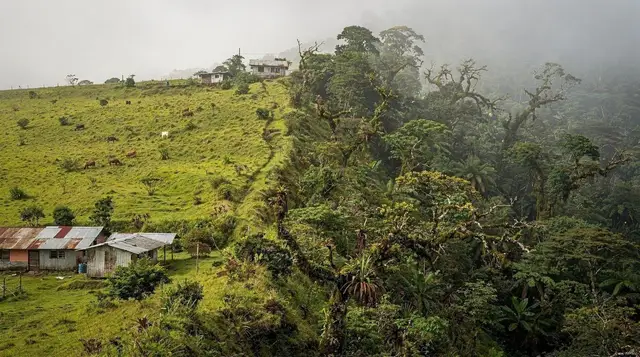
BEN isn’t a single block of forest with one gate. It wraps around and connects to the Monteverde and Santa Elena reserves along the Continental Divide, then drops steeply down the Caribbean slope toward the lowlands, and reaches more modestly onto the Pacific side as well. That range in elevation is the whole point biologically — it lets wildlife move between cloud forest at 1,400m and warmer lowland rainforest thousands of metres below, following the corridor rather than getting boxed into an island of protected land surrounded by farmland.
For a visitor, the practical consequence is that “the reserve” isn’t one place. It’s several separate access points, built to very different standards, scattered across a large and largely roadless area. Confusing them is the single most common mistake made when planning a visit.
Bajo del Tigre: the sector actually built for visitors
If you’re coming from La Fortuna and have a normal day-trip amount of time, Bajo del Tigre is the sector you want. It sits at the edge of Santa Elena town, at a noticeably lower elevation than the cloud forest reserves above it — around 1,100m rather than 1,400m+ — which means the forest here looks different: more premontane wet forest, less draped in the thick moss and epiphyte loads that define the cloud forest proper.
Bajo del Tigre has a loop trail system of a few kilometres, clearly marked, on graded paths that are manageable for most fitness levels and reasonably stroller-friendly on the main loop. There’s a butterfly garden, a hummingbird garden near the entrance, and a small visitor centre. Guided night walks depart from here too, aimed at the frogs, kinkajous and insects that come out after dark — a gentler and often less crowded alternative to the night walks run out of central La Fortuna or the Bogarín Trail.
This is the sector to combine with a Selvatura Park or Curi-Cancha visit on the same trip — geographically close, open on a normal schedule, no special booking needed beyond a same-day ticket.
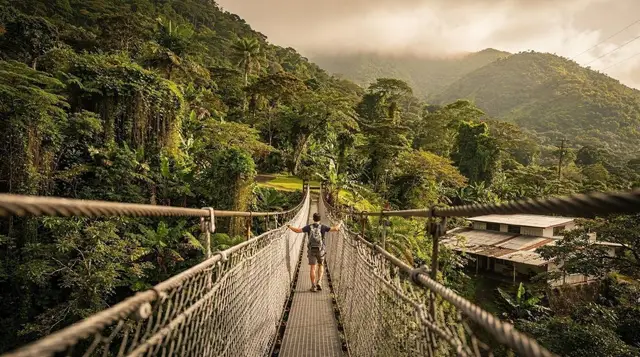
a guided hanging-bridges hike through the Selvatura canopy near Santa Elena pairs naturally with a Bajo del Tigre walk, since both start from the same side of town.
San Gerardo and Poco Sol: the sectors that are not set up for casual visits
Here’s the trap. Because Bajo del Tigre is easy, it’s tempting to assume the rest of the Children’s Eternal Rainforest is equally accessible. It is not, and treating it that way is how people end up stranded, under-prepared, or simply turned away.
The San Gerardo field station sits on the Caribbean slope of the reserve, reached either by a long hiking trail (several hours, steep, often muddy) from near the Santa Elena side, or by a rough vehicle track from the lowlands. There’s a rustic dormitory-style lodge with basic beds and limited hot water, no restaurant, and no food for sale — you bring in what you need, or arrange meals in advance through the Monteverde Conservation League, which manages bookings and is not a same-day, walk-up operation. It exists primarily for birders chasing species that don’t show up in the higher cloud forest, and for researchers and student groups on multi-day programs.
Poco Sol, on the Pacific side of the reserve, is more remote again — accessed in small groups, oriented around research and conservation work rather than casual tourism, and effectively out of reach unless you’re booking a specialist trip well ahead of time.
Neither of these is a place to show up expecting the boardwalks, signage and gift shop you’ll find at Monteverde or Santa Elena’s main reserves, or even at Bajo del Tigre. If a guide or a listing describes “hiking through the Children’s Eternal Rainforest” without naming a specific sector, ask which one — the difference between Bajo del Tigre and San Gerardo is the difference between a two-hour stroll and a multi-day expedition.
Why birders and researchers make the effort anyway
The reward for reaching the less-visited sectors is real. Lower visitor numbers and less trail maintenance mean wildlife here behaves more like it does away from any tourist infrastructure at all. Camera-trap surveys run by the Conservation League have recorded tapirs, ocelots and pumas using the corridor between elevations — animals rarely seen even by guides who work the more popular reserves daily.
For birders, the resplendent quetzal is the headline species in this whole region, best looked for from February through July when it descends to feed on wild avocados; it belongs to Monteverde generally rather than to any one reserve sector, so don’t expect a guaranteed sighting anywhere. Three-wattled bellbirds, umbrellabirds and a long list of hummingbirds are also part of what draws dedicated birdwatchers to book the remote stations specifically, rather than settling for a shorter walk closer to town.
Getting there from La Fortuna
There’s no direct entrance to the Children’s Eternal Rainforest from La Fortuna itself — you reach it as part of a Monteverde-area trip. The jeep-boat-jeep crossing across Lake Arenal takes about three hours and is the route most La Fortuna visitors use; driving the long way round by road takes closer to three and a half to four hours over partly unpaved sections. Either way, you’ll arrive in Santa Elena, from where Bajo del Tigre is a short local hop — walkable from the centre of town for a reasonably fit visitor, or a five-minute taxi ride.
If you’re weighing whether to base yourself in La Fortuna or Monteverde for this part of the trip, it’s worth reading through La Fortuna vs Monteverde before booking accommodation, and looking at a combined La Fortuna and Monteverde itinerary to see how much time the crossing actually eats out of your schedule.
How the entrance fees work
Entrance fees at Bajo del Tigre go directly to the Monteverde Conservation League, which uses the income — along with the “adopt an acre” donations — to fund land purchases that expand the reserve’s protected corridor. It’s a smaller, more direct funding model than the government-run national parks nearby, and one reason conservation-minded visitors specifically seek this reserve out rather than only visiting the more famous cloud forest reserves next door.
Comparing the sectors
| Sector | Typical access | Trail conditions | Who it suits |
|---|---|---|---|
| Bajo del Tigre | Short walk or taxi from Santa Elena, same-day ticket | Graded, marked loop trails, a few kilometres | Day-trippers, families, first-time visitors |
| San Gerardo station | Long hike or rough track, advance booking required | Steep, often muddy, unmarked in places | Birders, students, multi-day hikers |
| Poco Sol station | Small-group access only, booked well ahead | Remote, minimal infrastructure | Researchers, specialist wildlife trips |
| Monteverde Cloud Forest Reserve (adjacent, separate reserve) | Entrance fee, open daily | Well-maintained boardwalks and trails | Most visitors — see its own guide |
| Santa Elena Reserve (adjacent, separate reserve) | Entrance fee, open daily | Well-maintained, less crowded than Monteverde | Visitors wanting a quieter alternative |
For a closer look at how those two neighbouring reserves compare to each other, see Monteverde’s cloud forest reserves compared and the dedicated Curi-Cancha and Selvatura guide.
Practical tips
- Book Bajo del Tigre’s night walk in advance in high season (December-April); it fills up alongside the more famous night walks at Selvatura and in La Fortuna itself.
- If you want to hike into San Gerardo, contact the Monteverde Conservation League directly rather than assuming a tour operator can arrange it same-day — bunk space is limited and food isn’t sold on site.
- Bring a rain jacket regardless of season. Even in the dry months, this stretch of the Continental Divide catches cloud and mist that the lowlands around La Fortuna rarely see.
- Closed shoes with real tread, not sandals — the lower Bajo del Tigre trails get slick with mud after rain even outside the official green season.
- Binoculars matter more here than at almost any other stop near La Fortuna. If birding is the goal, don’t skip them to save luggage space.
- Combine Bajo del Tigre with a private guided walk through the Santa Elena Cloud Forest Reserve for a fuller day without needing to arrange the remote stations at all.
- If time is tight, a guided wildlife-spotting walk through the Monteverde canopy covers similar terrain and species to Bajo del Tigre with a naturalist guide doing the spotting for you.
Anyone weighing whether to add Monteverde to a La Fortuna trip at all should also check how many days in La Fortuna makes sense first — the Children’s Eternal Rainforest is worth a detour, but it’s an addition to a Monteverde stop, not a reason on its own to change your route through the things to do in Monteverde list.
FAQs about the Children’s Eternal Rainforest
Is the Children’s Eternal Rainforest the same reserve as Monteverde Cloud Forest Reserve?
No. They’re adjacent and connected, but they’re separately managed. The Monteverde Cloud Forest Reserve and the Santa Elena Reserve are their own protected areas with their own entrance fees and trail systems; the Children’s Eternal Rainforest surrounds and connects to both but is run by the Monteverde Conservation League as a distinct reserve.
Which part of the Children’s Eternal Rainforest can I actually visit on a day trip?
Bajo del Tigre, near Santa Elena town. It has marked trails, a visitor centre, and a butterfly and hummingbird garden, and it’s open on a normal daily schedule without advance booking. The reserve’s other sectors require significantly more planning.
Can I hike to the San Gerardo station without booking ahead?
Not realistically. Beds are limited, there’s no food service on site, and the trail in is long and can be difficult to navigate without local knowledge. Contact the Monteverde Conservation League to arrange a stay before you travel.
Why is it called the “Children’s” Eternal Rainforest?
Because the land purchases that created it began with a Swedish schoolteacher and her students raising money in the late 1980s to buy and protect a threatened patch of rainforest. Children in other countries followed with their own donations, and the reserve grew from those funds under the Monteverde Conservation League.
Will I see a quetzal here?
Possibly, especially between February and July, but there’s no guarantee anywhere in the Monteverde area. Quetzals move with fruiting wild avocado trees rather than staying in one spot, and sightings depend heavily on the guide’s knowledge that day.
How does Bajo del Tigre compare to Monteverde Cloud Forest Reserve for a short visit?
Bajo del Tigre sits lower in elevation, so the forest looks and feels different — less draped in moss, warmer, and generally quieter in terms of visitor numbers. It makes a good add-on rather than a substitute if you only have time for one main reserve, which should usually be Monteverde or Santa Elena.
Do I need a guide at Bajo del Tigre?
No, the main loop is self-guided and well marked, though a guide will help you spot far more wildlife than you’d find alone. Guides are effectively required for the remote stations, both for safety and because the routes aren’t signed for casual hikers.
Is this reserve reachable directly from La Fortuna without going through Santa Elena?
No. Every practical access point sits on the Santa Elena side of the Continental Divide, so a visit means routing through the same jeep-boat-jeep crossing or road trip used to reach Monteverde generally — there’s no separate shortcut from La Fortuna into the reserve.