Inside Costa Rica’s original cloud forest reserve
The Monteverde Cloud Forest Reserve is the one that started it all. Established in 1972 by the Tropical Science Center on land partly donated by the Quaker families who founded the village of Monteverde two decades earlier, it covers roughly 40 km2 of primary and secondary cloud forest straddling the Continental Divide.
It is older, better known internationally, and more tightly protected than the reserves that came after it — but it is also a separate business from Santa Elena Reserve and from Curi-Cancha, both of which sit nearby and get confused with it constantly in trip-planning threads. If a friend says “we loved Monteverde reserve,” it’s worth asking which one they mean.
This page covers the 1972 reserve specifically: what’s actually inside it, when to go, what it costs, and the one claim you’ll see repeated online that isn’t quite true.
What the reserve actually protects
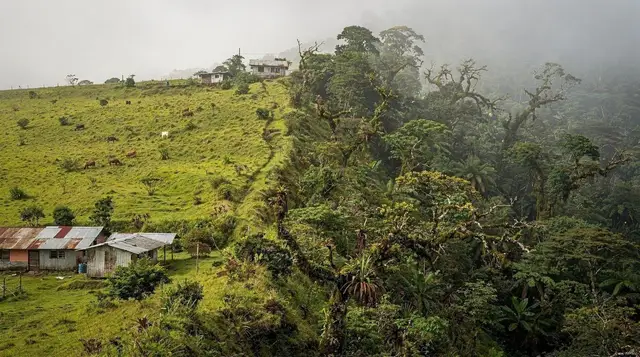
Cloud forest is a specific, fragile ecosystem: mid-to-high elevation forest that sits inside clouds for much of the year, so moisture arrives as mist and drip rather than only as rain. The Monteverde reserve sits mostly between 1,400 and 1,800 m along the Continental Divide, which means weather systems from both the Pacific and Caribbean slopes collide here — one reason the forest is so dense with epiphytes, mosses, bromeliads, and orchids growing on every available branch.
Inside the reserve boundary you’ll find:
- A network of maintained, mostly flat trails through primary forest, looping past the reserve’s most photographed features
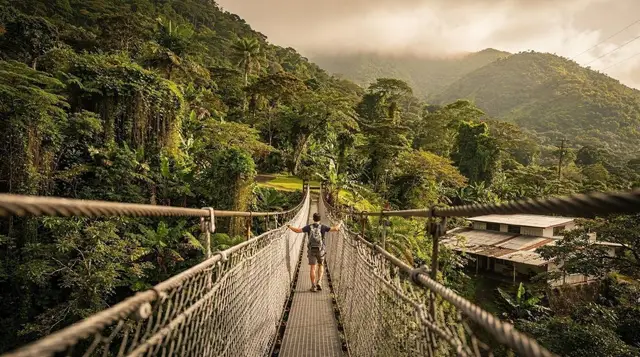
- A suspension bridge crossing a forest ravine, used for canopy-level viewing rather than as an adventure-park thrill
- The Continental Divide viewpoint, where on a clear day you can, in theory, see both the Pacific and Caribbean slopes — clear days are the exception, not the rule
- A visitor center with trail maps, natural history displays, and a hummingbird garden near the entrance
Entry is limited by timed capacity, so even on a busy dry-season morning the trails rarely feel overrun the way some more heavily marketed parks near La Fortuna can.
The quetzal question, honestly
The resplendent quetzal is the single biggest reason people add Monteverde to a Costa Rica itinerary, and it’s also the source of the most common disappointment. This reserve is a legitimate quetzal habitat — arguably the country’s best known one — but it is not an aviary. Sightings track the fruiting of wild avocado trees, the quetzal’s preferred food, which peaks roughly February through July. Outside that window, birds are still resident but far more dispersed and harder to locate.
If quetzals are your main goal, plan the trip around that window and go early, ideally with a guide carrying a spotting scope. Guides communicate by radio when a bird is found, which is how most visitors who do see one actually see one — not by wandering trails solo and getting lucky. Treat any claim of guaranteed sightings, in a brochure or a guide’s pitch, as marketing rather than biology.
Other wildlife worth watching for
Quetzals get the headlines, but the reserve’s real strength is density and diversity, not one showcase species. Depending on season and luck, guided walks turn up:
| Species | Best odds | Notes |
|---|---|---|
| Resplendent quetzal | Feb–Jul | Follows wild avocado fruiting |
| Three-wattled bellbird | Mar–Jun | Heard more often than seen |
| Coatis, agoutis | Year-round | Common on lower trails |
| Sloths | Year-round, low odds | Guides scan canopy gaps |
| Hummingbirds | Year-round | Concentrated near the visitor center |
| Orange-kneed tarantula | Night walks only | Not seen on daytime reserve trails |
For a broader sense of what’s realistic to expect across the wider Monteverde area, our regional birdwatching guide sets more general expectations than any single reserve can.
Practical details: hours, tickets, guides
Tickets are sold at the reserve entrance or online in advance during peak season (roughly late December through April), when capacity limits can genuinely sell out by mid-morning. Independent (unguided) entry is allowed, but a guided walk — either a small group tour booked in advance or a private guide hired at the entrance — is what separates a good visit from a mediocre one in a forest this quiet and this good at hiding its wildlife.
a guided suspension-bridge hike through the reserve’s canopy trails pairs a naturalist guide with the reserve’s signature bridge crossing, and is a reasonable single booking if you only have one morning here.
For visitors who want a broader wildlife focus rather than a fixed bridge-and-trail route, a small-group wildlife exploration walk through the cloud forest canopy spends more time stationary at productive spots — the approach that tends to produce better bird and mammal sightings than a brisk walking pace.
How this reserve differs from Santa Elena and Curi-Cancha
All three sit within a short drive of each other and share the same forest type, which is exactly why they get mixed up. The real differences:
| Reserve | Established | Managed by | Character |
|---|---|---|---|
| Monteverde Cloud Forest Reserve | 1972 | Tropical Science Center (private) | Largest, most famous, busiest in dry season |
| Santa Elena Reserve | 1992 | Local high school (community) | Higher elevation, often quieter, more exposed views |
| Curi-Cancha Reserve | Later, private | Independent operator | Smaller, strong for guided birding, flexible entry |
If your time is genuinely limited to one reserve, this one — the original — is the safest single choice for a first visit. If you have two mornings, pairing it with Santa Elena or Curi-Cancha gives a useful comparison and roughly doubles your wildlife odds without repeating the same trails. Our side-by-side comparison of the Monteverde-area reserves breaks down entry fees, trail lengths, and crowd patterns in more detail.
Getting here from La Fortuna
This is the detail that catches people off guard: Monteverde is close on a map and far in practice. There is no fast, direct road. Two realistic options:
- Jeep-boat-jeep: a minibus from La Fortuna to the shore of Lake Arenal, a boat crossing the lake, then a second minibus up into Santa Elena — about 3 hours door to door, and noticeably cheaper than a private transfer covering the same ground by road.
- Driving: roughly 3h30 to 4h for around 130 km, much of it on unpaved Route 702, which can be slow and dusty in dry season, muddy and rutted in green season. A 4x4 is genuinely useful outside the December–April window.
There’s no shortcut that avoids one of the two. Our jeep-boat-jeep versus driving guide walks through the trade-offs in more detail, and the La Fortuna and Monteverde itinerary lays out a realistic multi-day sequence rather than trying to force both into one long day.
Should you day-trip it or stay overnight?
A single-day round trip from La Fortuna — roughly 3 hours each way via the boat crossing — is technically doable but leaves only a few hours in the forest after accounting for transfer, lunch, and reserve entry logistics. It works if Monteverde is a nice-to-have rather than a priority. If quetzals, cloud forest, or serious birding are why you’re coming to Costa Rica at all, staying at least one night, ideally two, in Santa Elena or Monteverde village lets you do an early guided walk when animals are most active, rather than arriving mid-morning with the day already half gone.
For travelers weighing whether Monteverde deserves the detour at all against staying focused on the Arenal Volcano National Park side of a trip, our La Fortuna versus Monteverde comparison is a more direct answer than this single-reserve page can give.
What to pack for the reserve
Cloud forest weather is its own thing: cool, damp, and prone to sudden mist even in the middle of dry season. Bring:
- Closed, grippy shoes — boardwalk sections get slick, and trail sections after rain get muddy
- A light rain jacket, packed even in December–April
- A warm layer; temperatures at this elevation run noticeably cooler than La Fortuna’s lowland heat
- Binoculars if you own a pair — most guided tours supply a spotting scope, but personal binoculars help on your own between guide stops
Night walks and other add-ons nearby
Daytime reserve visits and nighttime wildlife walks are genuinely different experiences, run at different hours with different target species — frogs, kinkajous, sleeping birds, and insects that never show up on a daytime trail. If your schedule allows a second outing, a guided night walk through the Monteverde forest is a reasonable way to use an evening you’d otherwise spend at the hotel, and it doesn’t compete for the same trail time as your reserve visit.
Quick facts
| Established | 1972 |
| Managed by | Tropical Science Center (private, nonprofit) |
| Area | ~40 km2 |
| Elevation | ~1,400–1,800 m |
| Trail difficulty | Mostly flat, well maintained |
| Best quetzal window | February–July |
| Recommended visit length | Half a day; a second early morning if birding seriously |
Frequently asked questions about the Monteverde Cloud Forest Reserve
Is the Monteverde Cloud Forest Reserve the same as Santa Elena Reserve?
No. They’re two separate, independently managed reserves a short drive apart. The Monteverde Cloud Forest Reserve (1972) is privately run by the Tropical Science Center and is the older, more famous one; Santa Elena Reserve (1992) is community-owned and run by the local high school, sits at slightly higher elevation, and tends to be less crowded.
Will I definitely see a resplendent quetzal here?
No sighting is ever guaranteed. Your odds are genuinely good from February to July, when wild avocado trees fruit and quetzals feed at lower, more visible levels. Outside that window, especially August to January, quetzals are present but far harder to find, and some visitors leave without one.
How does this reserve compare to visiting Monteverde from La Fortuna as a day trip?
It’s a long day either way: 3–4 hours of road driving or about 3 hours via the jeep-boat-jeep crossing, each direction. A single-day round trip from La Fortuna is physically possible but leaves little real time in the forest. Most visitors who want to see this reserve properly base themselves in Santa Elena or Monteverde for at least one night.
Do I need a guide inside the reserve?
The trails are well marked and safe to walk alone, but a naturalist guide with a spotting scope is the difference between an empty-looking forest and a genuinely rewarding walk. Cloud forest wildlife is quiet, still, and camouflaged; guided small groups spot far more birds, sloths, and frogs than solo visitors typically do.
What should I wear and bring?
Closed shoes with grip, a light rain jacket even in dry season, and a layer for cool, damp air — the reserve sits near 1,400 m and mist rolls through most days. Binoculars are worth carrying if you have them; guides usually supply a scope but not personal binoculars.
Are the trails difficult?
No. The main loop trails are mostly flat, wide, and well maintained, suitable for most fitness levels and older children. Boardwalk sections can be slippery when wet, and the reserve limits how many visitors enter at once, so trails rarely feel crowded even on busy days.
Is there a suspension bridge inside this reserve?
Yes, a network of trails includes a suspension bridge across a forest ravine, used mainly for canopy-level views rather than as a standalone adventure attraction — it’s a quieter experience than the multi-bridge hanging-bridges parks near La Fortuna or Selvatura.
Can I combine this with hot springs or Arenal in the same trip?
Yes, but not the same day. The standard pattern is a few nights around La Fortuna and Arenal for hot springs, waterfalls, and the volcano, then a separate 2–3 night stop in Monteverde reached via the jeep-boat-jeep, before continuing on or returning to San José.