Wetland Birds of Caño Negro: A Birdwatcher's Guide
When is the best time to see wetland birds at Caño Negro?
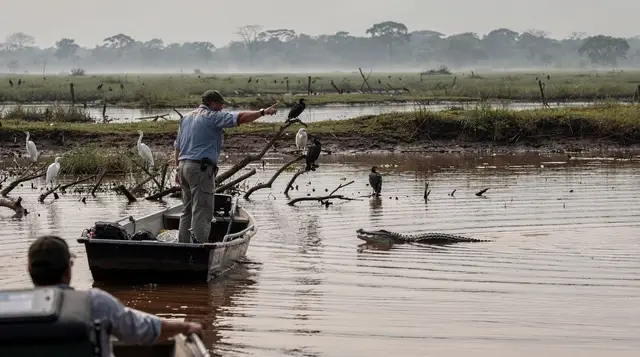
Go out on the water in the first two hours after sunrise or the last two hours before sunset, when birds are actively feeding and the light is low enough that a slow boat doesn't spook them. The dry season, roughly December to April, concentrates far more birds around the shrinking lagoon than the green season does, when the wetland spreads out and the same species scatter across a much larger flooded area.
Why the boat, not the checklist, decides what you’ll see
Caño Negro shows up on almost every “top wildlife spot” list that mentions La Fortuna, and most of those lists stop at a general description of the wetland. This one doesn’t. If you already want the full picture of the refuge — the Ramsar designation, the seasonal lake, the caimans and monkeys alongside the birds — that’s covered in the Caño Negro day trip guide and the boat safari overview. Here, the only question is: when do you get in the boat, and what changes the number of species you’ll actually see.
The honest answer is that the departure time and the season matter more than the operator you book with. A silent, slow boat with a mediocre guide at 6:30 am will out-perform an excellent guide on a noisy afternoon run. Caño Negro’s wetland birds — herons, storks, ibis, jacanas, kingfishers, anhingas — are wary of engine noise and direct sun, and they behave on a schedule that has nothing to do with tour company timetables.
Dawn and dusk: the two windows that actually work
Wetland birds at Caño Negro feed on a rhythm set by temperature and insect activity, not by convenience. Two windows consistently produce the most sightings:
- Early morning, roughly 6:00 to 9:00 am. Birds that roosted overnight in the trees along the Río Frío move out to feed as the light comes up. The air is still cool enough that reptiles and insects are also active near the surface, which draws herons and kingfishers to the water’s edge. Boats that leave La Fortuna before 5:00 am to catch this window are not being dramatic — the difference between a 6:00 am and a 9:00 am departure is real.
- Late afternoon, roughly 3:30 pm to dusk. As the heat of the day breaks, birds resume feeding before settling in for the night. This window is shorter and less reliable than the morning one, because afternoon rain is common in the green season and can shorten or cancel a float outright.
Between roughly 10:00 am and 2:00 pm, most wading birds retreat into shade and the water surface goes quiet. A midday boat isn’t wasted — you’ll likely still see caimans, iguanas, and howler or spider monkeys — but treat it as wildlife viewing in general, not a birding trip specifically. If birds are the priority, decline any itinerary that only offers a midday slot.
Boat noise is the other variable within your control. Smaller, quieter boats — paddled or running on a low-wake electric or idle motor — get closer to shoreline birds before they flush. A larger diesel launch moving at speed will still show you plenty of open-water species, but it pushes shy waders like the bare-throated tiger heron back into the reeds well before you’re close enough to get a good look.
What the dry season concentrates — and what the green season spreads out
This is the trap most descriptions of Caño Negro skip: the refuge does not hold a constant density of birds year-round, and treating a single trip report as representative of “what Caño Negro is like” is a mistake.
Dry season, roughly December to April. The seasonal lake that gives the refuge its character shrinks steadily through these months, and by March and April it can retreat to a network of channels and shallow pools. Every heron, stork, ibis, and duck in the area ends up concentrated around what water remains, which is exactly why the dry season has the reputation for spectacular bird numbers — it’s not that more birds arrive, it’s that the same population is squeezed into a much smaller, more visible area.
Green season, roughly May to November. Rain refills the wetland and the lake spreads out, in some years covering many times its dry-season footprint. Birds are still present in similar numbers, but they’re distributed across a far larger area of flooded forest and grassland, so a single boat circuit turns up fewer sightings per hour. Guides who know the current water levels — which changes year to year — matter more here than in the dry season, when almost any competent boat operator can find birds simply by following the shrinking shoreline.
Neither season is objectively “better” for a first-time visitor who just wants a good half-day out. The dry season is the more reliable bet if bird density is your main goal and you’re deciding when to visit La Fortuna partly around this trip. If you’re already committed to a green-season itinerary for other reasons — lower prices, thinner crowds, greener landscapes elsewhere in the region — Caño Negro is still worth the detour, just with lowered expectations on sheer numbers and a stronger case for booking the earliest boat available.
Species you’re likely to see, and where to look for them
No boat trip guarantees a fixed list, but certain wetland species turn up reliably enough to know where to point your binoculars.
| Species | Where to look | Best season | Notes |
|---|---|---|---|
| Jabiru stork | Open shallows and mudflats | Dry season | The largest stork in the Americas; unmistakable white body and dark head |
| Roseate spoonbill | Shallow pools, sweeping bill side to side | Dry season | Pink coloring is most vivid on adults |
| Bare-throated tiger heron | Reed edges, motionless near shore | Year-round | Easily missed — it stands still and blends into vegetation |
| Anhinga | Perched with wings spread to dry | Year-round | Swims with only its snake-like neck above water |
| Northern jacana | Walking on floating vegetation | Year-round | Long toes let it walk on lily pads without sinking |
| Wood stork | Wading in groups, feeding by touch | Dry season | Often seen in loose flocks rather than alone |
| Ringed kingfisher | Perched on low branches over water | Year-round | Larger and louder than the smaller kingfisher species nearby |
| Boat-billed heron | Dense shoreline vegetation, mostly at dusk | Year-round, best at dusk | Nocturnal feeder; the late-afternoon window is often the only chance to see it active |
Species diversity at Caño Negro extends well beyond this table — the refuge’s bird list runs into the hundreds when migratory visitors are counted — but these are the ones a two-to-three-hour boat trip turns up most consistently, dry season or green.
Getting there and choosing an operator
Caño Negro sits roughly two hours from La Fortuna by road, mostly through Guatuso and Upala, with the last stretch on unpaved roads that slow most vehicles down regardless of season. Almost every visitor books a day trip that includes transport rather than self-driving, both because of the road condition and because the boats themselves depart from a handful of fixed docks that aren’t obvious to find independently.
a half-day rivers-and-lagoons boat tour built specifically around bird and wildlife spotting is the most direct option if birdwatching is the actual goal of the day, rather than one stop among several. Ask specifically about departure time when booking — “morning” can mean anything from a 5:00 am pickup to an 8:30 am one, and that difference changes the trip.
If you’d rather build a longer stay around the wetlands of the northern lowlands instead of a single day trip, a multi-day tent camp experience in the region gives you repeated early-morning and dusk windows instead of just one, which matters more here than almost anywhere else in the things to do list around La Fortuna, precisely because the best sightings cluster so tightly into those two short windows each day.
Pairing the trip with nearby wetlands
Caño Negro isn’t the only wetland-birding option within reach of La Fortuna, and depending on your dates it may not even be the most convenient one. The Peñas Blancas River offers a shorter float much closer to La Fortuna itself, with a similar cast of herons and kingfishers on a scaled-down version of the same idea — worth considering if the two-hour transfer to Caño Negro doesn’t fit your schedule. Full comparison in the safari float guide.
The Río Frío corridor near Sarapiquí is another option, and some operators run trips that combine the two areas or offer Río Frío as an alternative on days when Caño Negro’s water levels are too low for boats to move freely — this happens occasionally toward the end of the dry season, in March and April, when the lake retreats furthest. a nature and agriculture tour around Puerto Viejo de Sarapiquí pairs well with a Río Frío boat outing if you’re basing part of your trip around Sarapiquí rather than La Fortuna directly.
If cloud forest species interest you more than wetland ones, that’s a different ecosystem and a different trip entirely — see the Monteverde and around birdwatching guide rather than expecting quetzals or resplendent highland species at Caño Negro’s lowland wetlands.
What to bring on a birding boat trip
- Binoculars. Bring your own if you own a pair; shared boat binoculars are rarely enough for a full group, and a compact 8x32 is easier to manage one-handed on a moving boat.
- Long sleeves and long trousers in light fabric, even on a hot morning — the wetland edges hold plenty of biting insects, especially at dawn and dusk, the exact windows that produce the best birding.
- Insect repellent. Apply before boarding, not once you’re already on the water and the boat is committed to its route.
- A hat and sun protection for the open stretches of lagoon, where there’s no shade once the boat leaves the treeline.
- A dry bag or waterproof phone case for cameras — spray comes up off the bow more than most first-timers expect.
- Something warm for a dawn departure. Pre-sunrise boat rides in an open launch are cooler than the daytime heat suggests, particularly in the December-to-February stretch of the dry season.
Combining it with the rest of your trip
A dawn or dusk boat safari is most of a day once transport is factored in, which is worth weighing against how many days you have. The wildlife-focused itinerary works Caño Negro in alongside night walks and the Bogarín Trail rather than treating it as a stand-alone excursion, and the general how many days in La Fortuna guide is worth checking before committing a full day to a two-hour transfer each way. For a broader sense of general wildlife-spotting odds around the region beyond birds specifically, the La Fortuna wildlife spotting guide covers sloths, monkeys, and frogs closer to town.
Rain is the other planning variable. Afternoon downpours are common for much of the year in the northern lowlands, and a boat trip that starts dry can end in a squall — see rainy afternoons: how to plan your day for how operators typically handle it, which is usually to keep going unless lightning is involved, since birds are often still active in light rain.
Caño Negro birdwatching: questions before you book
What time of day gives the best birdwatching at Caño Negro?
Early morning, from roughly 6:00 to 9:00 am, and late afternoon, from around 3:30 pm until dusk, are the two windows when wading and fishing birds are most active and the water is calmest. Midday heat pushes most species into shade and stillness, so a boat between 10:00 am and 2:00 pm usually turns up far less.
Is Caño Negro birdwatching better in the dry season or the green season?
The dry season, December to April, is the stronger bet for sheer numbers, because the seasonal lake shrinks and concentrates birds around the remaining channels and mudflats. In the green season, May to November, the wetland floods much wider, so the same species are still present but spread thin, and a guide who knows the current water level matters more than the calendar.
How long does a Caño Negro bird-watching boat safari last?
Most boat tours run 2 to 3 hours on the water, plus transport time from La Fortuna, which puts a half-day trip at around 6 to 7 hours door to door. A handful of operators run a shorter sunrise-only or sunset-only float for travelers who don’t want to give up a full day.
Do I need my own binoculars, or does the boat provide them?
Some operators carry a shared pair or two, but they’re rarely enough for a full boat of six to ten people. Bring your own if you have them; a compact 8x32 pair is easier to use one-handed on a moving boat than a heavier 10x42.
Can I combine Caño Negro birdwatching with other wildlife stops nearby?
Yes. Caño Negro sits close enough to Río Frío and the Sarapiquí lowlands that some day trips pair a morning boat safari with an afternoon stop elsewhere in the region, though that makes for a long day from La Fortuna and leaves less time on the water for birds specifically.
Is Caño Negro good for birdwatching with children?
The boat ride itself is calm and low-effort, which suits most kids, but younger children can lose interest quickly if a guide is scanning the reeds for twenty minutes at a stretch. A shorter 2-hour sunset float tends to hold attention better than a full 3-hour morning circuit.
What’s the single biggest mistake visitors make when birdwatching here?
Booking a mid-morning departure because it fits the rest of the day’s schedule. By 10:00 am the light has flattened, the heat has risen, and much of what a dawn boat would have seen has already moved into cover — the schedule that’s convenient for a driver is rarely the one that’s good for birds.
Birdwatching on GetYourGuide
Verified deep-linked GetYourGuide tours. Book through these links and we earn a small commission at no cost to you.
GetYourGuide does not provide a product photo for this activity — the image shows the meeting point, photographed by us.