Has La Fortuna Gotten Too Touristy?
Three Minibuses, One Parking Lot, Every Evening
I ate dinner on a Thursday in late February at one of the sodas just off the main street in La Fortuna’s town centre, and for most of the meal I could see three tour company minibuses idling in the lot across the road, engines running for the air conditioning, drivers waiting on guests who were still finishing their own plates somewhere nearby.
At the next table, a family from Ontario compared notes with a couple from Munich about which hot springs complex they’d each booked for the following afternoon. Two tables over, someone was describing the hanging bridges to a friend who hadn’t done them yet. I’d walked past four almost-identical adventure tour offices to get there, each with the same laminated photos of ziplines and waterfalls in the window.
None of this was a surprise. La Fortuna is a district of roughly 15,000 residents that receives a volume of day-trippers and overnight visitors well out of proportion to that number, and the town centre has organized itself accordingly — tour desks, transfer vans, restaurants sized for groups, hotels with names that promise a volcano view whether or not the volcano is actually visible that week. What struck me that night wasn’t that it exists. It was how completely everyone at every table around me was there for the same three or four things.
What the Crowds Are Actually Here For
That’s the part worth being honest about: the concentration isn’t random. People come to La Fortuna to see the volcano, soak in water the volcano heats, walk one of the 1968 lava trails, and cross a suspension bridge or two above the canopy. That’s a short list, and it’s the same short list for almost everyone, which is exactly why the parking lots fill up and the tour offices multiply. It isn’t a town spreading its visitors across dozens of scattered attractions the way a bigger destination might. It’s a town where most people are doing a version of the same day.
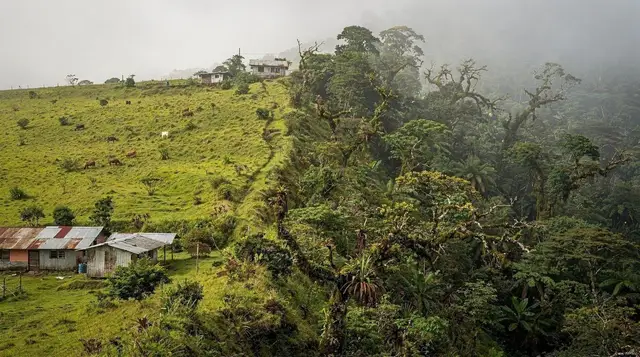
I’d gone that afternoon to walk toward the volcano’s base, and I wasn’t alone on the trail — far from it, groups passed at regular intervals, guides pointing out the same overlooks to different clients within minutes of each other. If crowding at that specific spot bothers you, a guided hike to the volcano’s base with a smaller group and a set start time thins that out considerably compared to showing up unbooked at midday. The same logic applies to the waterfall: arrive at opening and you’re one of a few dozen people on the 500 steps down; arrive at 11am in dry season and you’re one of several hundred.
The Case for the Standard Itinerary Being the Right One
Here’s the thing I keep coming back to, though: the standard itinerary is standard because it’s good, not because marketing made it up. The waterfall really does drop 70 metres into a canyon worth the climb back up. The heat in the springs really does come from the same geology that built the volcano’s cone, and a day pass to a volcanic hot springs complex delivers on that in a way a hotel pool simply can’t.
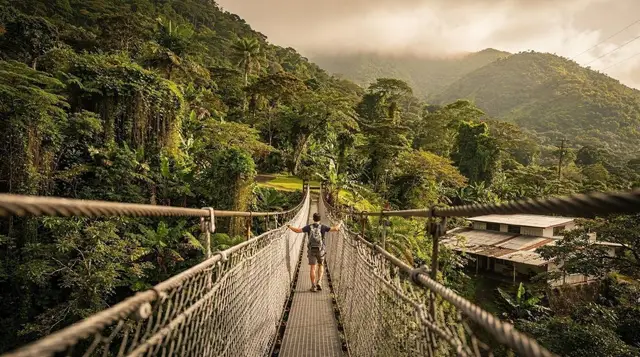
The canopy really does look different from a suspension bridge than from the ground, which is why the private hanging bridges tour keeps getting booked out despite three competing bridge parks nearby. None of that is diminished by a busload of other people having decided the same thing an hour before you.
Compare that to a genuinely overtouristed spot — somewhere the crowd has outgrown what’s actually on offer, where you queue for something ordinary because it went viral. That isn’t La Fortuna. The volcano is 1,670 metres of real stratovolcano whether it’s clear or buried in cloud that morning. The turquoise of a river two hours away or the cloud forest three hours away don’t get worse because La Fortuna’s town centre is full; if anything, the crowding here is concentrated enough that those places stay comparatively quiet, which is its own kind of evidence that the concentration is specific to the easy, obvious draws rather than to the region as a whole.
Where the Crowding Actually Gets Old
I don’t want to overcorrect into a defense with no edges. The parts that wear thin are the parts adjacent to the sights, not the sights themselves: the identical souvenir stalls, the restaurants that clearly optimize for turnover over a memorable meal, the sense some evenings that the town centre is less a place people live than a place people are processed through between a shuttle and a hotel bed.
A sloth and monkey walk booked through a reputable operator, like the guided wildlife walk I did on a quieter morning outside peak hours, felt entirely different from the same activity attempted at 10am with six other groups converging on the same trail junction. Timing and operator choice matter more here than almost anywhere else I’ve traveled — that’s a real cost of the crowding, and pretending otherwise would be dishonest. It’s also, notably, a solvable cost rather than a structural one, which is a distinction worth holding onto.
There’s a temptation, writing something like this, to reach for nostalgia — to imply La Fortuna used to be better before the minibuses, quieter, more “authentic.” I’m not going to make that claim, because I have no basis for it. This has been the country’s busiest excursion base for a long time, built specifically around bringing people to the volcano and the water it heats.
The version I saw at dinner that Thursday isn’t a decline from some earlier version; it’s what a well-marketed, genuinely rewarding cluster of natural attractions looks like at scale in 2026. If you’re weighing whether that scale is a dealbreaker for your own trip, our comparison of Rio Celeste and La Fortuna and our notes on how many days actually make sense here are more useful starting points than a verdict on whether the town has “changed.”
So Is It Worth It?
Yes, and not with much hesitation. The crowding is a fair description of La Fortuna’s town centre, especially in dry season, and it’s fair to plan around it — book ahead, go early, choose smaller operators where it matters. What it isn’t is a reason to write the destination off. The volcano is still the volcano. The water is still hot. The waterfall still falls 70 metres whether you’re the first person down the steps or the fiftieth. I’d rather eat dinner across from three idling minibuses in a town whose main attractions earn the crowd than find a quiet town whose attractions don’t.
For a broader gut check before you commit to a trip here at all, our guide to common La Fortuna planning mistakes and the first-timer’s overview both cover ground this piece deliberately doesn’t. And if timing your visit to dodge the worst of the crowds is what you actually came here for, that’s a separate, more practical page — start with when to visit La Fortuna rather than this one.
Questions About Crowds and Overtourism in La Fortuna
Is La Fortuna too crowded to visit in high season?
It’s busy, not overwhelmed. December to April brings the heaviest crowds at the waterfall, the hanging bridges and the resort hot springs, with minibuses arriving in waves through the morning. Booking entry times ahead and starting early still gets you a manageable visit.
What makes La Fortuna feel so touristy?
A town of around 15,000 people hosts day-trippers and multi-night visitors funneled toward the same handful of draws — the volcano, the waterfall, the hot springs and the hanging bridges — so the concentration is more visible here than in a bigger, more diffuse destination.
Are the hot springs and waterfall still worth visiting despite the crowds?
Yes. The geothermal heat, the 70-metre drop of the waterfall and the volcano’s cone on a clear morning are not diminished by other people being there too. The crowding affects logistics, not the substance of the place.
When is La Fortuna less crowded?
Shoulder weeks in green season and early mornings at any time of year both thin the crowds noticeably. That’s a planning question with its own answer on our best time to visit La Fortuna page rather than something to solve here.
Is La Fortuna losing its authenticity to tourism?
The town centre is unmistakably built around excursion tourism, and has been for decades — this isn’t a recent shift. Whether that counts as a loss depends on what you expected to find; it was never an undiscovered village.
Should first-time visitors worry about overtourism here?
Not enough to change plans. Book popular activities and park entries ahead, expect company at the well-known spots, and the crowding becomes a minor planning detail rather than something that shapes the trip.
tours.Opinion
Verified deep-linked GetYourGuide tours. Book through these links and we earn a small commission at no cost to you.
GetYourGuide does not provide a product photo for this activity — the image shows the meeting point, photographed by us.