One Week in La Fortuna: The Complete 7-Day Itinerary
If your week has room for exactly one base in Costa Rica’s northern lowlands, this is the version built around staying put. It skips Monteverde and Río Celeste entirely — not because they’re not worth seeing, but because a single week spent chasing two climate zones ends up shallow in both. This plan stays in and around La Fortuna for all seven days and goes deep instead of wide: the waterfall, the volcano’s old lava trail, the hanging bridges, a full day on the lake, a wildlife-focused day trip to Caño Negro, and a proper sloth walk, with the pace of an actual holiday rather than a checklist.
Why This Itinerary Stays Put
La Fortuna alone has enough for a week without repeating a day. The trade-off is honest: you will not see Monteverde’s cloud forest or Río Celeste’s turquoise water on this trip. If either of those matters more to you than a relaxed, unhurried week in one town, look at the La Fortuna and Monteverde or La Fortuna and Río Celeste itineraries instead — both compress this same list of activities into fewer days to make room for a second base.
What you gain by staying here for the full week is fewer transfers, no half-days lost to travel, and time to actually rest between activities, which matters given how much of this region’s appeal — hot springs, sloth walks, slow river floats — rewards not rushing.
One planning note that applies to every day below: La Fortuna sits on the windward, rainier side of the country’s central mountains, and it rains here most afternoons whether you visit in the dry season (December to April) or the green season (May to November). The difference between seasons is really about rainfall totals and how green the forest looks, not whether afternoons stay dry. Plan outdoor activities for the morning and treat the afternoon as flexible.
Seven Days at a Glance
| Day | Focus | Pace |
|---|---|---|
| 1 | Arrival, settle into La Fortuna town | Easy |
| 2 | La Fortuna Waterfall and town centre | Moderate |
| 3 | Arenal 1968 trail and Mistico Hanging Bridges | Full day |
| 4 | Full day on Lake Arenal | Full day |
| 5 | Caño Negro wildlife day trip, rental car | Full day |
| 6 | Bogarín Trail sloths, slow afternoon, evening hot springs | Easy |
| 7 | Last morning, departure | Easy |
Day 1: Arrival and Settling In
Most visitors land at either SJO in San José or LIR in Liberia, and both routes to La Fortuna run about three hours by road. If you’re arriving from San José, our SJO to La Fortuna guide and the Liberia route guide cover shuttle, private transfer, and driving options — worth reading before you book, since the two airports differ a lot in road quality and travel time depending on time of year.
Don’t schedule anything demanding for arrival day. Check into your accommodation, walk the compact grid of La Fortuna’s town centre, and get dinner at one of the local sodas rather than a tourist-menu restaurant — it’s cheaper and usually better. If your flight lands early enough, the free hot spring river at El Choyin is a gentle, unstructured way to end a long travel day without committing to a full evening at a resort. Go to bed early; day two starts with a real hike.
Day 2: La Fortuna Waterfall and Town
Start at the La Fortuna Waterfall itself, ideally right at opening, before both the tour buses and the afternoon rain arrive. The roughly 500-step staircase down into the canyon is steeper on the way back up than it looks in photos, and the pool at the base is where you swim — not directly under the 70-metre drop, where the current is genuinely dangerous. Budget two to three hours including the climb back out. Our La Fortuna Waterfall guide has the practical details on timing, footwear, and what the entrance fee covers.
Spend the rest of the day around town at an easier pace: browse the shops and cafés, and if you want a first taste of local wildlife without a structured tour, the paths around Ecocentro Danaus or the Butterfly Conservatory are low-key half-day options. Keep the evening light — the two biggest days of the week are days three and five.
Day 3: Arenal 1968 Trail and Mistico Hanging Bridges
This is the day that explains what actually happened here. In 1968, Arenal erupted violently, destroying the villages of Tabacón and Pueblo Nuevo and killing roughly 87 people, then stayed continuously active for 42 years until it fell quiet in October 2010. The Arenal 1968 lava trail walks you across the solidified lava field from that eruption, with the volcano’s cone visible above you on a clear morning — the closest this trip gets to standing where the eruption actually happened.
A guided hike through the 1968 trail and surrounding forest adds context that’s easy to miss walking it alone, including how the reforested sections differ from land the lava never reached.
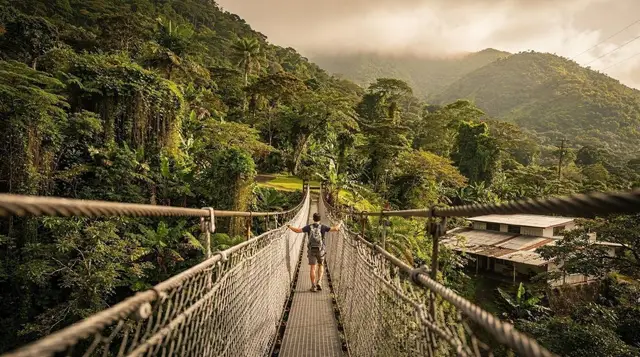
In the afternoon, head to Mistico Hanging Bridges, the best known of the region’s three suspension bridge parks and the one with the most bridges strung through primary forest canopy. It’s a different kind of walk from the morning — flatter, shadier, and better for wildlife spotting than for volcano views.
A guided walk across Mistico’s suspension bridges is worth it here specifically, since guides routinely spot sloths, toucans, and eyelash vipers that are nearly impossible to find without local eyes. Our guide comparing the region’s hanging bridge parks explains how Mistico differs from Sky Adventures and the Peninsula-side bridges if you’re deciding between them.
Day 4: A Full Day on Lake Arenal
Lake Arenal is worth a dedicated day, not a drive-by photo stop. At roughly 85 square kilometres, it’s the largest lake in Costa Rica, and it’s entirely artificial — the Arenal Dam was closed in 1979, flooding the original village of Arenal and forcing its relocation to what’s now Nuevo Arenal further along the north shore. Spend the morning on or near the water: a boat tour across Lake Arenal that finishes at a hot spring is an efficient way to combine both, with the volcano visible across the water for much of the crossing on a clear day.
In the afternoon, drive the north shore toward Nuevo Arenal for lunch with lake views, or continue as far as the dam itself for the closest look at the structure that created the lake. If you’d rather stay active, the Arenal Observatory Lodge has trails open to day visitors with some of the closest official views of the volcano’s slopes anywhere in the park. Either way, this is a slower, scenery-first day compared to the hikes on either side of it — treat it as recovery built into the schedule.
Day 5: Caño Negro Wildlife Refuge by Rental Car
This is the one day this itinerary asks you to drive rather than book a shuttle. The Caño Negro Wildlife Refuge, a roughly 100-square-kilometre Ramsar wetland site on the Río Frío, is about two hours from La Fortuna and is genuinely better with your own car — it gives you control over timing for the boat safari and the flexibility to stop along the way, which a fixed-departure tour doesn’t. Our renting a car for La Fortuna guide covers what to expect on the region’s roads, including the one-lane bridges you’ll cross more than once.
The refuge itself is a boat safari, not a hike: a slow river cruise past caimans, howler and spider monkeys, and — depending on the month — genuinely large numbers of wading birds, since Caño Negro’s seasonal lake draws species that concentrate here as water levels drop later in the dry season. Our Caño Negro boat safari guide has departure times and what to bring. It’s a full day round trip with the drive, so start early and expect to be back in La Fortuna for a late dinner.
Day 6: Bogarín Trail Sloths and a Slow Afternoon
Make this the low-effort day. The Bogarín Trail, a short, flat, guided walk practically inside La Fortuna town, is consistently the most reliable place in the region to actually see sloths — far more so than hoping to spot one on a random park trail. Go in the morning; guides here know the resident sloths’ usual spots and the walk rarely takes more than 90 minutes.
Keep the rest of the day open. This is the point in the week to catch up on sleep, do laundry, or simply sit somewhere with a view of the volcano’s cone, which by day six you’ll have learned to check for at odd hours rather than expect on demand. In the evening, go to a hot spring properly — not the free river this time, but a paid complex where you can actually relax for a few hours. A day pass to Paradise Hot Springs is a solid mid-range choice if you haven’t already picked one.
| Hot spring option | Style | Typical cost |
|---|---|---|
| El Choyin (free river) | Public, unstaffed, no facilities | Free |
| Paradise Hot Springs | Mid-range complex, multiple pools | ~40-55 USD |
| Los Lagos | Large complex, family-oriented, wildlife park on-site | ~45-60 USD |
| Tabacón | Premium resort-style, landscaped grounds | ~85-115 USD |
Our hot springs comparison guide goes through all of the region’s options in more detail if you want to swap this one out.
Day 7: Last Morning and Departure
Keep this morning short and unplanned in case rain from the night before is still clearing, or use it as a buffer if any earlier day ran long — Caño Negro and the volcano trail day are the two most likely to overflow their schedule. A last coffee in La Fortuna town, one more stop at a souvenir shop, and the drive back to whichever airport you flew into. If your flight is out of Liberia rather than San José, budget slightly less driving time but leave the same buffer for the region’s mountain roads.
Weather Across the Week
One mistake worth avoiding: don’t plan around a single forecast for the whole week. La Fortuna sits on the wet, windward side of the country, and afternoon rain is close to a daily feature here in both the dry season (December to April) and the green season (May to November) — the real difference between seasons is how much rain falls and how long it lasts, not whether it rains at all.
Mornings are consistently your best window for outdoor activities and for catching the volcano’s cone clear of cloud; by early-to-mid afternoon, plan on rain and build in an indoor or covered fallback. Our guide to planning around rainy afternoons has more on structuring each day around this pattern rather than fighting it.
One Week in La Fortuna: FAQ
Is it possible to see lava on Arenal during a week in La Fortuna?
No. Arenal’s last eruptive activity was in October 2010, and there has been no visible lava since. Seven days here buys you a clear view of the cone on a lucky morning, the solidified 1968 lava field on foot, and the volcano’s geothermal heat in the hot springs — not lava.
Why does this itinerary skip Monteverde and Río Celeste?
Both are worth a visit, but each adds a travel day in each direction and a different climate zone. Fitting either into this same week means cutting a full day from La Fortuna itself, which is what this itinerary is built to avoid. See our La Fortuna and Monteverde or La Fortuna and Río Celeste itineraries if you want both destinations in one trip.
Do I need a rental car for this itinerary?
You can do most of these days by shared shuttle or organized tour, but the Caño Negro day trip is far more flexible with a rental car, and it is how this itinerary is written. Roads in the region include several one-lane bridges, so a bit of driving confidence helps.
What’s the best order for the hot springs in a full week?
Save a paid hot spring complex for one evening near the end of the week, once you actually need it, rather than the first night when jet lag and a long flight make the water feel wasted on you. A free soak at El Choyin earlier in the week is a good low-cost preview.
Is Cerro Chato part of this itinerary?
No. The Cerro Chato crater lagoon hike has been closed to visitors since 2018 because of erosion and safety concerns, regardless of what older guides suggest. It is not included here or reachable as a day hike.
How much should I budget for a week in La Fortuna?
A mid-range week, including one paid hot spring visit, a rental car for part of the trip, entrance fees, and two or three tours, typically runs in the region of 900 to 1,400 USD per person before flights, depending on accommodation standard. Prices at parks and tours are set in USD.
What’s the weather really like across seven days?
Expect rain most afternoons no matter the season, since La Fortuna sits on the windward side of the mountains and receives moisture year-round. Mornings are the more reliable window for outdoor activities and for a clear view of the volcano’s cone.
Can I fit Monteverde into this same week?
Only by shortening La Fortuna itself, and this itinerary deliberately doesn’t. If a second base matters more to you than depth in one town, the La Fortuna and Monteverde itinerary restructures the week around both.
tours.7 days
Verified deep-linked GetYourGuide tours. Book through these links and we earn a small commission at no cost to you.
GetYourGuide does not provide a product photo for this activity — the image shows the meeting point, photographed by us.