4 Days in La Fortuna: A Complete Itinerary
Three days in La Fortuna covers the essentials — the volcano trail, the bridges, the waterfall — but it leaves no room for anything beyond the immediate town. A fourth day changes that. It buys you a full excursion to Venado Caves and El Castillo, two places that get cut from every shorter version of this trip, without forcing you to rush the waterfall or the sloth walk to make time for them. If three days already feels tight for you, start with three days in La Fortuna and treat this as the version with breathing room.
What four days buys you in La Fortuna
The extra day here does not go toward Lake Arenal or Monteverde. Both are real destinations that deserve their own base, not a rushed afternoon bolted onto an Arenal trip, and trying to fit either in means long drives for short visits. Four days is enough to go deep on one area — the immediate La Fortuna and Arenal zone — not to run two. If your plan already includes Monteverde or a wider loop, this itinerary is not the right shape for you; La Fortuna with a rental car is built for stringing multiple zones together and will serve you better.
What this version does instead: it keeps the waterfall, the hanging bridges, and the Bogarín Trail sloth walk as daytime activities rather than compressing them into a single overloaded day, and it gives Venado Caves and El Castillo — usually the first things cut from a three-day plan — a full day of their own.
| Day | Focus | Pace |
|---|---|---|
| 1 | La Fortuna Waterfall, town centre, evening hot springs | Moderate |
| 2 | Arenal 1968 trail, Mistico Hanging Bridges, Bogarín sloth walk | Full |
| 3 | Venado Caves, El Castillo | Full |
| 4 | River float or extra hot springs, departure | Light |
Day 1: La Fortuna Waterfall and settling in
Start close to town. The La Fortuna Waterfall drops around 70 metres into a canyon, reached by roughly 500 steps down — and, unavoidably, 500 steps back up. Go early, both to beat the tour buses and because the light in the canyon is better before midday. The current at the base is strong; swim in the pool downstream of the falls, not underneath them.
Back in La Fortuna’s town centre for lunch, a soda serving a casado is a better value than most hotel restaurants, and paying in colones rather than dollars avoids the unfavourable change rate most tour operators apply.
Save the evening for hot springs, and decide upfront whether you want a resort experience or the free option. El Choyin, the warm river under the bridge near Tabacón, costs nothing and has no changing rooms or security — bag theft happens there, so bring only what you can watch. If you would rather pay for facilities and a bar, a pass like the Los Lagos Hot Springs admission ticket gets you volcano-heated pools without Tabacón’s premium pricing.
Either way, the water is real — it is heated by the same geothermal activity that used to feed the volcano’s lava, which is the closest thing to lava you will encounter on this trip. For the full breakdown of which springs suit which budget, see the free hot springs guide or the wider hot springs comparison.
Day 2: The volcano, the bridges, and sloths in daylight
This is the fullest day of the trip, so start early. Arenal last produced visible lava in October 2010, after 42 years of near-continuous activity that began with the 1968 eruption — so no tour here promises lava, and any that does is not telling you the truth. What the 1968 trail does show you is the solidified lava field itself, walkable ground that used to be a moving flow, with the volcano’s cone visible above it when the clouds cooperate, usually earliest in the morning. A guided option like Arenal 1968 Volcano Trails Adventures adds context you would miss walking it alone.
Cerro Chato, the extinct crater sometimes mentioned alongside this trail, has been closed to hikers since 2018 — erosion and accidents closed the ascent for good, and no version of this itinerary includes it.
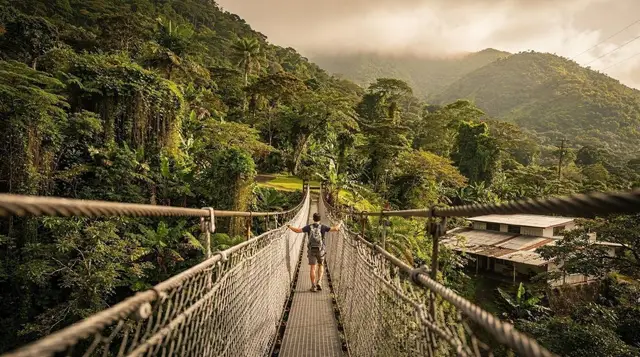
Midday, head to Mistico Hanging Bridges, the best known of the three bridge parks in the area and the one worth prioritising if you only do one — see the comparison of all three parks if you want to understand why they keep getting confused with each other. A guided walk, such as this guided hanging bridges nature walk, turns up more wildlife than walking it solo, since guides spot movement in the canopy that most visitors miss entirely.
Close the day at the Bogarín Trail, a short, flat, guided walk built specifically around finding sloths, and one of the more reliable places in the area to actually see one. Doing this in daylight rather than as a night walk is deliberate: sloths are what you are here for, and guides can see them clearly against the canopy in daylight in a way a headlamp cannot replicate. A guided slot like this Bogarín Trail sloth watching tour is worth booking rather than walking in cold, since the guides know the current roosting spots.
Day 3: Venado Caves and El Castillo, the day the short trip skips
This is the day that a three-day itinerary has no room for, and it is worth the detour. Give it the whole day.
Venado Caves are a limestone cave system about an hour from La Fortuna, explored on foot with a guide and a headlamp. The floor is wet the entire way through — mud from the entrance, knee-deep water in several stretches — and there is no dry version of this activity. Wear closed shoes with actual grip, never sandals or flip-flops; the rock is slick throughout, and a slip in low light with a headlamp is a genuinely bad way to end the morning. Most operators rent rubber boots on site if your own shoes are not up to it. See what to wear for Venado Caves before you go — this is the single most common mistake visitors make here, and it is entirely avoidable.
In the afternoon, move on to El Castillo, the small village on the lake road that most La Fortuna visitors drive past without stopping. It is worth the stop: a butterfly conservatory, quiet viewpoints of the volcano without the crowds of the main trails, and a scattering of small chocolate and coffee operations running short workshops on how cacao actually becomes chocolate. It is a slower, quieter afternoon after a muddy morning underground, and a fair trade for the extra hour of driving. The road in is unpaved for a stretch, which is one more reason a rental car — or at least a reliable shuttle — makes this day easier than trying to arrange it piecemeal.
Day 4: One more activity, then go
The last day is intentionally light — a half-day activity and a departure, not a second full day of touring. Two directions work well here, and which one you pick depends on what Day 2 and Day 3 left you wanting.
If you want more wildlife and a gentler pace, a float down the Peñas Blancas River is closer to a slow boat safari than a rafting trip — good for spotting birds, caimans, and the occasional sloth from the water without needing paddling experience. If you would rather end the trip with something more active, the Balsa River offers real whitewater rafting rather than a float; either way, the rafting versus safari float comparison breaks down which one actually suits you before you book.
Alternatively, if four days of activity has been enough, skip the float entirely and spend the morning back at the hot springs before your ride to the airport. Whichever you choose, build in real transit time: San José’s airport is roughly three hours away, Liberia’s around two and a half to three, and both routes run through mountain roads that do not forgive a tight connection. Before you leave, it is worth a last look at the travel mistakes to avoid in La Fortuna — most of them are timing mistakes, not activity mistakes, and this last day is where they tend to happen.
Planning notes for this itinerary
Money. Tours, hotels, and park entrances quote prices in US dollars, but change comes back in colones, often at a worse rate than you would get elsewhere. Bills of USD 50 and 100 are frequently refused outright. Carrying some colones for sodas and small purchases avoids both problems.
Weather. La Fortuna sits on the windward side of the country and gets rain year-round, typically in the afternoon, regardless of the official dry season running December to April. Plan outdoor activities — the waterfall, the trails, the caves — for the morning where you can, and treat an overcast volcano as the default rather than the exception.
Tipping. Restaurant bills already include a 10% service charge and 13% tax by law. A guide tip of USD 5 to 10 per person per day is standard on top of that, and worth budgeting for across four days of guided activities.
Questions about a 4-day La Fortuna trip
Is 4 days enough for La Fortuna?
Yes, if you stay in the immediate Arenal area. Four days lets you add a full day at Venado Caves and El Castillo without rushing the waterfall, the bridges, or the volcano trails. It is not enough to also fit Lake Arenal or Monteverde as a second base.
Do I need a rental car for this itinerary?
It helps but is not required. Most operators run shuttle pickups from La Fortuna hotels to the waterfall, the bridges, Venado Caves, and El Castillo. A car saves time and lets you set your own pace, especially on the unpaved stretch to El Castillo.
What should I wear to Venado Caves?
Closed shoes with real grip, not sandals or flip-flops. The cave floor is wet limestone mud from the entrance to the exit, and several stretches require wading through knee-deep water. Most operators rent rubber boots on site if you did not bring shoes you are willing to ruin.
Will I see lava on this itinerary?
No. Arenal has not produced visible lava since October 2010. What you will see, cloud cover permitting, is the volcano’s near-perfect cone and the solidified 1968 lava field you walk across on the trail.
Why does this itinerary skip Lake Arenal and Monteverde?
Four days is enough to go deep on one area, not to run two. Lake Arenal and Monteverde both deserve at least a night of their own, and squeezing them into a day trip means long drives for short visits. If you want both, plan for La Fortuna and Monteverde as a five- or six-day trip with a rental car.
Is the Bogarín Trail sloth walk better in the day or at night?
For sloths specifically, daytime. Sloths are most visible when guides can actually see them against the canopy, and the Bogarín Trail is a short, flat, low-effort walk that works well in daylight without the added logistics of a night tour.
tours.4 days
Verified deep-linked GetYourGuide tours. Book through these links and we earn a small commission at no cost to you.
GetYourGuide does not provide a product photo for this activity — the image shows the meeting point, photographed by us.