Green Season Is the Good Season
My August in La Fortuna, Rain Forecast and All
Every forecast I checked before flying into SJO showed the same thing: rain, every single day, for the two weeks I’d be in La Fortuna. I’d read enough about Costa Rica’s green season to know this was normal for August, but normal on paper and normal while you’re standing in a canyon holding a camera are two different things. I went anyway, mostly because the flights were cheaper and I couldn’t get the dates to work any other way. I came back arguing the opposite of what I expected to argue: green season isn’t the fallback option for La Fortuna. For a lot of travellers, it’s the better one.
That’s not a claim I make lightly, and it’s not a claim that the rain doesn’t happen. It does, almost daily, and I want to be honest about that before I get to why it didn’t matter as much as I thought it would.
The Case Nobody Makes for Green Season
Everyone tells you to come in the dry months, December through April. Fewer people say the quiet part: those are also the months when every hanging bridge, every hot spring, and every waterfall staircase in the region is at its busiest and most expensive. I’ve since compared notes with readers who visited Mistico in February versus August, and the pattern holds. In dry season, tour buses queue at the gate before opening. In green season, I had long stretches of the trail with nobody on it but the tour guide and me.
A few things stack in green season’s favour that rarely make it into the brochures:
- Fewer people at the marquee sights. Not empty, but noticeably calmer, especially before midday.
- Lower prices, particularly on accommodation and multi-day packages, since operators discount through the slow months.
- A denser, greener forest. The cloud forest canopy and the trails around the 1968 lava field look genuinely different after months of rain than they do at the end of a four-month dry spell.
- The veranillo. Late June into July brings a real, if unofficial, break in the rain pattern — a “little summer” locals mention before you even ask. I landed in the tail end of it and got three clear mornings in a row.
None of this means the rain isn’t real. It is, and I’d rather tell you what it actually looked like than pretend it wasn’t there.
What the Rain Actually Looks Like
La Fortuna sits on the windward side of the Arenal range, which means it gets rain in some form nearly every day of the year, dry season included. In green season, the pattern is just more consistent: clear or lightly overcast mornings, building clouds by early afternoon, and a downpour, sometimes heavy, sometimes brief, sometime between 1 p.m. and 5 p.m. Some days it broke by dinner. A couple of days it didn’t let up until after dark.
What it did not do was ruin a single morning of activity. I never once had to cancel or reschedule something I’d booked for before noon. That’s the pattern worth planning around, and it’s exactly why I’d point anyone building a green-season trip toward a fuller breakdown of what the afternoon rain actually does to a day rather than trying to summarize a whole season in one blog post.
The Days That Went Right Anyway
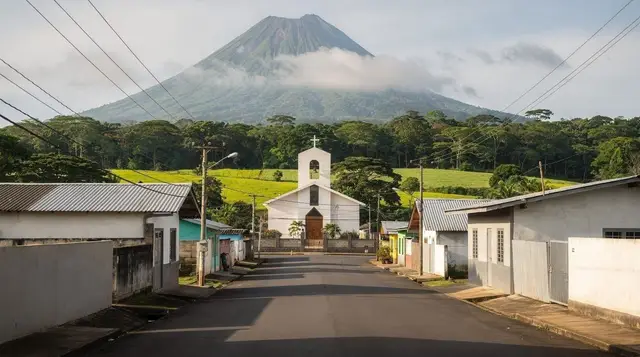
The clearest morning I had, I used for the hike up to the Arenal volcano base, on a guided hike through the national park to the volcano’s base. The cone was out for maybe twenty minutes before the cloud closed back in, which is honestly about as good as it gets even in dry season — Arenal makes its own weather regardless of the calendar.
Another morning went to the early guided walk that turned up two sloths and a troop of howler monkeys, and the guide told me flatly that green season sightings are usually better, not worse, because the forest is fruiting and the animals are more active and easier to spot against the wet, dark bark. I believed him after the second sloth.
Afternoons, when the rain arrived on schedule, I did what La Fortuna is built for: got wet on purpose. The free hot river at El Choyin doesn’t care if it’s raining, since you’re already soaked and warm at the same time, and one truly grey afternoon I paid for a day pass at a hot springs complex with pools and slides built into the hillside instead, which felt like the correct response to a downpour rather than something to wait out.
I went back a second time on a different rainy afternoon for the day pass at another of the valley’s hot spring parks, partly for comparison and partly because sitting in 38°C water while it rains is not a hardship anyone needs to be talked into twice. If you’re weighing which complex suits your trip, the hot springs comparison is worth reading before you book either.
The La Fortuna waterfall I saved for a clear morning on purpose — the 500 steps down are steep enough dry, and I didn’t want to test them wet — and it paid off with a flow that was visibly fuller than the photos I’d seen from dry season visits.
Where Green Season Genuinely Helps
| Dry season (Dec–Apr) | Green season (May–Nov) | |
|---|---|---|
| Crowds at hanging bridges and waterfalls | Heavy, especially midday | Light to moderate |
| Typical afternoon | Clear or dry | Rain likely, often heavy |
| Typical morning | Clear | Usually clear or lightly overcast |
| Prices (lodging, multi-day tours) | Peak | Noticeably lower |
| Forest and river flow | Drier, browner by March–April | Green, rivers and waterfalls fuller |
| Wildlife activity | Good | Often better |
| Best sub-window | January–February | Late June–July (the veranillo) |
What I’d Do Differently
Book outdoor, weather-sensitive activities — the volcano hike, the hanging bridges, the waterfall — for the morning, every time, and treat anything that starts after 1 p.m. as a coin flip. Pack a proper rain jacket instead of a poncho, since you’ll wear it more than once a day. And don’t stack two half-day outdoor activities back to back; give yourself a hot springs or an indoor stop for the afternoon block, which La Fortuna is unusually well equipped for.
When Green Season Isn’t the Answer
I won’t pretend it suits everyone. If your trip is a single long weekend with no flexibility on which day you do which activity, the odds of a rained-out afternoon mattering more go up. If you’re combining La Fortuna with a trip to Monteverde, the unpaved sections of road turn to mud faster in the wettest months, so budget more time and ideally a 4x4.
And September and October, the wettest stretch in the northern lowlands, are a tougher sell than June or July. For the full month-by-month picture rather than my one August, the best time to visit guide lays out every month side by side, and it’s the page I’d actually plan a trip from — this one is just an argument for reading it with an open mind about the second half of the calendar.
Green Season in La Fortuna: Frequently Asked Questions
Does it rain every day in La Fortuna during green season?
Most days, yes, but usually in the afternoon or evening. Mornings are commonly clear or lightly overcast, which is why outdoor bookings before noon tend to go smoothly.
What is the veranillo?
A short dry spell, roughly late June into July, in the middle of green season. It’s not guaranteed, but it’s a real pattern locals plan around, and it made my own August trip start with several unusually clear days.
Are hot springs and waterfalls open during green season?
Yes, all year. Heavy rain can occasionally raise river levels or trigger a brief closure at a specific site, but the hot springs parks and the main waterfall trail operate through the wet months.
Is green season cheaper than dry season in La Fortuna?
Generally yes, particularly on accommodation and multi-day tour packages, which are often discounted from May through November outside of the veranillo weeks.
Is the Arenal volcano more or less visible in green season?
About the same, honestly. Cloud cover around the cone depends more on the volcano’s own microclimate than on the season, and early morning is the best window for a clear view in either season.
Should I avoid La Fortuna in September and October?
Not necessarily, but those are the wettest months in the northern lowlands, so build in extra flexibility, especially for road travel to Monteverde or Río Celeste.
Do I need a 4x4 for green season in La Fortuna?
Not for La Fortuna itself, but if you’re driving unpaved stretches toward Monteverde or El Castillo, a 4x4 is genuinely useful once the rains set in.
Seasonal experiences on GetYourGuide
Verified deep-linked GetYourGuide tours. Book through these links and we earn a small commission at no cost to you.
GetYourGuide does not provide a product photo for this activity — the image shows the meeting point, photographed by us.