A Sunday Morning in Ciudad Quesada
I left La Fortuna a little after eight on a Sunday morning with no plan except to not be on the main street for a few hours. Nothing was wrong with it. I had walked past the same rental-board shops and the same tour desks enough times that I could recite their signs from memory, and I wanted to see something that wasn’t built with me in mind. Forty-five minutes later I was parking near the market in Ciudad Quesada, and I didn’t leave until early afternoon.
Ciudad Quesada isn’t a secret. It’s the working capital of San Carlos canton, the district that La Fortuna technically belongs to, and most visitors pass through its outskirts on the highway without ever slowing down. There’s no waterfall here, no suspended bridge, no volcano view. What there is, on a Sunday, is a market that spills out from its covered hall onto the surrounding streets: crates of tomatoes and yuca, hanging slabs of beef, plastic buckets, machetes, rubber boots in every size, a woman selling nothing but tamales wrapped in banana leaf out of a cooler. None of it is arranged for a camera.
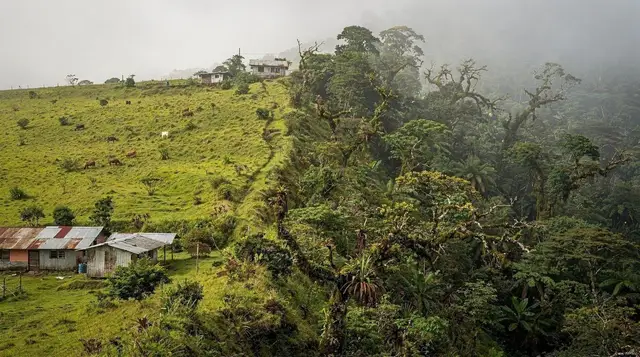
I spent the first hour just walking the stalls, not buying much, mostly listening. The vendors weren’t talking to each other about tourists; they were talking about cattle prices and a fence that needed mending and whether it was going to rain before lunch, which in this part of the country it usually does. San Carlos is dairy and cattle country before it is anything else, and the market read like the accounts ledger of that economy laid out on folding tables. It was the first time in a week that I’d been somewhere in this region that wasn’t, in some direct way, organized around people like me.
By mid-morning the market thinned out and the plaza in front of the church filled instead. Families arrived in their good clothes for the second Mass of the day, kids in ironed shirts kicked a ball around the edges while their parents talked, and an ice cream cart did steady business under a tree that was clearly everyone’s regular spot, not mine. A few blocks over, a Sunday league football match was underway on a dirt field, watched by maybe forty people who all seemed to know each other. I didn’t understand every joke shouted from the sideline, but I understood the shape of the morning: this was a town going through its own weekly rhythm, one that existed identically the Sunday before I arrived and the Sunday after I left.
That’s the difference I keep coming back to. La Fortuna’s main street is a good, honest tourist strip — I don’t think it’s fake, exactly — but it exists because of us. Its restaurants, its souvenir stands, its zipline booths were all built to answer a question visitors bring with them: what should I do today.
Ciudad Quesada answers a completely different question, one that has nothing to do with tourism at all: what does this town need this week. A butcher shop, a feed store, a pharmacy, three competing hardware stores within a hundred metres of each other. You could ask whether La Fortuna has gotten too touristy and get a real, arguable answer. You couldn’t ask that question about Ciudad Quesada, because tourism was never the premise.
I want to be honest that I still spent most of my week doing exactly what everyone does here. Two days earlier I’d done the hike to the base of Arenal volcano with a local guide, and the evening before this Sunday I’d soaked at the Los Lagos hot springs, both of which I’d recommend without hesitation.
The morning after Ciudad Quesada, I went back to a Paradise hot springs day pass because my legs were sore and I wasn’t sorry about it. None of that is a contradiction. La Fortuna sells hot springs and volcano hikes because those are genuinely worth doing, and I did them because I wanted to, not out of obligation.
But the Sunday in Ciudad Quesada is the morning I actually think about when someone asks what San Carlos is like, more than any single hour I spent in La Fortuna itself. It wasn’t curated for a good story, and that’s exactly why it made one. Nobody in that market was performing “authentic Costa Rica” for me; they were doing their shopping. The gap between those two kinds of mornings is, I think, the honest answer to why a place like this is worth a detour at all.
I want to be equally clear about what I’m not arguing. This isn’t a pitch to pencil Ciudad Quesada into a rental-car itinerary between the waterfall and the hanging bridges, and I’d resist anyone turning it into that. It has no ticket booth, no fixed hours, no guide, nothing that survives being scheduled.
If you go expecting a sight, you’ll leave confused about what you were supposed to see, and you’ll have missed the point twice over. It only works as a loose morning with no agenda, the kind that’s easy to overlook when you’re working through a first-timer’s checklist or trying to avoid the usual mistakes — this isn’t on either list, and it shouldn’t be.
Getting there was uneventful, which is its own kind of local education. The road out of La Fortuna toward Ciudad Quesada crosses a couple of the region’s one-lane bridges, the ones where you learn fast who yields and who doesn’t, and it’s smoother than most of what you’ll find if you’re driving without a 4x4 further out toward Bijagua or Sarapiquí. Lunch at one of the sodas near the plaza cost less than a coffee and pastry on La Fortuna’s main strip, which says something about what a week here actually costs once you step outside the visitor economy for even half a day.
I don’t know how many nights it takes before La Fortuna starts to feel repetitive — that depends on the person and how many days you’re giving the region — but I know that one ordinary Sunday in a town with nothing to sell me did more to explain where I actually was than any amount of time spent where everything was for sale. If you have a free morning and no plan, that’s the whole recommendation. Nothing more organized than that.
tours.Field notes
Verified deep-linked GetYourGuide tours. Book through these links and we earn a small commission at no cost to you.
GetYourGuide does not provide a product photo for this activity — the image shows the meeting point, photographed by us.