The One-Lane Bridges That Taught Me How to Drive Here
Four seconds at a bridge I had never seen before
Four seconds does not sound like much until you are the only car at a narrow bridge, another car is coming the other way, and you genuinely do not know which one of you is supposed to move first.
That was me, about twenty minutes past Ciudad Quesada on the road up from San José, three days into my first trip to this part of Costa Rica and feeling reasonably confident behind the wheel. Then the road narrowed to a single strip of concrete over a ravine, a car appeared on the far side, and a yellow sign came at me faster than I could fully process it: CEDA EL PASO.
I know now that it means give way. I did not know it then. I slowed to something close to a full stop, the other driver slowed too, and for what felt like an embarrassingly long stretch of time we both just sat there, thirty meters apart, neither of us moving, each clearly waiting for the other to go first. Eventually he waved me across. To this day I have no idea whether that was generosity, or whether the sign had actually been facing him and he simply decided not to make an issue of it.
What the sign is actually telling you
Northern Costa Rica has a lot of these bridges, far more than I expected before I arrived, and they solve a plain engineering problem — a two-lane bridge costs more to build than a one-lane one — with a plain traffic rule. Whichever direction faces a CEDA EL PASO sign has to stop and let the other side cross first. If you are not facing the sign, you generally have the right of way and keep rolling, within reason and without racing anyone to the gap.
That is the whole rule. It is not complicated once you know it. What makes it disorienting the first time is that nobody mentions it before you are already on top of your first crossing, and the sign itself gives you maybe two or three seconds of warning at normal road speed.
The mistake I nearly made: assuming a pattern
Here is the part I actually got wrong for my first day or two behind the wheel: I assumed that whichever direction had yielded at the first bridge would yield at every bridge after it. It does not work that way. Priority is not tied to compass direction, or to which road feels more major, or to which side carries more traffic.
Each crossing is signed on its own, and on the road along /destinations/lake-arenal/ toward /destinations/nuevo-arenal/ I crossed two bridges within about four kilometres of each other where the yield direction was reversed. Coming from La Fortuna, at one I had priority and just kept driving; at the next, I was the one stopping. There is no way to predict it from the bridge before. You read the sign, or the absence of one, at every single crossing, every time.
I mention this because a fair amount of casual advice treats it as a fixed rule — something like “cars heading toward the volcano always have priority” — which is not true, and will eventually put you face to face with an oncoming truck with both of you certain you have the right of way.
Where you will actually run into this
It is not a rare, one-off encounter you might get lucky and avoid. Drive out toward the /destinations/venado-caves/ , loop around the lake toward /destinations/tilaran/ , or take the mostly unpaved road out to /destinations/el-castillo/ , and you will cross several. The stretch between La Fortuna and /destinations/ciudad-quesada/ has more than most drivers expect for what looks, on a map, like a fairly major connector.
The same applies if you are self-driving out for a morning hike to the base of Arenal itself, or timing your own early arrival for a quieter sloth and monkey walk before the day’s groups show up — both routes cross at least one of these bridges, and no tour operator is going to warn you about it in the confirmation email.
Head toward /destinations/monteverde/ by road instead of by boat and you will meet a handful more, mixed in with the gravel stretches that make that route the longer, tougher option in the first place — which is exactly why most visitors we hear from choose the /itineraries/la-fortuna-and-monteverde/ boat crossing instead; our /guides/jeep-boat-jeep-vs-driving-to-monteverde/ guide lays out that trade-off properly.
Why this outranks the rental spreadsheet
Before I arrived, I spent a genuinely embarrassing number of hours comparing car rental companies — insurance excess, deposit holds, whether the quoted price actually included the mandatory liability coverage the country requires. All of that mattered, and I would still tell you to read a proper /guides/renting-a-car-for-la-fortuna/ before you book.
But none of it prepared me for what driving here actually felt like, and the one-lane bridges shaped those four days behind the wheel more than any line item on a rental contract. It is the kind of detail that never makes it into a spec comparison, because it is not a spec. It is a habit you build in your first ten minutes on the road, or you do not, and either way you will need it by your first bridge.
If I am honest, it is also just a better story than “I compared three insurance policies,” which is probably why nobody had told me about it before I got here.
What I would actually tell you before your first bridge
Slow down for every narrow bridge, even if you have already crossed twenty that day. Look for the sign before you are on top of it — they are usually posted a reasonable distance back, but easy to miss if you are watching the road surface instead of the roadside. If you cannot read it in time, or there is not one, treat it as unmarked and negotiate the crossing the way you would a four-way stop with no lights: slow down, make eye contact, and let whoever is already partway across finish.
And do not assume the bridge on your way back follows the same rule as the one on your way out, even if it is the exact same crossing — some of them post a CEDA EL PASO sign facing only one direction, precisely because the rule coming from the other side is simply “you have priority, keep going.”
If you are still weighing whether you actually need four-wheel drive for any of this, I go deeper on that specific question in /blog/should-you-rent-a-4x4-here/. And if the choice between flying into San José or Liberia is still open, it shapes this whole driving question more than people expect — I wrote about that decision in /blog/liberia-or-san-jose-the-airport-that-changed-my-trip/.
None of this needs a full driving guide to explain, and I would rather point you to our dedicated /guides/renting-a-car-for-la-fortuna/ piece for the deposit, insurance, and paperwork side of things, or to /guides/how-to-get-from-sjo-to-la-fortuna/ and /guides/how-to-get-from-lir-to-la-fortuna/ if you have not decided how you are arriving yet. What I wanted to write down here is smaller than a guide: just the four seconds at that first bridge near /destinations/la-fortuna-town-centre/, and the fact that nobody had mentioned them to me before I was already stopped on one, unsure whether to go.
One-lane bridges in northern Costa Rica: the FAQ
What does CEDA EL PASO mean on a one-lane bridge?
It is Spanish for give way. Whichever direction the sign faces is the direction that must stop and let traffic already crossing, or arriving from the other side, go first.
Is the yielding side always the same, so I can just remember it?
No. Some bridges give priority to the direction you are coming from, others give it to the opposite side, and there is no rule tied to compass direction or road size. You check the sign at each bridge, every time.
What if the sign is faded, missing, or I genuinely cannot tell?
Slow down early, make eye contact or a hand signal with the other driver, and let whichever vehicle is already committed to the bridge finish crossing. It works; the risk comes from assuming rather than checking.
Are one-lane bridges dangerous?
Not if you slow down and read each sign. The real risk is arriving too fast, on a blind corner, without enough time to see the sign or the oncoming vehicle.
Do these only show up on back roads, or on main routes too?
Both. You will find them on paved primary roads between La Fortuna and Ciudad Quesada, not only on the unpaved stretches toward Monteverde or El Castillo.
Should I rent a 4x4 specifically because of the bridges?
The bridges themselves do not require one; any car can cross them. A 4x4 matters more for unpaved sections like the road toward Monteverde, especially in green season.
What actually happens if two cars start crossing at the same time?
In practice, one driver realizes first and backs off at the edge; it rarely turns into a real standoff. It happened to me once, and the other driver simply waved me through.
Does any of this affect the jeep-boat-jeep transfer to Monteverde?
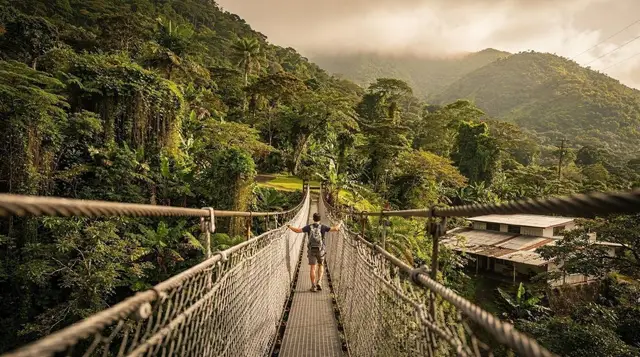
No, because you are not driving. If you would rather skip the one-lane bridges and the unpaved stretch entirely, the Arenal Hanging Bridges Tour makes a fine morning stop on the paved side of the lake before you ever need to think about it, and the boat crossing to Monteverde avoids the road altogether.
Transfers and transport passes on GetYourGuide
Verified deep-linked GetYourGuide tours. Book through these links and we earn a small commission at no cost to you.
GetYourGuide does not provide a product photo for this activity — the image shows the meeting point, photographed by us.