A garden with a gate and a ticket booth, not a trail through the forest
Set that expectation before anything else: La Paz Waterfall Gardens is a privately owned park. You pay to get in, a staff member checks your ticket at a turnstile, and you walk a paved and graveled trail system that the owners built and maintain. It is not a wild waterfall you stumble on at the end of a free hike, and it is not the kind of thing you can visit for the price of a parking spot. That distinction matters on this site, because [/destinations/la-fortuna-waterfall/] and the free river at [/destinations/el-choyin-free-hot-springs/] sit at the opposite end of the spectrum — natural, low-cost, and open to anyone who shows up.
La Paz Waterfall Gardens is the opposite model: a curated, landscaped, ticketed experience with a restaurant, a gift shop, and a schedule of feeding times for the animals on display. Neither model is wrong. But a visitor who arrives expecting a free forest trail and finds a USD 50 admission fee at the gate is going to feel misled, and enough trip reports online describe exactly that surprise that it’s worth saying plainly here: know what you’re buying before you drive the two-plus hours to get there.
Where it sits, and why it always comes up with Poás
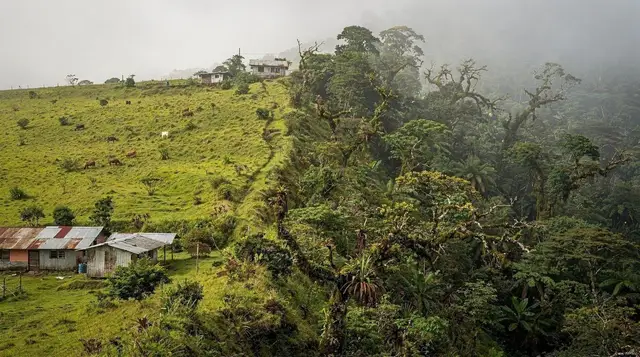
The gardens are built into a steep, cloud-forest-edge property along the road that climbs from the Central Valley toward [/destinations/poas-volcano/], near the crossroads village of Vara Blanca. That location is the whole reason this park exists on a La Fortuna trip planner at all: it sits directly on the route most people already take to see the Poás crater, whether they’re coming from [/destinations/san-jose/], [/destinations/alajuela/], or driving down from La Fortuna itself.
Because the two sites share a road, nearly every organized day trip and a large share of independent itineraries fold them into the same outing — crater viewpoint in the morning while the weather is still clear, gardens in the afternoon once the clouds have usually rolled in anyway.
This page covers the gardens on their own terms. For the volcano itself — the timed-entry system, the helmet requirement, the frequent closures when gas activity rises — see the dedicated [/destinations/poas-volcano/] page and the [/guides/poas-volcano-day-trip/] guide. Don’t expect volcano detail here; the two sites are neighbors on a map, not the same visit.
What’s actually behind the gate
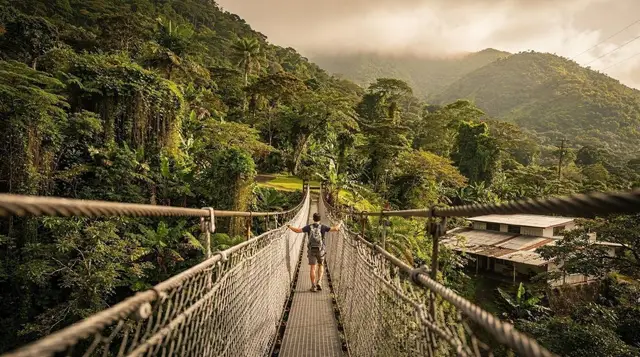
The property is built around a looping trail — mostly paved or boardwalked, with handrails and resting points — that descends through cloud forest to a series of five named waterfalls, then climbs back up (there’s a shuttle for anyone who doesn’t want to walk back up the last stretch). Along the way, the trail passes through a run of wildlife exhibits that make up as much of the visit as the waterfalls themselves:
- A butterfly observatory, a screened garden where dozens of native species fly loose among host plants, best seen mid-morning when it’s warm enough for them to be active.
- A hummingbird garden, feeders strung through a planted courtyard where several species dart at close range — reliably the easiest hummingbird photos most visitors will get anywhere in Costa Rica.
- A frog exhibit, terrariums holding red-eyed tree frogs, poison dart frogs, and other species that are genuinely hard to find on a random night walk — see [/guides/night-walks-in-la-fortuna-guide/] for how much luck that normally takes.
- A serpentarium, housing local snake species including the fer-de-lance (terciopelo), the same animal every packing list on this site tells you to watch for on a trail — here you can see one safely behind glass instead.
- A toucan and macaw aviary, large screened enclosures with keel-billed toucans and scarlet macaws you can photograph at eye level, again a guaranteed sighting versus the wild toucans of [/things-to-do/monteverde/] or [/things-to-do/la-fortuna/], which come or don’t come on their own schedule.
- A big-cat rescue area attached to the on-site lodge, housing jaguars, pumas, and ocelots that cannot be released to the wild — worth knowing going in, since some visitors expect a zoo-free nature park and are caught off guard by caged cats, however well the enclosures are kept.
The five waterfalls
The waterfalls that give the park its name are reached by descending a system of stairs and platforms cut into the hillside. Each has a named viewpoint — the tallest and most photographed is La Paz Waterfall itself, visible even from the public highway if you know where to look, though the close-up viewing platform inside the park is what most people come for. The others step down the same river in a shorter, steeper series, with mist rising off several of them thick enough to feel from the platforms on a humid day.
None of the waterfalls here are for swimming — this is a look -and-photograph circuit, not a bathing spot, unlike the plunge pool at [/destinations/la-fortuna-waterfall/] or the river at [/destinations/venado-caves/]. The full descent-and-return covers a fair number of stairs; anyone who struggled with the 500 steps at the La Fortuna waterfall (see [/guides/la-fortuna-waterfall-guide/]) should budget the shuttle ride back up rather than walking it, since the return climb here runs longer.
What it costs, compared with a natural alternative
| La Paz Waterfall Gardens | La Fortuna Waterfall | |
|---|---|---|
| Type | Private garden and wildlife park | Public natural waterfall |
| Entry fee | Roughly USD 45–55 (adult) | Roughly USD 18–20 |
| Wildlife | Captive exhibits, guaranteed sightings | Wild, no guarantee |
| Swimming | Not permitted | Yes, in the plunge pool |
| Time on site | 2.5–3.5 hours | 2–3 hours |
| Typical pairing | Poás Volcano, same-day drive | Stands alone near town |
Neither column is objectively “better” — they’re different products. The gardens sell a predictable, accessible, animal-rich half-day; the waterfall near town sells a wilder, cheaper, swim-in-the-pool half-day. See [/guides/waterfalls-near-la-fortuna-compared/] for how the rest of the region’s waterfalls stack up against both.
Getting there from La Fortuna
The drive follows essentially the same route as the trip to Poás Volcano — up through the mountains via Ciudad Quesada or via Naranjo, depending on which road is chosen, then across to Vara Blanca. Plan on roughly 2 hours 15 minutes of driving each way, the same figure that applies to [/destinations/poas-volcano/].
That timing is exactly why combining the two into one long day makes more sense than two separate trips: doubling that drive on consecutive days burns most of a day for no extra payoff. For guidance on the road itself and the one-lane bridges scattered along this part of the country, see [/guides/renting-a-car-for-la-fortuna/]; without a rental car, most visitors book an organized tour instead, since public transport doesn’t run a practical route between La Fortuna and Vara Blanca.
a full-day trip from San José that pairs a coffee plantation tour with both the gardens and the Poás crater covers the whole combination in one booking, which is the version most people end up wanting once they see how the geography lines up.
A version built specifically around the crater comes as a Poás Volcano crater visit with La Paz Waterfall Gardens and guided birdwatching added on, useful if birdwatching matters more to you than the coffee stop. For travelers based in the capital rather than La Fortuna, a San José day tour covering Poás Volcano, a coffee farm, and the waterfall gardens is the standard version sold out of most hotel desks.
If your route runs the other direction — arriving via [/destinations/sjo-airport/] and heading toward La Fortuna rather than the reverse — see [/guides/how-to-get-from-sjo-to-la-fortuna/] and [/guides/san-jose-stopover-guide/] for how to fit this stop into that transfer instead of treating it as a separate excursion from your La Fortuna base.
Combining it into a wider Central Valley day
Because the gardens sit close to [/destinations/alajuela/] and the road network around [/destinations/sjo-airport/], some visitors fold this stop into a broader loop that also touches coffee country or a same-day arrival transfer, rather than a dedicated round trip from La Fortuna. That version tends to suit travelers following [/itineraries/san-jose-la-fortuna-monteverde-manuel-antonio-loop/] or anyone [/itineraries/arriving-via-liberia/] and routing through the Central Valley before continuing north. If you’re doing this as a straightforward out-and-back from La Fortuna with your own vehicle, [/itineraries/la-fortuna-with-a-rental-car/] covers how to slot a Poás-and-gardens day into a longer stay without giving up a full day elsewhere.
Who this suits, and who it doesn’t
Families traveling with small children tend to like this park more than most other stops on a La Fortuna itinerary, precisely because the sightings are guaranteed and the walking is manageable — paved paths, handrails, a shuttle for the uphill return. If your group already visited [/destinations/bogarin-trail/] hoping for sloths and came away without a sighting, or spent a night walk at [/destinations/arenal-natura/] without much luck, the gardens offer the version of that experience with certainty attached, at a price.
Photographers who want a reliable toucan or hummingbird shot without waiting out a wild encounter get the same trade. Budget travelers, and anyone who specifically wants a wilder or more physically demanding hike, will likely find the [/destinations/la-fortuna-waterfall/] trail or the [/destinations/venado-caves/] outing a better match for less money.
Practical notes before you go
The park is at a meaningfully higher, cooler elevation than La Fortuna — bring a light jacket, since the cloud-forest air near Vara Blanca runs noticeably colder than the plains around the volcano. Trails can be slick after rain, which is common in this transition zone; closed shoes with grip matter more here than sandals. The on-site restaurant runs a buffet lunch that many day-tour packages include; if yours doesn’t, budget separately for it, since there’s no practical alternative once you’re inside the gate. Cameras are welcome throughout, including in the animal exhibits, though flash photography is generally discouraged near the frogs and butterflies.
FAQ: La Paz Waterfall Gardens
Is La Paz Waterfall Gardens free to visit?
No. It’s a privately owned park with a paid admission, typically in the range of USD 45–55 per adult. There is no free or public access to the trail system or the waterfall viewpoints inside the gate.
Can you swim at La Paz Waterfall Gardens?
No. Swimming isn’t permitted at any of the five waterfalls inside the park. If a swim is part of what you want from a waterfall stop, the plunge pool at the [/destinations/la-fortuna-waterfall/] near town is the better choice.
How long does a visit take?
Most visitors spend 2.5 to 3.5 hours covering the trail, waterfalls, and wildlife exhibits, longer if you eat at the on-site restaurant. Combined with the drive from La Fortuna, that makes it essentially a full-day outing rather than a quick stop.
Should I visit La Paz Waterfall Gardens or Poás Volcano, or both?
Most organized tours combine both, since they sit on the same road and the drive from La Fortuna runs over two hours either way. See the [/destinations/poas-volcano/] page for the crater itself and [/guides/poas-volcano-day-trip/] for how the timed-entry system affects planning around it.
Is it worth it for wildlife photography?
Yes, more reliably than most wild trails in the region. The butterfly observatory, hummingbird garden, and toucan aviary offer close, well-lit, near-guaranteed sightings that a night walk or a forest trail can’t promise.
Is this a good stop for kids?
Generally yes. The paved and boardwalked trails, handrails, and shuttle back up the hill make it more manageable for small children than steeper natural trails elsewhere on this site.
How does the price compare with other waterfall stops near La Fortuna?
It’s considerably more expensive than the natural waterfalls covered elsewhere on this site, including the main La Fortuna waterfall. The [/guides/waterfalls-near-la-fortuna-compared/] guide lays out the full comparison across cost, difficulty, and swimming access.
Can I visit without a car?
It’s possible but impractical on your own, since there’s no direct public transport route from La Fortuna. Nearly everyone visits as part of an organized day tour that also covers Poás Volcano, or as a stop arranged with a private driver.